When discussing modern technology, terms like "laser" and "optical sensor" are often used, sometimes interchangeably, leading to confusion. A common question arises: Is a laser an optical sensor? To answer clearly: No, a laser is not an optical sensor. They are fundamentally different components in photonic and electronic systems, each serving distinct roles. Understanding this distinction is crucial for engineers, students, and technology enthusiasts working with devices ranging from barcode scanners to autonomous vehicles.
A laser, which stands for Light Amplification by Stimulated Emission of Radiation, is an active device that generates a highly focused, coherent beam of light. It is essentially a light source. Lasers produce light through a process of optical amplification based on stimulated emission. This light can be of various wavelengths—visible, infrared, or ultraviolet—and is characterized by its monochromaticity (single color), directionality, and high intensity. Common applications include laser pointers, cutting and welding tools, medical surgery instruments, fiber-optic communication transmitters, and in reading data from DVDs or Blu-ray discs. In these roles, the laser acts as the emitter or transmitter of light, providing the optical signal that interacts with an object or medium.
In contrast, an optical sensor is a passive or active device designed to detect, measure, or respond to light. It functions as a receiver. Optical sensors convert incoming light (photons) into an electrical signal that can be processed, analyzed, or used to trigger actions. They are the "eyes" of a system. These sensors can detect various light properties such as intensity, wavelength, phase, or polarization. Examples include photodiodes, phototransistors, charge-coupled devices (CCDs) in digital cameras, ambient light sensors in smartphones, and photoelectric sensors in industrial automation. An optical sensor does not generate its own coherent light; instead, it reacts to light from an external source, which could be ambient light, an LED, or indeed, a laser.
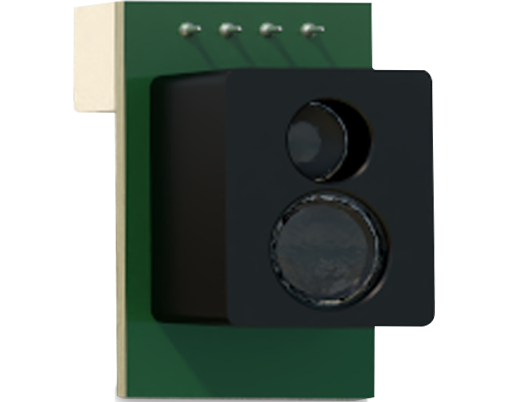
The relationship between lasers and optical sensors is often complementary in integrated systems. A typical setup involves a laser serving as the precise light source, and an optical sensor acting as the detector. For instance, in a laser rangefinder or LIDAR (Light Detection and Ranging) system, a laser pulse is emitted toward a target. The light reflects off the target and returns to an optical sensor (like an avalanche photodiode). The sensor detects this reflected light, and the system calculates distance based on the time of flight. Here, the laser and sensor work together as two separate components within a larger system—one emits, the other receives. Neither fulfills the other's primary function.
Another illustrative example is a fiber-optic communication link. At one end, a laser diode converts electrical data signals into pulses of light that travel through an optical fiber. At the receiving end, a photodiode (an optical sensor) detects these light pulses and converts them back into electrical signals. The laser is the transmitter; the photodiode is the receiver. Confusing the two would be akin to confusing a loudspeaker (which produces sound) with a microphone (which detects sound). Both are essential for audio communication but perform opposite tasks.

The confusion likely stems from the fact that many devices colloquially called "lasers" are actually systems that incorporate both a laser emitter and an optical sensor. A supermarket barcode scanner is a prime example. It uses a laser beam to illuminate the barcode stripes. However, a separate photodetector (optical sensor) inside the scanner reads the pattern of reflected light to decode the information. The entire unit is often called a "laser scanner," but the laser is only one part of its sensing mechanism. Similarly, in optical computer mice, a low-power laser illuminates the surface, while a tiny CMOS sensor captures successive images to track movement.
From a technical specification and design perspective, the parameters defining lasers and optical sensors are entirely different. Laser specifications focus on output power, wavelength, beam divergence, coherence length, and modulation capability. Specifications for optical sensors, however, center on sensitivity, responsivity (current output per watt of light), spectral range, response time, and noise characteristics. An engineer selects a laser based on the light source needs and chooses an optical sensor based on detection requirements.
In summary, a laser is a specialized light source that emits coherent radiation. An optical sensor is a device that detects and measures light. They are distinct technological components with separate principles of operation. While they are frequently paired in advanced electro-optical systems to enable precise measurement, communication, and sensing, their roles are not interchangeable. Recognizing a laser as an emitter and an optical sensor as a detector clarifies their functions and aids in the proper design and application of photonic technologies across industries such as manufacturing, telecommunications, healthcare, and consumer electronics. This fundamental understanding prevents misapplication and fosters innovation in integrating these powerful tools effectively.