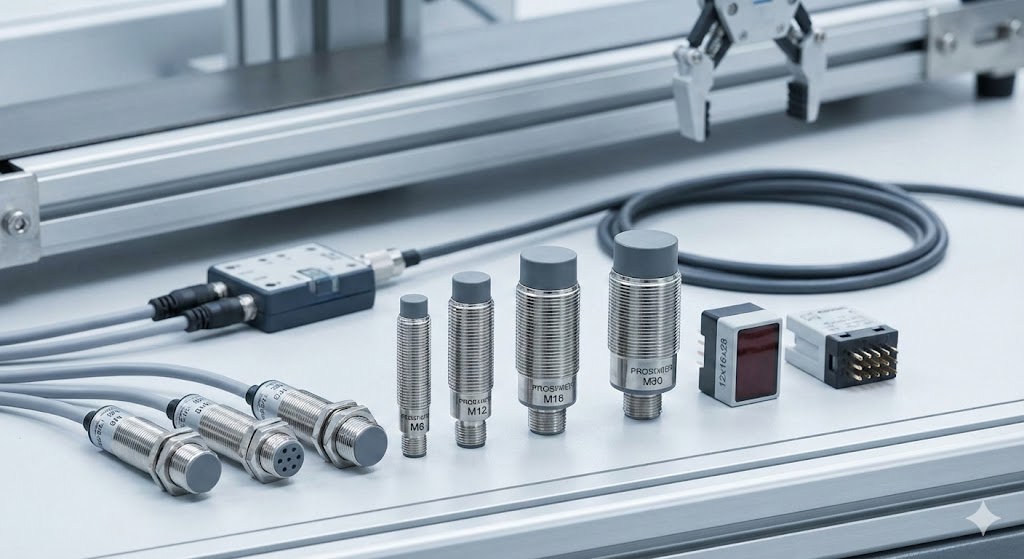
As smart manufacturing demands higher precision in equipment, proximity switches—the "sensory tentacles" of automation control systems—are undergoing a new wave of technical evolution. Recent market data indicates that a full range of industrial-grade proximity switches, covering M8 to M30 specifications, is becoming the standard in manufacturing. Their high adaptability and modular designs are solving long-standing issues regarding installation difficulty and high maintenance costs.
From Miniature to Heavy-Duty: Covering All ScenariosCurrent mainstream sensing solutions are no longer limited to a single specification. The new generation of product matrices demonstrates exceptional versatility:
Precision Space Solutions: M8 and M12 series miniature proximity switches, with their compact footprints, are perfectly suited for precision equipment with strict space limitations, such as electronic assembly and robotic grippers.
Heavy Industry Pillars: For harsh operating conditions, the M18 and M30 series sensors offer longer detection distances and stronger anti-interference capabilities, making them widely used in heavy-duty conveyors and large machining centers.
Form Factor Innovation: Plug-in and Square Designs Boost EfficiencyBeyond traditional cylindrical designs, the growing popularity of Square (e.g., 12x16x28) and Plug-in designs is reshaping equipment maintenance logic.
Plug-in designs allow users to replace only the sensing head without re-wiring in the event of damage, significantly reducing downtime.
Square designs offer more possibilities for non-standard mounting surfaces, solving the fixation challenges often faced by cylindrical sensors in specific fixtures.
Cost-Effectiveness Driving AdoptionThanks to mature supply chains, the cost of high-precision DC two-wire sensors (such as the KJN30 series) and general-purpose switches has decreased significantly. This trend of "high performance, low barrier to entry" is prompting more small and medium-sized enterprises (SMEs) to accelerate their transition from mechanization to full automation.