In the realm of industrial automation and precision engineering, proximity sensors have emerged as indispensable tools for non-contact length measurement. These sensors, which detect the presence or absence of an object without physical contact, are pivotal in ensuring accuracy, repeatability, and efficiency in various manufacturing and processing environments. The principle behind using proximity sensors for length measurement is fundamentally based on time or motion correlation. As an object moves along a conveyor or a linear path, the sensor detects its leading and trailing edges. By integrating this detection signal with data on the object's velocity—often provided by rotary encoders or tachometers—the system can calculate the object's length with high precision.
There are several types of proximity sensors commonly employed for this purpose, each with distinct advantages. Inductive proximity sensors are ideal for detecting metallic objects. They generate an electromagnetic field and react to changes caused by metallic targets, offering high reliability in harsh environments with dust, oil, or moisture. Capacitive proximity sensors, on the other hand, can detect both metallic and non-metallic materials, such as plastic, wood, or liquid containers, by sensing changes in capacitance. Ultrasonic proximity sensors use sound waves to measure distance to an object and are excellent for applications requiring larger sensing ranges or dealing with transparent or variably colored objects. Photoelectric sensors, utilizing light beams, provide very fast response times and high resolution, suitable for detecting small or fast-moving items on production lines.
The implementation of proximity sensors for length measurement involves careful consideration of several factors. Sensor selection must align with the target material, required sensing range, environmental conditions, and desired accuracy. For instance, in steel rolling mills, inductive sensors are preferred for their robustness against scale and heat, while in packaging lines for bottles, capacitive or photoelectric sensors might be chosen. Installation is critical; sensors must be positioned perpendicular to the object's path to ensure consistent detection. Shielding and grounding are essential to mitigate electrical noise interference, which can cause false triggers or measurement errors.
Signal processing and integration with control systems form the backbone of an effective measurement setup. The sensor's output signal (typically a digital pulse or analog value) is fed into a Programmable Logic Controller (PLC) or a dedicated measurement module. Advanced systems employ high-speed counters or time-stamping techniques to capture the exact moments of edge detection. The length (L) is calculated using the formula: L = v Δt, where 'v' is the constant velocity of the conveyor or object, and 'Δt' is the time difference between the detection of the leading edge and the trailing edge. For systems where velocity is not constant, integration with precise motion control feedback is necessary.
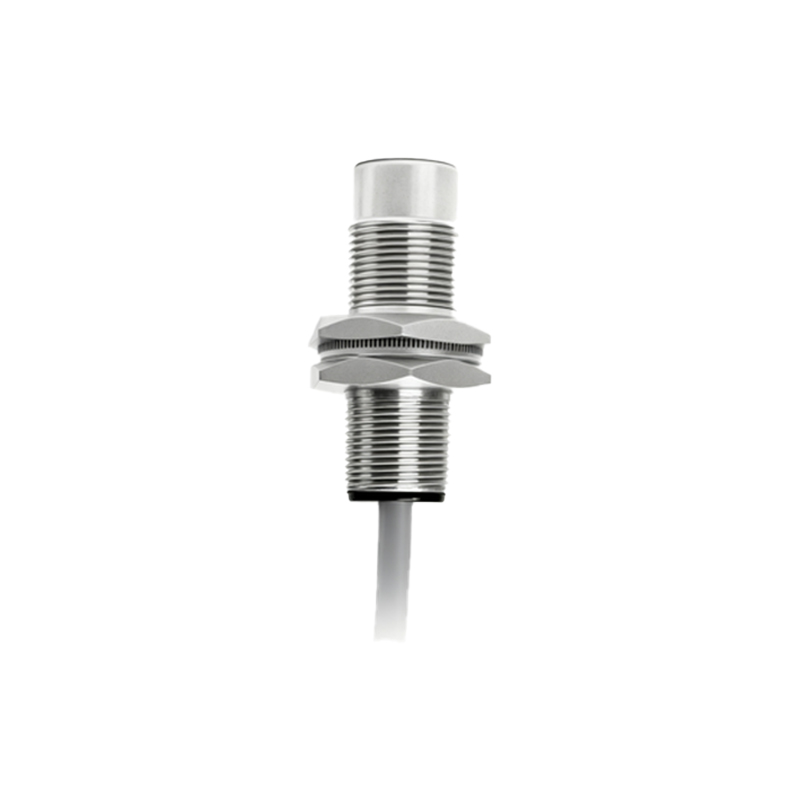
The benefits of using proximity sensors for length measurement are substantial. They eliminate mechanical wear associated with contact methods, thereby reducing maintenance costs and downtime. Non-contact measurement prevents damage to delicate products. Furthermore, these sensors enable high-speed, inline measurement, which is crucial for modern high-throughput production. This facilitates real-time quality control, allowing for immediate rejection of out-of-specification products and dynamic adjustment of downstream processes like cutting or sorting.
Applications are widespread across industries. In metal fabrication, proximity sensors measure the length of bars, tubes, or sheets for cutting. In the paper and printing industry, they control the cutoff length of webs or monitor roll diameter. In logistics and packaging, they verify parcel dimensions on sorting conveyors. Emerging trends include the integration of IO-Link communication for enhanced diagnostics and parameterization, and the use of multi-sensor arrays for profiling or measuring complex shapes.
However, challenges persist. Factors like target surface finish, color, or material composition can affect sensor performance, particularly for photoelectric or capacitive types. Temperature variations may influence ultrasonic sensor accuracy. Therefore, thorough testing and calibration under actual operating conditions are imperative. Regular maintenance, including lens cleaning for optical sensors and checking for sensor fouling, ensures long-term reliability.
In conclusion, proximity sensors offer a versatile, reliable, and efficient solution for non-contact length measurement in industrial settings. By leveraging the appropriate sensor technology and integrating it seamlessly with control systems, engineers can achieve precise dimensional control, enhance product quality, and optimize overall operational efficiency. As Industry 4.0 advances, the role of smart, networked proximity sensors in providing critical measurement data for digital twins and predictive analytics will only become more pronounced.