In the rapidly evolving world of technology, the fusion of different sensing modalities has led to groundbreaking innovations. One such powerful combination is the camera laser sensor, a hybrid system that is transforming industries from autonomous driving to industrial automation. But what exactly is it, and how does it work?
At its core, a camera laser sensor integrates two primary components: a digital camera and a laser sensor, often in the form of LiDAR (Light Detection and Ranging). The camera captures high-resolution two-dimensional visual data—colors, textures, and patterns—much like the human eye. Simultaneously, the laser sensor emits pulsed laser beams to measure distances with extreme precision, creating a detailed three-dimensional point cloud map of the environment. By merging these two data streams, the system achieves a comprehensive perception that neither technology could provide alone. The visual context from the camera gives meaning to the precise spatial data from the laser, enabling machines to not only "see" but also understand depth, shape, and spatial relationships in real-time.
The applications of camera laser sensors are vast and growing. In autonomous vehicles, they are indispensable. The laser sensor accurately detects the distance to pedestrians, other vehicles, and obstacles, even in low-light conditions, while the camera identifies traffic signs, lane markings, and signal colors. This redundancy and complementarity are crucial for safety, allowing the vehicle's computer to make split-second navigation decisions. Similarly, in robotics and manufacturing, these sensors guide robots for precise picking, placing, and assembly tasks in dynamic environments. They enable drones to perform accurate aerial surveys and inspections of infrastructure like bridges and power lines. Even in consumer electronics, this technology is emerging in smartphones for advanced photography features like portrait mode and augmented reality applications.

The advantages of combining these technologies are significant. Laser sensors provide excellent range and accuracy in 3D mapping, unaffected by lighting conditions, but they struggle with identifying colors and fine details. Cameras excel at capturing rich visual information and texture but cannot natively perceive depth. Together, they overcome each other's limitations. This sensor fusion enhances reliability, reduces errors, and allows for more sophisticated environmental interpretation. For instance, a system can distinguish between a plastic bag blowing across the road and a solid obstacle, a critical distinction for an autonomous car.
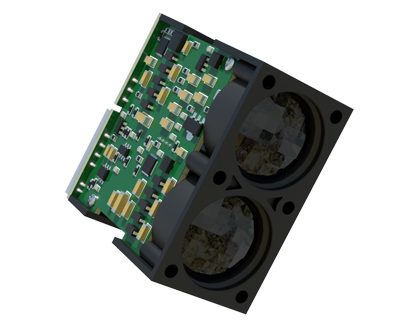
However, challenges remain. Integrating data from two different sensor types—processing 2D images and 3D point clouds—requires complex algorithms and substantial computing power. Calibration between the camera and laser must be precise to ensure data alignment. Furthermore, factors like weather conditions (e.g., heavy fog or rain) can sometimes attenuate laser beams, while extremely bright light can overwhelm a camera sensor. Ongoing research focuses on improving robustness, reducing the size and cost of components (especially for LiDAR), and developing more efficient data fusion software.
Looking ahead, the future of camera laser sensors is incredibly promising. As artificial intelligence and machine learning advance, the interpretation of the fused data will become more intelligent and contextual. Miniaturization will lead to their integration into more compact devices, expanding use cases in security, healthcare, and smart home systems. The synergy of visual and spatial sensing is a cornerstone for building truly perceptive machines, paving the way for smarter cities, safer transportation, and more automated industries. Understanding this technology is key to grasping the next wave of innovation in automation and intelligent systems.