Inclined angle laser sensors represent a significant advancement in non-contact measurement technology, offering unparalleled precision in challenging industrial environments. Unlike traditional perpendicular laser sensors, these devices emit a laser beam at a predefined acute or obtuse angle relative to the target surface. This fundamental design characteristic unlocks capabilities essential for modern automation, quality control, and robotic guidance systems.
The core operating principle hinges on triangulation. The sensor projects a focused laser spot onto the target. The diffusely reflected light is captured by a receiving lens at a specific angle and focused onto a position-sensitive detector, typically a CCD or CMOS array. When the target's distance changes, the position of the light spot on the detector shifts. For an inclined angle sensor, the geometry of the setup—where the laser emitter, receiver, and measurement point form a triangle—is optimized for measurements on non-horizontal surfaces, deep grooves, or behind obstructions where direct line-of-sight is impossible with a 90-degree approach. The sensor's internal processor calculates the distance or displacement with micron-level accuracy based on this positional shift.
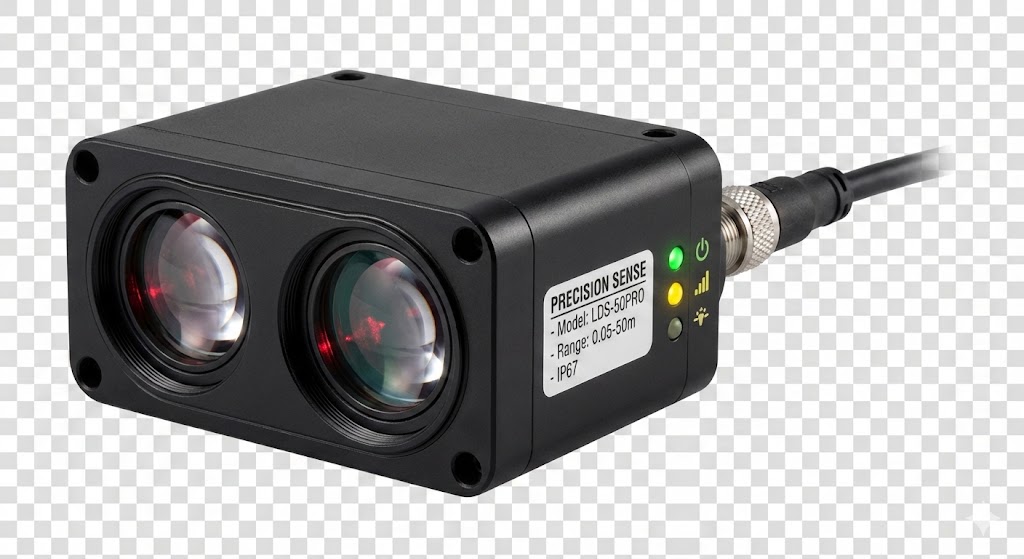
Key advantages drive their adoption across sectors. First is accessibility. They can measure surfaces that are not directly accessible from above, such as the inner walls of boreholes, the underside of components on an assembly line, or the profile of a deep groove in a machined part. Second is the mitigation of specular reflection issues. By using an oblique angle, the sensor often avoids the direct, mirror-like reflection from shiny surfaces (like polished metal or glass) that can blind a standard sensor, instead capturing the diffuse component for a stable reading. Third is profile and edge detection. The angled beam is exceptional for detecting precise edges, steps, or complex contours, making it ideal for dimensional inspection and part positioning.
Industrial applications are vast and varied. In automotive manufacturing, these sensors verify the precise depth and geometry of engine cylinder walls or gear teeth. In electronics, they measure coplanarity of ball grid array (BGA) solder balls or the height of tiny components on a PCB. In metal processing, they monitor sheet flatness or the wear on cutting tools. Robotic arms frequently employ them for accurate bin-picking, where the robot needs to identify and grasp randomly oriented parts from a container, relying on the sensor's ability to map complex surfaces from an angle.
Selecting the right inclined angle laser sensor requires careful consideration of several parameters. The measurement range and stand-off distance must suit the physical constraints of the application. The angle of inclination itself is critical; common angles like 30°, 45°, or 60° offer different shadowing effects and accessibility. Resolution and linearity define the precision of the measurement. The type of output (analog voltage/current, digital IO-Link, Ethernet-based protocols) must integrate with the existing control system. Environmental robustness, indicated by IP ratings, is non-negotiable for use in environments with dust, coolant, or vibration.
Integration challenges, while manageable, must be acknowledged. The non-perpendicular setup can create shadow zones or require more complex calibration. The exact orientation and mounting of the sensor relative to the target must be rigid and precisely engineered. Ambient light interference, though mitigated by using modulated laser light and optical filters, should be evaluated in the final installation.
Looking ahead, the convergence of inclined angle laser sensing with Industry 4.0 trends is clear. Sensors with integrated intelligence and IO-Link communication provide not just measurement data but also diagnostic information, enabling predictive maintenance. Miniaturization continues, allowing deployment in ever-tighter spaces. Furthermore, the integration of 2D or even 3D profiling capabilities using arrays or scanning versions of inclined lasers is opening new frontiers in complete surface inspection.
In conclusion, inclined angle laser sensors are indispensable tools for solving complex measurement tasks that defy conventional perpendicular methods. Their ability to deliver high-precision data from difficult-to-reach or highly reflective surfaces makes them a cornerstone technology for enhancing quality, efficiency, and automation in advanced manufacturing and beyond. Engineers must leverage their unique geometry to innovate and overcome previously insurmountable measurement challenges.