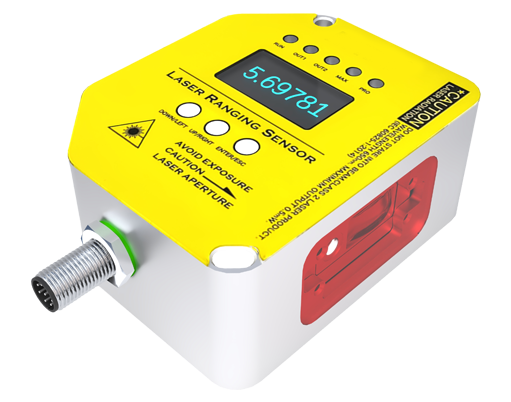
In the realm of industrial automation and precision measurement, laser ranging sensors have become indispensable tools. These devices leverage the fundamental properties of light to determine distances with remarkable accuracy, enabling applications from robotics and manufacturing to surveying and quality control. This article delves into the core principles behind laser ranging technology, exploring the methods and components that make such high-precision measurements possible.
The foundational concept of laser ranging is based on the constant speed of light in a given medium, typically air. A laser diode emits a focused, coherent beam of light toward a target. The sensor then measures either the time it takes for the light to travel to the target and back (Time-of-Flight or ToF method) or the phase shift of a modulated light wave (Phase-Shift method). The Time-of-Flight method is straightforward: distance is calculated as D = (c * t) / 2, where 'c' is the speed of light and 't' is the measured round-trip time. This method is highly effective for long-range measurements, from several meters to kilometers, and is commonly used in LiDAR systems for terrain mapping and autonomous vehicles.
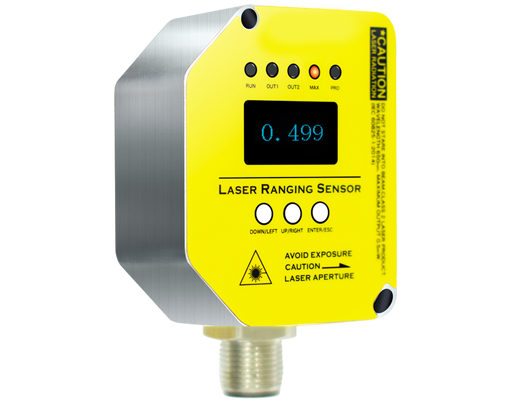
For shorter ranges requiring higher precision, often in industrial settings within sub-meter to several hundred meters, the Phase-Shift method is frequently employed. Here, the intensity of the laser beam is modulated at a specific frequency. The reflected light wave experiences a phase shift relative to the emitted wave. By comparing the phase difference, the sensor calculates the time delay and, consequently, the distance. This technique offers superior resolution, often down to the millimeter or sub-millimeter level, making it ideal for tasks like part positioning, thickness monitoring, and assembly verification.
A third, triangulation-based method is also prevalent in specific sensor configurations, particularly for very short ranges or when measuring on diffuse surfaces. In this setup, the laser emitter, the reflected spot on the target, and the receiving sensor (like a CCD or CMOS array) form a triangle. Knowing the baseline distance between the emitter and receiver and the angle of the reflected beam allows for precise distance calculation through trigonometric principles. This method excels in applications like profile scanning and surface contour analysis.

Key components of a laser ranging sensor include the laser source (typically a Class 1 or Class 2 laser diode for safety), the optical system (lenses for beam shaping and focusing), the photodetector (to receive the reflected signal), and sophisticated signal processing electronics. The choice of laser wavelength, often in the visible red or near-infrared spectrum, affects performance factors like beam visibility, atmospheric absorption, and surface reflectivity. Modern sensors incorporate advanced algorithms to filter out ambient light noise, compensate for varying target properties, and provide stable, reliable readings.
The advantages of laser ranging are numerous: non-contact measurement, high speed, exceptional accuracy, and the ability to measure a wide variety of materials. However, challenges exist. Highly reflective or transparent surfaces can cause signal loss or erroneous readings. Environmental factors like dust, fog, or extreme temperatures can attenuate the laser beam. Manufacturers address these issues through techniques like using multiple echo evaluation, adaptive power control, and protective housing designs.
In industrial practice, selecting the right laser ranging sensor depends on the specific requirements of range, precision, target surface, response time, and environmental conditions. From monitoring fill levels in silos to guiding robotic arms for precise pick-and-place operations, the principles of laser ranging provide the technological backbone for countless automation solutions, driving efficiency and quality in modern industry. As technology advances, we see trends toward miniaturization, higher measurement rates, and increased integration with smart factory networks and IoT platforms, further expanding the horizons of this critical sensing technology.