In the high-stakes world of modern manufacturing, precision is not merely a goal; it is an absolute prerequisite. At the intersection of computer numerical control (CNC) machining and advanced metrology lies a critical component enabling this precision: the laser sensor. These sophisticated devices have evolved from auxiliary tools to fundamental elements of the smart factory, driving efficiency, quality, and automation to unprecedented levels. This article delves into the technology, integration, and transformative applications of laser sensors within CNC machining environments.
Fundamentally, a laser sensor designed for CNC applications is a non-contact measurement device. It projects a focused beam of coherent light onto a target surface—be it metal, plastic, or composite. The sensor then analyzes the reflected light. Different principles are employed based on the required measurement. Triangulation sensors are prevalent for high-resolution distance and displacement measurements. A laser diode projects a spot onto the target, and the reflection is focused onto a position-sensitive detector (PSD) or a CMOS/CCD array. Any change in the target's distance causes the spot to shift on the detector, allowing for micron-level accuracy. For measuring vibration, surface contour, or detecting minute defects, laser interferometers and confocal chromatic sensors are deployed, offering nanometer-scale resolution.
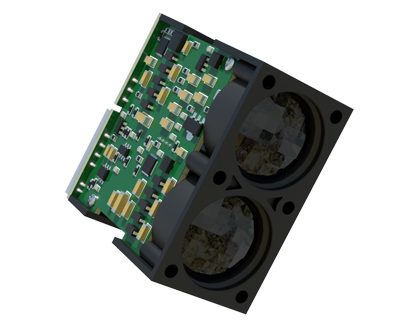
The true power of these sensors is unlocked through seamless integration with the CNC system. This is far more than a simple physical mounting. It involves deep electronic and software integration. Modern laser sensors communicate via high-speed industrial protocols like EtherCAT, PROFINET, or direct analog/digital I/O. This allows the sensor's real-time data to be fed directly into the CNC controller's closed-loop system. For instance, during a milling operation, a laser displacement sensor can continuously measure the workpiece dimensions. If thermal expansion or tool wear causes a deviation from the programmed path, the CNC controller can dynamically adjust tool offsets in real-time, compensating for the error without stopping the process. This capability is the cornerstone of adaptive machining, eliminating the need for intermediary manual inspections and significantly reducing scrap rates.

Key applications are revolutionizing shop floor operations. First, in-process inspection and compensation is paramount. Sensors mounted on the machine spindle or within the work envelope can measure critical features immediately after a machining step, enabling on-the-fly correction for the next operation or a subsequent part. Second, tool setting and breakage detection are crucial for unmanned machining. A laser sensor can automatically measure tool length and diameter after a tool change, verifying integrity and updating the tool table. More importantly, it can scan the tool tip before and after a machining cycle to detect even hairline cracks or chipping, preventing catastrophic failure and poor surface finishes. Third, workpiece alignment and probing have been enhanced. Instead of traditional touch-trigger probes, laser line scanners can rapidly generate a 3D point cloud of a raw casting or forging, allowing the CNC to calculate the optimal zero point and machining strategy for that specific part, maximizing material usage.
The selection of an appropriate laser sensor for a CNC machine depends on a rigorous assessment of parameters. The required measurement range, stand-off distance, spot size, and resolution must align with the application. Environmental robustness is non-negotiable; sensors must withstand omnipresent coolant mists, metal shavings, oil, and significant vibration. Industrial-grade enclosures with high IP ratings (e.g., IP67) are standard. Furthermore, the sensor's response speed must match or exceed the machine's feed rates to ensure no data lag.
Looking forward, the convergence of laser sensing with Industrial Internet of Things (IIoT) platforms and artificial intelligence is setting the stage for predictive manufacturing. Networks of laser sensors will provide continuous streams of data not just for real-time control, but for long-term analytics. Machine learning algorithms can analyze trends in tool wear, part deformation, and machine thermal growth to predict maintenance needs and process drifts before they impact quality. This evolution from reactive correction to predictive assurance represents the next frontier.
In conclusion, CNC machining laser sensors are pivotal technologies that bridge the digital and physical realms of manufacturing. They transform a CNC machine from a blind executor of G-code into a perceptive, adaptive, and intelligent production unit. By enabling real-time metrology-in-process, they ensure that the theoretical precision of digital design is faithfully and consistently rendered into the physical workpiece, driving the relentless pursuit of perfection in advanced manufacturing.