In the rapidly evolving landscape of industrial automation, precision and reliability are paramount, especially in welding applications. Among the advanced sensing technologies enabling this precision, the line laser weld seam sensor stands out as a critical component for automated welding systems. This article delves into the operational principles, key advantages, and practical applications of this sophisticated technology.
At its core, a line laser weld seam sensor operates on the principle of optical triangulation. The sensor projects a highly focused line of laser light onto the target workpiece surface. This line, typically generated by a laser diode and specialized optics, deforms according to the surface profile it encounters. A high-resolution camera, positioned at a known angle relative to the laser projector, captures the image of this deformed laser line. Sophisticated onboard algorithms then analyze the captured image in real-time. By calculating the displacement of each point along the laser line from its expected position on a flat reference plane, the sensor's processor constructs a highly accurate 3D profile of the weld joint. This profile data includes critical geometric parameters such as groove width, depth, root gap, and mismatch, which are essential for precise weld path planning and parameter adjustment.
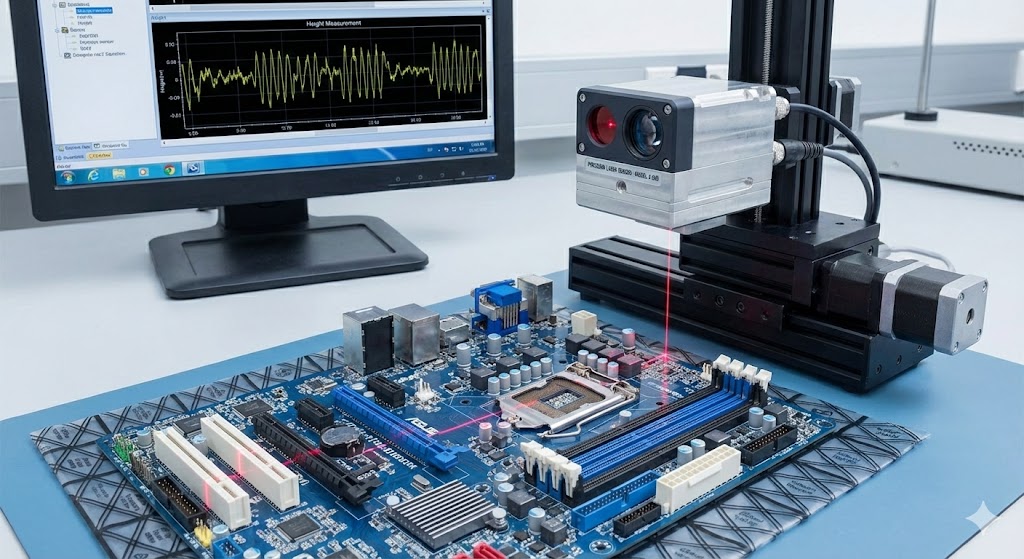
The advantages of using line laser sensors over traditional tactile or through-arc sensing methods are substantial. First and foremost is their non-contact nature. The sensor never physically touches the workpiece, eliminating the risk of mechanical wear, damage to delicate materials, or contamination of the joint. This leads to significantly higher system longevity and reduced maintenance. Secondly, they offer exceptional speed and real-time capability. Data acquisition and processing occur at rates often exceeding thousands of profiles per second, allowing robotic welding systems to make instantaneous corrections to the torch path and welding parameters (voltage, current, wire feed speed) during the process. This is crucial for adaptive welding, where joint fit-up may vary. Thirdly, their accuracy is remarkable, capable of detecting sub-millimeter variations in joint geometry. This level of precision ensures consistent weld bead placement and penetration, directly impacting weld quality and structural integrity. Furthermore, these sensors are highly versatile. They can be effectively used on a wide range of materials, including steel, aluminum, and stainless steel, and can detect various joint types—V-grooves, lap joints, fillet welds, and even complex 3D contours.
In practical industrial applications, line laser seam sensors are integrated directly onto the welding torch or a separate mounting bracket ahead of the torch. A typical workflow involves a pre-weld scan. Before the arc is initiated, the robot moves the sensor along the programmed weld path. The sensor scans the entire joint, building a complete digital map. This map is used to correct the robot's programmed path for any deviations in part placement or joint preparation. More advanced systems employ real-time tracking during the welding process itself. Here, the sensor operates in a "look-ahead" mode, scanning the joint just ahead of the molten weld pool. This allows the control system to dynamically adjust for thermal distortion, which can cause the joint to move or change shape as heat is applied. This capability is invaluable for long seams or in applications involving thin-gauge materials prone to warping.
The integration of this sensor data with robotic controllers and welding power sources creates a closed-loop adaptive welding system. The sensor's output becomes the guiding intelligence, enabling truly intelligent automation that compensates for real-world variability. This technology is extensively deployed in automotive manufacturing for body-in-white assembly, in shipbuilding for long panel seams, in pipeline construction for girth welds, and in heavy machinery fabrication for critical structural components.
Despite their robustness, successful implementation requires careful consideration. Sensor selection must account for the specific welding environment. Factors such as intense arc glare, spatter, fume, and ambient light can interfere with the laser line detection. Modern sensors incorporate narrow-band optical filters that only transmit the specific wavelength of the laser, effectively blocking most ambient light and arc radiation. Protective measures, like air purge systems and spatter-resistant coatings on the sensor window, are essential for longevity in harsh welding cells. Furthermore, proper calibration is critical to ensure the geometric relationship between the laser projector and the camera is precisely known, guaranteeing measurement accuracy.
Looking forward, the convergence of line laser sensing with artificial intelligence and machine learning presents the next frontier. AI algorithms can be trained to not only detect joint geometry but also predict weld quality outcomes based on the scanned profile and historical data, enabling predictive process control. Additionally, the development of more compact, lighter, and even more robust sensor designs will facilitate their use on smaller collaborative robots (cobots), further democratizing high-precision automated welding for small and medium-sized enterprises.
In conclusion, the line laser weld seam sensor is far more than just a measurement device; it is the enabling eye for modern robotic welding. By providing accurate, real-time, and non-contact 3D data of the weld joint, it transforms rigid automation into flexible, adaptive, and intelligent manufacturing processes. Its continued evolution promises to drive further gains in productivity, quality, and cost-efficiency across the global welding industry, solidifying its role as an indispensable tool in the advanced manufacturer's arsenal.