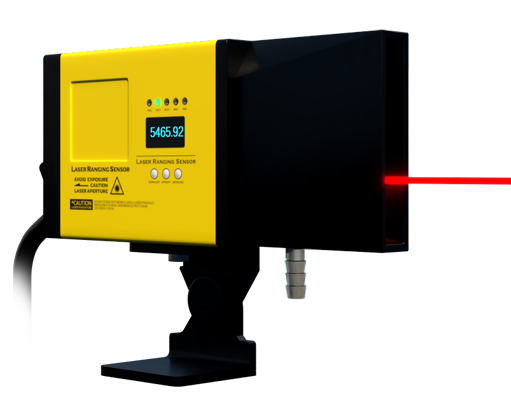
In the high-stakes environment of modern industrial automation, precision, safety, and efficiency are non-negotiable. Among the myriad of technologies safeguarding these principles, the laser anti-collision sensor stands out as a critical guardian. This sophisticated device is engineered to prevent costly and dangerous collisions between machinery, automated guided vehicles (AGVs), robotic arms, and other moving components within a facility. By emitting an invisible, highly focused beam of light, it continuously monitors designated safety zones, triggering an immediate halt or slowdown of equipment upon detecting an intrusion. The core technology hinges on time-of-flight (ToF) or phase-shift measurement principles, where the sensor calculates the distance to an object by measuring the time or phase difference between the emitted laser pulse and its reflection. This allows for remarkably accurate detection, often within millimeter precision, at ranges that can extend over several meters.
The applications of laser anti-collision sensors are vast and transformative. In automated storage and retrieval systems (AS/RS), they prevent cranes and shuttles from colliding with racking structures or each other, ensuring seamless 24/7 operation. On manufacturing floors, they create virtual safety curtains around robotic work cells, protecting human workers who need to enter collaborative spaces for maintenance or loading. For mobile robots and AGVs navigating dynamic warehouses, these sensors are indispensable for obstacle avoidance, enabling safe navigation around unexpected personnel, pallets, or other vehicles without the need for physical barriers. The logistics sector relies on them to protect sorting systems and conveyor lines, preventing jams and damage to parcels. Furthermore, in heavy industries like steel or automotive manufacturing, they safeguard large gantry cranes and transfer cars, where a collision could result in catastrophic damage and prolonged downtime.
Choosing the right laser anti-collision sensor requires careful consideration of several technical parameters. The *measuring range* must suit the specific application, whether it's a short-range perimeter guard or a long-range detection for large vehicles. *Response time* is paramount; in high-speed scenarios, a sensor must react within milliseconds to be effective. The *resolution* and *accuracy* determine the smallest detectable object and the reliability of the distance measurement. Environmental robustness is another key factor; sensors must be rated with appropriate *Ingress Protection (IP)* codes to withstand dust, moisture, and vibrations common in industrial settings. Additionally, features like programmable warning and stop zones, multiple output signals (e.g., NPN/PNP, analog, Ethernet/IP), and resistance to ambient light interference are crucial for integration into complex control systems. Modern sensors often come with intuitive software for easy configuration and diagnostics, allowing engineers to set up complex protection fields with simple graphical interfaces.
The future of laser anti-collision technology is intertwined with the rise of Industry 4.0 and smart factories. The next generation of sensors is becoming more intelligent and connected. Integration with Industrial Internet of Things (IIoT) platforms allows for predictive maintenance, where sensor performance data is analyzed to forecast potential failures before they occur. Advanced models incorporate AI algorithms to distinguish between different types of obstacles—for instance, identifying a human figure versus a stationary box—enabling more nuanced and efficient responses than a simple emergency stop. Furthermore, the miniaturization and cost reduction of laser components are making this high-level protection accessible for smaller-scale automation projects. As collaborative robots (cobots) become more prevalent, the demand for compact, highly reliable, and fast laser safety scanners will only intensify.
In conclusion, the laser anti-collision sensor is far more than a simple safety switch. It is a foundational element for enabling higher levels of automation, productivity, and human-robot collaboration. By providing a reliable, non-contact, and precise method for collision prevention, it protects valuable capital assets, ensures personnel safety, and maintains the uninterrupted flow of operations. For any engineer or manager designing or operating automated systems, understanding and implementing this technology is not just an option; it is a critical responsibility for building a resilient and efficient industrial future. Its continuous evolution promises to unlock even greater levels of autonomy and safety in the factories and warehouses of tomorrow.