In the demanding world of industrial automation, precision measurement is not a luxury—it is an absolute necessity. Among the leaders in providing this critical capability is Sick AG, a global pioneer in sensor and automation solutions. The Sick laser rangefinder sensor stands as a cornerstone technology, enabling machines to perceive their environment with remarkable accuracy and reliability. These sensors are engineered to deliver non-contact distance measurement, a function that is fundamental to a vast array of applications, from logistics and material handling to automotive assembly and mobile robotics.
At its core, a Sick laser rangefinder operates on the time-of-flight (ToF) principle. The sensor emits a pulsed laser beam towards a target. By precisely measuring the time it takes for the light pulse to reflect back to the sensor's receiver, the device calculates the distance to the object with exceptional precision. This method allows for measurements over considerable ranges, often spanning from a few centimeters to several hundred meters, depending on the specific model. The use of laser technology ensures a highly focused beam, enabling accurate measurements even on small or low-reflectivity targets, and providing excellent resistance to ambient light interference.

The versatility of Sick's laser rangefinder portfolio is a key strength. Models are available for both short-range and long-range applications. Compact models are designed for integration into tight spaces on automated guided vehicles (AGVs) for navigation and obstacle detection, ensuring safe and efficient movement within dynamic warehouse environments. High-performance, long-range sensors are utilized in bulk material handling, such as monitoring the level of solids in silos or measuring the position of crane trolleys in ports, where robust performance in harsh conditions is paramount.
Beyond simple distance measurement, advanced Sick laser sensors incorporate sophisticated functionalities. Many models feature programmable measurement windows, multiple echo evaluation, and onboard data processing. This allows them to perform complex tasks like contour detection, presence checking, and even basic dimensioning. The sensors communicate seamlessly with higher-level control systems via industry-standard interfaces like IO-Link, analog outputs, PROFINET, or EtherNet/IP, facilitating easy integration into existing Industrial Internet of Things (IIoT) architectures. This connectivity is crucial for predictive maintenance strategies, as the sensor can transmit health status and diagnostic data, minimizing unplanned downtime.
Durability is a non-negotiable trait for industrial sensors. Sick laser rangefinders are built to withstand the rigors of factory floors and outdoor installations. They typically feature rugged metal housings with high ingress protection (IP) ratings, safeguarding them against dust, moisture, and mechanical shock. Their design ensures stable operation across a wide temperature range, making them suitable for everything from refrigerated warehouses to steel mills.
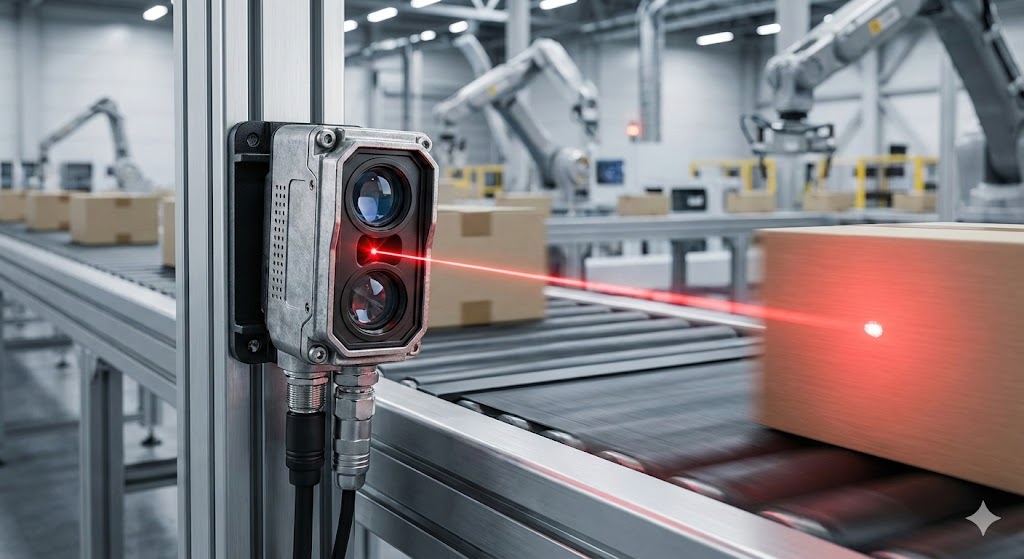
The practical applications are extensive. In automated storage and retrieval systems (AS/RS), these sensors ensure precise positioning of shuttles and cranes. In the automotive industry, they guide robots for accurate part placement and verify assembly gaps. For mobile platforms, they are indispensable for collision avoidance and navigation. In packaging machinery, they control fill levels and monitor material webs. Each application leverages the sensor's ability to provide a reliable, continuous stream of precise spatial data, which is the foundation for automated decision-making and control.
Choosing the right Sick laser rangefinder involves considering several factors: the required measurement range, the reflectivity and size of the target, the environmental conditions (dust, fog, vibration), the necessary response time, and the communication protocol. Sick's extensive product line and expert support network assist engineers in selecting the optimal sensor for their specific challenge, ensuring that the measurement solution is not just adequate, but optimal for enhancing system efficiency and safety.
Ultimately, the Sick laser rangefinder sensor is more than just a measuring device; it is an enabler of intelligent automation. By providing eyes for machines, it allows systems to operate with a level of precision, speed, and autonomy that was previously unattainable. As industries continue to evolve towards greater connectivity and flexibility, the role of such precise, reliable, and smart sensing technology will only become more central, driving productivity and innovation on the factory floor and beyond.