In the realm of industrial automation and precision measurement, line laser distance sensors have emerged as a pivotal technology, offering unparalleled accuracy and versatility. Unlike traditional point laser sensors that measure a single spot, a line laser projects a visible or invisible laser line onto a target surface. This fundamental difference unlocks a broader spectrum of applications, from profile inspection to 3D scanning. This article delves into the operational principles, key specifications, and diverse industrial applications of these sophisticated sensors.
At its core, a line laser distance sensor operates on the principle of optical triangulation. The sensor integrates a laser diode that emits a focused fan-shaped beam, creating a sharp line on the target object. A high-resolution CMOS or CCD image sensor, positioned at a known angle relative to the laser emitter, captures the reflection of this laser line. When the target object's distance or surface profile changes, the position of the laser line on the image sensor shifts accordingly. Sophisticated onboard processors analyze this displacement in real-time. By applying precise trigonometric calculations, the sensor determines the exact distance to each point along the laser line, effectively generating a detailed height profile or contour map of the object. This allows for the simultaneous measurement of multiple points, making it exceptionally efficient for inspecting complex geometries.
Several critical specifications define the performance and suitability of a line laser sensor for a given task. Measurement range, typically from a few millimeters to several meters, dictates how far the sensor can operate effectively. Resolution, often in the micron range, refers to the smallest detectable change in distance. Line length and the number of measurement points per line determine the width and detail of the inspected area. Scan rate, measured in Hertz (Hz), indicates how many profiles can be captured per second, which is crucial for high-speed production lines. Environmental factors like ambient light immunity, operating temperature, and ingress protection (IP) ratings are also paramount for reliable operation in harsh industrial settings such as welding shops or outdoor applications.

The applications of line laser distance sensors are vast and transformative across numerous sectors. In automotive manufacturing, they are indispensable for inspecting body panel gaps and flushness, ensuring consistent quality and fit. In electronics assembly, these sensors verify the coplanarity of component leads on printed circuit boards (PCBs) and measure solder paste height. The logistics and warehousing industry utilizes them for pallet profiling and volume measurement to optimize storage space. Furthermore, they are the backbone of many 3D scanning systems used for reverse engineering, robotic bin picking, and quality control of cast parts by comparing scanned profiles against a computer-aided design (CAD) model. Their non-contact nature prevents damage to delicate surfaces, and their high speed enables 100% inline inspection, reducing waste and improving overall equipment effectiveness (OEE).
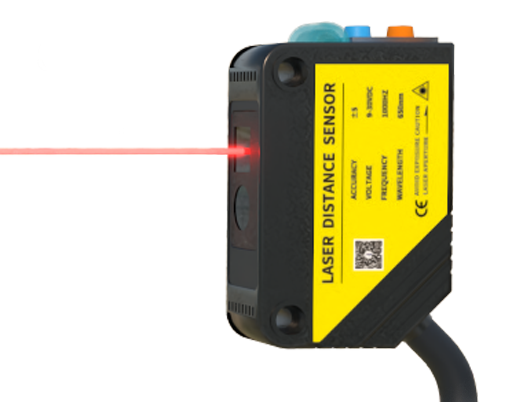
When integrating a line laser sensor, engineers must consider several practical aspects. Proper alignment and mounting are essential to ensure the laser line is perpendicular to the direction of object travel for accurate profiling. The reflectivity and color of the target surface can affect signal strength; some sensors offer automatic exposure control or multi-echo technology to handle varying surfaces. Data output interfaces, such as Ethernet/IP, PROFINET, or analog outputs, must be compatible with the existing programmable logic controller (PLC) or data acquisition system. Regular calibration against known standards is recommended to maintain long-term accuracy.
In conclusion, line laser distance sensors represent a significant advancement in metrology and machine vision. By transforming a single-point measurement into a comprehensive linear profile, they provide a powerful tool for enhancing quality control, enabling robotic guidance, and driving efficiency in automated processes. As industries continue to demand higher precision and smarter manufacturing capabilities, the role of these sensors will only become more central, pushing the boundaries of what is possible in automated inspection and measurement.
