Laser length measurement sensors, often referred to as laser length counters or laser measuring sensors, represent a significant advancement in industrial metrology and process control. These devices utilize laser technology to perform non-contact, high-precision measurement of length, distance, or position for moving or stationary objects. Their core principle typically involves emitting a focused laser beam towards a target surface. The sensor then analyzes the reflected light, often using triangulation, time-of-flight (ToF), or interferometry methods, to calculate the exact distance or displacement. This data is processed to determine linear length, often integrated with encoder signals from moving webs, cables, or production lines to provide real-time length or velocity information.
The advantages of laser-based systems over traditional mechanical contact wheels or encoder-based counters are substantial. Firstly, they eliminate issues like slippage, wear, and mechanical deformation inherent in contact methods, ensuring consistent accuracy over long-term operation. This is critical in industries handling delicate materials like thin films, optical fibers, or sensitive textiles, where physical contact could cause damage. Secondly, laser sensors offer exceptional resolution and repeatability, often down to the micrometer level, enabling precise control in manufacturing tolerances. Their high sampling speed allows for accurate measurement even at very high line speeds, which is essential in modern high-throughput production environments such as wire and cable manufacturing, printing, converting, and textile production.
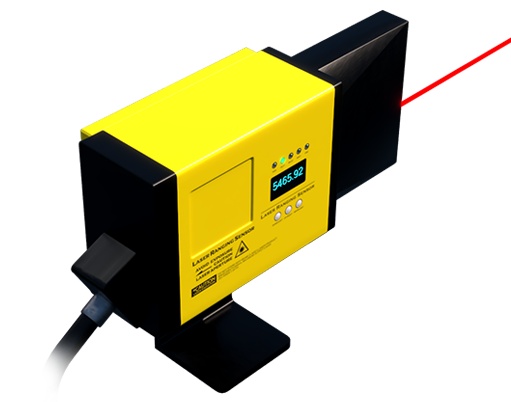
A typical industrial laser length measurement system comprises several key components: the laser sensor head, a controller or evaluation unit, and often a display or interface for system integration. The sensor head houses the laser diode, optics, and photodetector. Modern sensors frequently use Class 2 visible red lasers or Class 1 infrared lasers, which are eye-safe under normal operating conditions. The controller processes the raw distance signals, correlates them with motion data from an external rotary encoder (if used for moving materials), and computes the total length. Advanced units feature internal data logging, programmable batch counting, tolerance alarming, and various output options like analog voltage/current, digital I/O, or industrial communication protocols (Ethernet/IP, PROFINET, Modbus).
When selecting a laser length measurement sensor for an application, engineers must consider several parameters. The measuring range defines the minimum and maximum working distances from the sensor to the target. The standoff distance is the optimal range for operation. Specifications like linearity error, resolution, and repeatability define the system's precision. The laser spot size is crucial, as a smaller spot allows for measurement on narrower targets or edges. Environmental factors are paramount; industrial settings may involve dust, vibration, temperature fluctuations, or varying target surface properties (color, reflectivity, texture). Many sensors feature automatic background suppression or advanced algorithms to compensate for different surface conditions, ensuring reliable performance on materials ranging from shiny metals to dark, absorbent plastics.
Integration into automated control systems is a major strength. The measured length data can be fed into PLCs (Programmable Logic Controllers) or supervisory systems to trigger automatic cut-to-length operations, control tension, monitor production yield, or provide SPC (Statistical Process Control) data for quality assurance. In wire and cable production, for instance, laser sensors ensure precise length marking, cutting, and coiling. In printing and converting, they control repeat length and registration. In roll goods manufacturing, they provide accurate roll diameter and remaining length calculation.
Maintenance of these systems is generally minimal due to their non-contact nature. However, keeping the laser lens clean from dust and debris is essential to maintain accuracy. Regular calibration checks against a known standard are recommended. Future trends point towards smarter sensors with integrated IoT capabilities for predictive maintenance, enhanced connectivity for Industry 4.0 environments, and the development of multi-point or profile scanning systems for more complex dimensional analysis.
In conclusion, laser length measurement sensors are indispensable tools for modern industrial automation, offering a blend of high accuracy, reliability, and versatility. By enabling precise, non-contact measurement, they enhance product quality, optimize material usage, reduce waste, and improve overall operational efficiency across a diverse spectrum of manufacturing and processing applications. Their continued evolution will further solidify their role in the pursuit of smarter, more precise industrial processes.