Laser positioning sensors are pivotal components in modern industrial automation, enabling precise measurement and control in manufacturing, robotics, and quality inspection. These sensors operate on the fundamental principle of emitting a focused laser beam toward a target object and analyzing the reflected light to determine position, distance, or displacement. Typically, they utilize triangulation or time-of-flight (ToF) methods. In triangulation-based sensors, a laser diode projects a spot onto the target surface. The reflected light is captured by a receiver lens at a known angle, forming an image on a position-sensitive detector (PSD) or CMOS array. Any change in the target's position shifts the image on the detector, allowing calculation of distance with high accuracy, often within micrometers. This method excels in short-range applications requiring fine resolution, such as semiconductor wafer alignment or thickness gauging.
Alternatively, time-of-flight sensors measure the round-trip time for a laser pulse to travel to the target and back. By using the constant speed of light, the distance is computed as d = (c × t) / 2, where c is light speed and t is time. ToF sensors are ideal for longer ranges, up to several meters, and are commonly used in warehouse automation for pallet positioning or vehicle guidance. Advanced variants incorporate phase-shift analysis for enhanced precision.
Key elements of these sensors include laser sources (often red or infrared diodes for visibility and stability), optical components for beam shaping, and sophisticated signal processing electronics. Environmental factors like ambient light, surface reflectivity, and temperature can affect performance, necessitating features such as background suppression, automatic gain control, and temperature compensation. Modern laser positioning sensors integrate digital interfaces (e.g., IO-Link, Ethernet/IP) for seamless communication with PLCs, enabling real-time data feedback and adaptive control in Industry 4.0 systems. Their applications span from robotic pick-and-place operations and conveyor belt tracking to 3D scanning and assembly verification, driving efficiency and reducing errors in automated production lines.
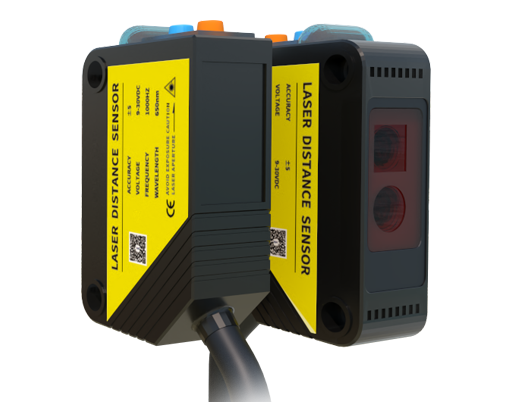
As technology advances, innovations like multi-point scanning and AI-enhanced pattern recognition are expanding sensor capabilities, making them indispensable for smart manufacturing. Engineers must consider parameters like measurement range, resolution, response time, and environmental ratings when selecting sensors to ensure reliable operation in specific industrial contexts.