In the realm of industrial automation, the reliable detection of objects without physical contact is paramount. Among the diverse array of sensing solutions, the Square 18 Proximity Sensor stands out as a robust and versatile component, engineered for precision and durability in demanding environments. This article provides a detailed technical examination of the Square 18 form factor, its operational principles, key specifications, and typical application scenarios.
The "Square 18" designation refers to the sensor's housing dimensions—typically an 18mm x 18mm cross-section. This compact, square-bodied design offers significant advantages in installation and space-constrained applications. Unlike cylindrical sensors, the flat sides of a Square 18 sensor facilitate easier mounting and alignment, often allowing for direct integration into machine frames or fixtures without the need for complex bracketry. The housing is commonly constructed from nickel-plated brass, stainless steel, or high-grade PBT plastic, providing excellent resistance to mechanical stress, cutting fluids, coolants, and industrial cleaning agents.
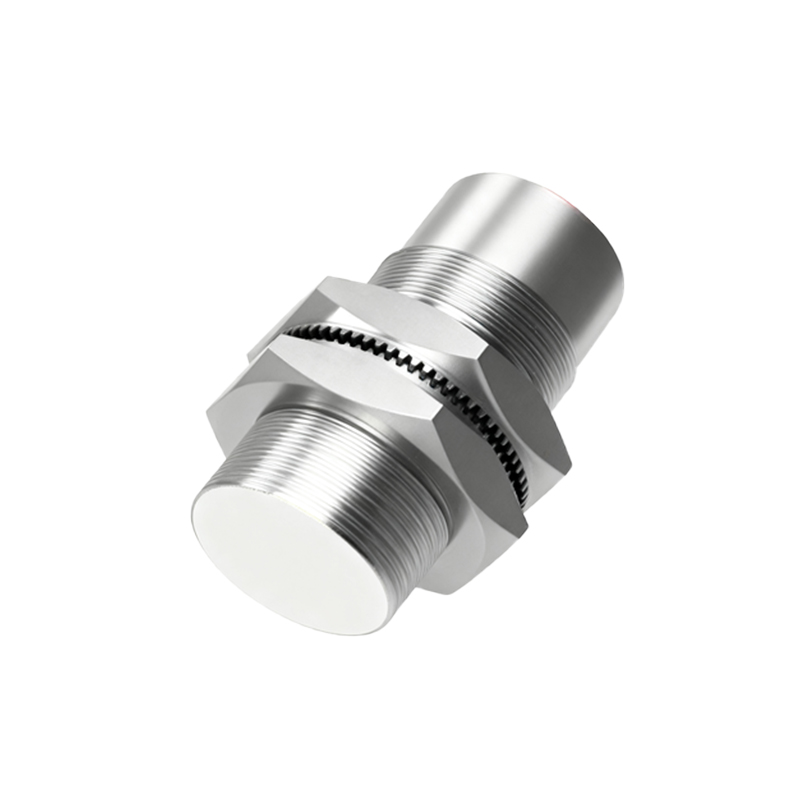
At its core, a Square 18 Proximity Sensor operates primarily on the inductive principle for detecting metallic objects. It contains an oscillator circuit that generates a high-frequency electromagnetic field at its active face. When a ferrous or non-ferrous metal target enters this field, eddy currents are induced within the target, causing a change in the oscillation amplitude. This change is detected by the sensor's threshold circuit, which subsequently triggers a solid-state output switch. For non-metallic object detection (e.g., glass, plastic, liquid), capacitive variants of the Square 18 sensor are available, which detect changes in the dielectric constant.
Key performance specifications define its suitability for various tasks. The sensing range, or nominal sensing distance (Sn), for inductive models is standardized, with common ranges being 5mm or 8mm for an 18mm square sensor. It is crucial to note that this rating is based on a standard mild steel target. Factors such as target material, size, and shape (must be equal to or larger than the sensor's face) influence the effective sensing distance. Repeat accuracy is exceptionally high, often within microns, ensuring consistent operation in precision positioning tasks. Operating voltage ranges are broad, typically covering 10-30V DC or 20-250V AC, making them compatible with most industrial control systems (PLCs). Output configurations include NPN (sinking), PNP (sourcing), or NO/NC (Normally Open/Normally Closed) contacts, with 2-wire, 3-wire, and 4-wire (with separate sense and output lines) versions available.
A critical feature of modern Square 18 sensors is their embedded protection and indication circuitry. Short-circuit, reverse polarity, and overload protection are standard, safeguarding the sensor and connected equipment from wiring errors or fault conditions. An LED status indicator provides visual confirmation of power and output switching, invaluable for quick diagnostics and commissioning. Furthermore, many models offer increased switching frequency capabilities (up to several kHz), enabling reliable detection of fast-moving objects on high-speed production lines.
Application areas are extensive across factory automation. They are indispensable in machine tools for tool positioning, workpiece presence verification, and end-of-travel limit sensing. In material handling, they monitor pallet positions, count products on conveyors, and control gate mechanisms. Packaging machinery utilizes them for fill-level control and label detection. Their ruggedness makes them ideal for harsh environments like welding cells, where they are often equipped with weld-field immunity (WFI) to withstand electromagnetic interference from nearby spot welding equipment.
Selection and installation require careful consideration. Engineers must first define the target material to choose between inductive or capacitive sensing. The required sensing distance and mounting conditions (flush or non-flush) must be evaluated, as non-flush mounting reduces the effective range. Environmental factors such as ambient temperature, potential for physical impact, and exposure to chemicals dictate the required housing material and IP (Ingress Protection) rating, with IP67 and IP69K being common for washdown areas. Proper electrical integration, following manufacturer datasheets for wiring diagrams and load considerations, is essential for optimal performance and longevity.
In conclusion, the Square 18 Proximity Sensor represents a mature, highly engineered solution for non-contact detection. Its standardized form factor, combined with advanced electronic functionality and robust construction, provides a reliable "building block" for countless automation systems. By understanding its technical parameters and application guidelines, engineers and technicians can leverage its capabilities to enhance machine reliability, safety, and operational efficiency, ensuring seamless integration into the smart factories of today and tomorrow.