In the realm of industrial automation, marking machines play a pivotal role in product identification, traceability, and branding. At the heart of these systems' precision and reliability lies a critical component: the laser displacement sensor. This article delves into the principles, applications, and benefits of laser displacement sensors within marking machines, offering insights for engineers and industry professionals.
Laser displacement sensors operate on the principle of triangulation or time-of-flight measurement. In triangulation-based sensors, a laser diode projects a focused beam onto the target surface. The reflected light is captured by a receiving element, such as a CCD or CMOS array. By calculating the angle of the reflected beam relative to the sensor, the exact distance to the target is determined with high accuracy. Time-of-flight sensors, on the other hand, measure the round-trip time of a laser pulse to compute distance. Both methods enable non-contact measurement, which is essential for maintaining the integrity of delicate or moving surfaces during marking processes.
In marking machines, these sensors are primarily utilized for height detection and surface profiling. Before applying marks—whether through laser engraving, dot peening, or inkjet printing—the machine must accurately gauge the distance to the workpiece. Variations in part height, caused by tolerances in manufacturing or fixture inconsistencies, can lead to poor mark quality, such as blurred text or inconsistent depth. Laser displacement sensors provide real-time feedback, allowing the marking head to adjust its Z-axis position dynamically. This ensures optimal focus and contact pressure, resulting in crisp, legible marks even on uneven surfaces.
Another key application is in automated alignment and registration. In high-speed production lines, parts may not be perfectly positioned under the marking head. Laser sensors can scan the surface to detect edges, grooves, or pre-existing features, enabling the system to correct the marking coordinates on-the-fly. This capability enhances throughput by reducing setup times and minimizing scrap due to misalignment. For instance, in automotive part marking, sensors help align serial numbers with specific areas on engine components, ensuring compliance with industry standards.
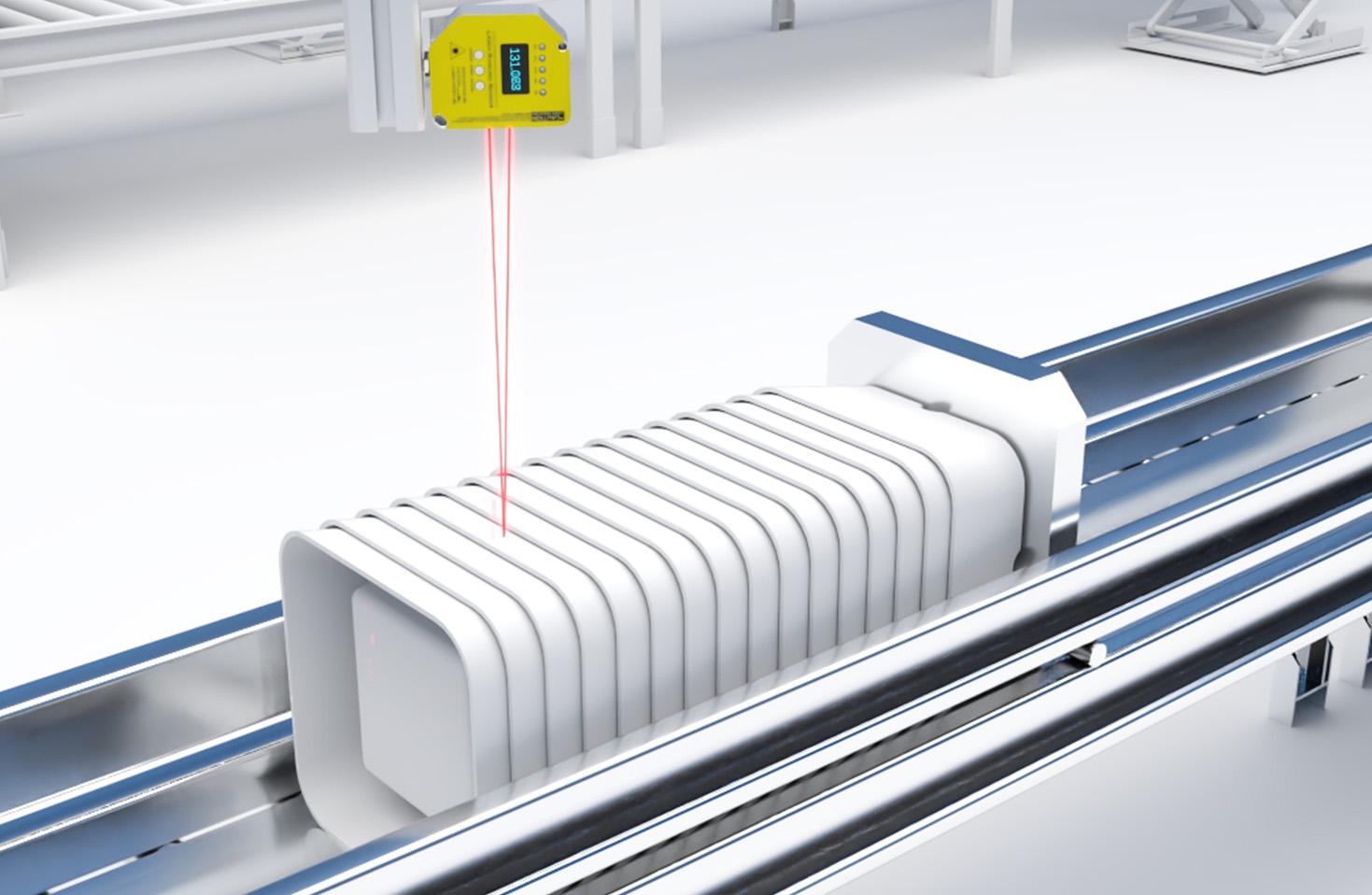
The advantages of integrating laser displacement sensors into marking machines are manifold. First, they offer exceptional accuracy, often within micrometer ranges, which is crucial for applications like micro-machining or PCB marking. Second, their non-contact nature eliminates wear and tear associated with mechanical probes, reducing maintenance costs and downtime. Third, these sensors are highly responsive, capable of taking thousands of measurements per second, making them suitable for fast-paced industrial environments. Additionally, modern sensors are designed to withstand harsh conditions, including dust, vibrations, and temperature fluctuations, common in manufacturing settings.

When selecting a laser displacement sensor for a marking machine, engineers must consider several factors. Measurement range and resolution should align with the part dimensions and required precision. For small, intricate components, a sensor with a narrow beam spot and high resolution is preferable. The type of surface also matters; reflective or dark materials may require sensors with adjustable sensitivity or specialized optics. Integration ease, including communication protocols like Ethernet/IP or PROFINET, ensures seamless data exchange with the marking controller. Lastly, environmental robustness—such as IP ratings for dust and water resistance—should match the operational context.
In practice, successful implementation involves careful calibration and testing. Sensors must be mounted stably to avoid vibrations that could affect readings. Regular cleaning of lenses prevents contamination from debris or coolant mist. Software configuration, such as setting tolerance thresholds and filtering algorithms, helps in handling noise or surface irregularities. Many advanced marking systems now incorporate machine learning algorithms that use sensor data to predict and compensate for process variations, further enhancing quality control.
Looking ahead, trends in laser displacement sensing are driving innovations in marking technology. The adoption of blue laser sensors, which offer better performance on organic or translucent materials, is expanding application scopes. Miniaturization allows sensors to be embedded into compact marking heads for portable or robotic systems. Moreover, the integration with Industry 4.0 platforms enables real-time monitoring and predictive maintenance, where sensor data analytics can alert operators to potential issues before they impact production.
In conclusion, laser displacement sensors are indispensable for modern marking machines, elevating precision, efficiency, and adaptability. By understanding their operational principles and strategic applications, engineers can optimize marking processes to meet evolving industrial demands. As technology advances, these sensors will continue to underpin smarter, more responsive manufacturing ecosystems.