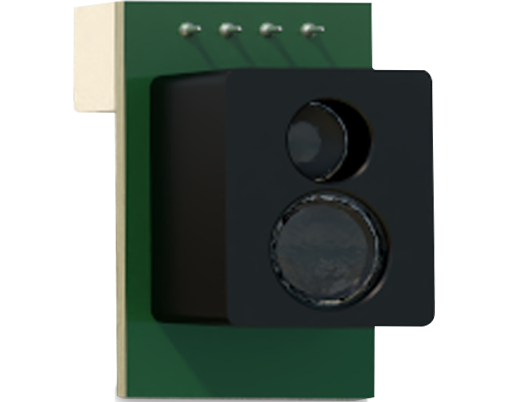
In the realm of industrial automation and precision measurement, red laser autofocus sensors have emerged as a cornerstone technology, enabling unparalleled accuracy and reliability. These sophisticated devices utilize a focused beam of red laser light, typically in the 650nm wavelength range, to determine the exact distance to a target surface. The core principle involves projecting a laser spot onto an object and analyzing the reflected light. By employing triangulation or confocal measurement techniques, the sensor calculates displacement or height variations with micron-level precision. This capability is critical in applications where maintaining a constant working distance is paramount, such as in semiconductor wafer inspection, precision machining, and automated optical assembly lines.
The operational advantages of red laser autofocus sensors are multifaceted. Their visible beam allows for straightforward alignment and setup, reducing commissioning time. Compared to other spectral ranges, red lasers offer a favorable balance of performance, cost, and eye-safety considerations under standard usage. Modern iterations integrate advanced CMOS or CCD detectors and high-speed processors, allowing them to track rapidly moving objects or surfaces with complex textures. Key performance metrics include sampling rate, often exceeding 10 kHz, linearity error of less than 0.1% of the measurement range, and a spot size that can be focused down to a few micrometers. This combination ensures stable performance even on challenging surfaces like transparent materials, shiny metals, or low-contrast objects, where traditional optical or capacitive sensors might fail.
Integration into automated systems is seamless, with standard industrial communication protocols like EtherCAT, PROFINET, and IO-Link. This facilitates real-time data exchange with PLCs and robotic controllers, enabling closed-loop control for processes such as laser welding, dispensing, or micro-drilling. For instance, in PCB manufacturing, these sensors dynamically adjust the Z-axis of a drilling head to compensate for board warpage, ensuring consistent via depth. In 3D scanning and profilometry, they serve as the foundational component for capturing high-resolution topographic data.

Selecting the appropriate red laser autofocus sensor requires careful analysis of the application environment. Factors such as the target material's reflectivity, surface roughness, required stand-off distance, and ambient light conditions must be evaluated. Manufacturers offer models with different measurement ranges, from a few hundred micrometers to several tens of millimeters. Protective housings with high IP ratings (e.g., IP67) are available for operation in harsh industrial environments with dust, coolants, or vibrations.
Looking ahead, the evolution of this technology is geared towards even greater miniaturization, higher speeds, and enhanced intelligence. The integration of AI-driven algorithms for surface classification and adaptive filtering is on the horizon, promising to further improve measurement stability and reduce setup complexity. As Industry 4.0 and smart factory concepts mature, the role of the red laser autofocus sensor as a critical enabler of precision and quality control will only become more pronounced, solidifying its status as an indispensable tool in the electrical and automation engineering landscape.