In the field of industrial automation, robotics, and advanced surveying, laser sensors have become indispensable tools for precise distance measurement. These sensors operate on the principle of emitting laser beams and analyzing the reflected light to calculate distance. The classification of laser sensors for distance measurement is primarily based on their underlying technology and operational methodology. Understanding these categories is crucial for selecting the right sensor for a specific application, considering factors such as range, accuracy, environmental conditions, and cost.
The most fundamental classification divides laser distance sensors into two broad categories: time-of-flight (ToF) sensors and triangulation-based sensors. Time-of-flight sensors, often considered for longer ranges, measure the time it takes for a laser pulse to travel to a target and back. The distance is calculated using the known speed of light. This category is further subdivided into pulsed ToF and phase-shift ToF sensors. Pulsed ToF sensors emit short, high-intensity laser pulses. They are ideal for very long-distance measurements, often exceeding hundreds of meters, and are commonly used in applications like aerial surveying (LiDAR), forestry, and large-scale construction. Their accuracy, however, can be influenced by the pulse width and the timing electronics. Phase-shift ToF sensors, on the other hand, emit a continuous wave of modulated laser light. They measure the phase difference between the emitted and reflected wave. These sensors typically offer higher accuracy than pulsed ToF for medium ranges (up to several hundred meters) and are widely used in industrial automation for positioning and level monitoring.

Triangulation-based laser sensors represent the other major class, excelling in short to medium-range applications demanding high precision. The operating principle involves projecting a laser spot onto the target surface. The reflected light is focused onto a position-sensitive detector (like a CCD or CMOS array) at a known angle. As the target distance changes, the position of the laser spot on the detector shifts. Using trigonometric calculations, the sensor determines the exact distance. These sensors are renowned for their exceptional accuracy, often in the micron or sub-micron range, but their effective range is limited, usually from a few millimeters to several meters. They are the workhorses in quality control, semiconductor manufacturing, and precision assembly lines where minute dimensional measurements are critical.
Beyond these primary categories, several specialized types exist. Confocal chromatic sensors use a white light source or a multi-wavelength laser. They measure distance based on the principle of chromatic aberration, where only a specific wavelength is perfectly focused on the target. The reflected light's wavelength is analyzed to determine distance. These sensors are particularly valuable for measuring transparent, shiny, or multi-layered surfaces where standard laser triangulation might fail. Interferometric sensors represent the pinnacle of precision, using the interference pattern of laser light waves to measure displacements with nanometer accuracy. They are primarily used in calibration laboratories, semiconductor lithography, and advanced scientific research, though their complexity and cost limit widespread industrial use.
Another important distinction is based on the type of laser used. While many sensors employ visible red lasers, others use infrared or blue lasers. The choice of wavelength affects performance. For instance, blue lasers have a shorter wavelength and scatter less on rough surfaces, potentially offering better performance for certain materials. Infrared lasers are often used in safety applications or where the laser beam should be invisible.
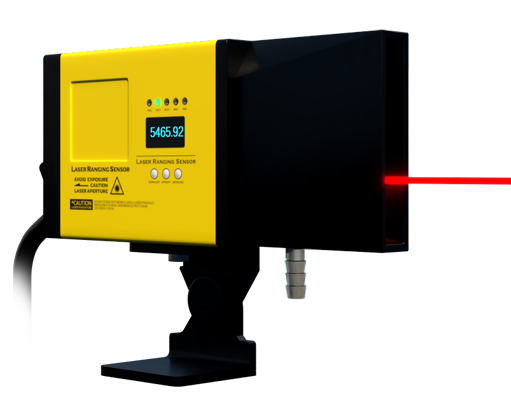
Selecting the appropriate laser distance sensor requires a careful analysis of the application's requirements. For long-range outdoor scanning, a pulsed ToF LiDAR sensor is likely the best choice. For high-speed, high-accuracy inspection on a factory floor, a triangulation sensor is indispensable. For measuring the thickness of a glass panel, a confocal sensor would be optimal. Environmental factors such as ambient light, dust, fog, and the target's surface properties (color, reflectivity, texture) must also be considered, as they can significantly impact the sensor's performance and reliability.
In conclusion, the landscape of laser distance measurement sensors is diverse and technologically rich. From robust, long-range ToF systems to exquisitely precise triangulation and confocal devices, each classification serves a distinct purpose in the modern technological ecosystem. A clear understanding of these classifications—Time-of-Flight (pulsed and phase-shift), Triangulation, Confocal Chromatic, and Interferometric—empowers engineers and technicians to make informed decisions, driving efficiency and innovation across countless industries. As technology advances, we can expect further refinement in these categories, with improvements in speed, accuracy, miniaturization, and cost-effectiveness.