In the realm of industrial automation, process control, and precision measurement, laser receiver sensors stand as critical components for detecting, measuring, and interpreting laser light signals. Unlike the laser emitter or source, the receiver is the "eye" of the system, converting optical information into reliable electrical data for system decision-making. This guide provides a thorough overview of laser receiver sensors, detailing their operating principles, primary types, key specifications, and dominant applications across various industries.
Fundamental Operating Principle
At its core, a laser receiver sensor functions by detecting incident laser light and converting its photons into an electrical signal. This process typically involves a photodetector, the heart of the receiver. Common photodetector technologies include Photodiodes (PD), Avalanche Photodiodes (APD), and Phototransistors. When laser photons strike the active area of these semiconductor devices, they generate electron-hole pairs, resulting in a photocurrent. This minute current is then amplified, conditioned (often through transimpedance amplifiers), and processed by subsequent circuitry. The receiver's electronics filter noise, interpret signal modulation (if present), and output a clean, usable signal—be it a digital switch signal, an analog voltage/current proportional to light intensity, or a precise timing pulse.

Primary Types of Laser Receiver Sensors
Laser receivers are categorized based on their functionality and the nature of the signal they process:

1. Digital/Switch Receivers: These are the most common type, used in presence detection and object counting. They provide a simple ON/OFF output. When the received laser intensity crosses a predefined threshold (set to distinguish the laser signal from ambient light), the output state changes. They are integral to safety light curtains and through-beam sensors.
2. Analog/Measuring Receivers: These sensors output a continuous signal (e.g., 0-10V, 4-20mA) proportional to the received light intensity. They are essential for applications like contrast detection, transparency measurement, distance measurement via triangulation, and monitoring material thickness or fill levels.
3. Position Sensitive Detectors (PSD): These specialized analog receivers do not just measure intensity but also the precise position where a laser spot strikes their surface. They output signals corresponding to the centroid of the light spot, enabling extremely high-resolution displacement and vibration measurement.
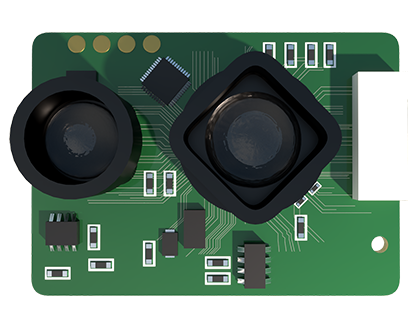
4. Time-of-Flight (ToF) Receivers: Used in LiDAR and laser rangefinders, these receivers are designed to detect the precise time at which a reflected laser pulse arrives. Their ultra-fast response is critical for calculating distance based on the speed of light.
5. Line/Array Receivers: These incorporate a linear or matrix array of photodetectors (like CCD or CMOS sensors). They are used in laser scanning systems for 2D/3D profiling, barcode reading, and alignment tasks, capturing the entire shape or pattern of a laser line.
Key Technical Specifications
Selecting the right receiver requires understanding its specifications:
* Spectral Response/Sensitivity: The wavelength range (e.g., 400-1100 nm for silicon) where the detector is most sensitive. It must match the laser's wavelength.
* Active Area: The size of the detecting surface, affecting alignment ease and field of view.
* Response Time/Rise Time: How quickly the sensor can respond to a change in light, crucial for high-speed counting or pulsed systems.
* NEP (Noise Equivalent Power) and Detectivity (D*): Metrics defining the minimum detectable signal, indicating sensitivity in low-light conditions.
* Output Type: Digital (NPN/PNP, push-pull), analog (voltage/current), or specialized (RS-422, Ethernet).
* Environmental Robustness: Ingress Protection (IP) rating, temperature range, and housing material for industrial durability.
Industrial Applications
Laser receiver sensors enable automation and precision in countless scenarios:
* Factory Automation: Object detection on conveyor belts, robotic guidance, part positioning, and break-to-beam safety systems.
* Metrology & Alignment: Precision leveling in construction, shaft alignment in machinery, and wafer alignment in semiconductor fabrication.
* Logistics & Packaging: Barcode and QR code scanning in sorting systems, package dimensioning, and fill-level control.
* Scientific & Medical: Used in confocal microscopy, flow cytometry, DNA sequencing instruments, and therapeutic device monitoring.
* Automotive & Aerospace: Integral to LiDAR for autonomous vehicles, vibration analysis on test benches, and component inspection.
Integration and Selection Considerations
Successful integration hinges on several factors. First, ensure spectral compatibility between laser and receiver. Second, consider the optical path: use lenses or apertures to control the field of view and reject stray ambient light. For analog systems, careful calibration against known references is vital. Environmental challenges like dust, fog, or extreme temperatures may necessitate protective housings or purging systems. Always consult the sensor's datasheet for required supply voltage, output load conditions, and connection diagrams.
In conclusion, laser receiver sensors are not passive components but sophisticated transducers that define the capability of a laser-based system. From simple on/off switching to micron-level displacement measurement, the choice of receiver directly impacts system performance, reliability, and accuracy. Understanding their principles and varieties is the first step toward designing robust and effective solutions for modern industrial challenges.