In the realm of industrial automation and control systems, proximity sensors are indispensable components, providing non-contact detection of metallic and, in some cases, non-metallic objects. A critical, yet often misunderstood, aspect of their operation is the phenomenon of oscillation damping. This article, written from the perspective of a seasoned electrical engineer, delves into the technical intricacies of this process, commonly referred to in industry parlance as the core operational principle of inductive proximity sensors.
At its heart, an inductive proximity sensor functions as a tuned oscillator circuit. A coil, wound around a ferrite core, forms the sensor's active face. This coil is part of an LC (inductor-capacitor) tank circuit, which is driven to oscillate at a high frequency, typically in the range of several hundred kilohertz to a few megahertz. In its normal state, with no target present, this circuit sustains a stable, high-amplitude oscillation. The system is designed to maintain this resonant state, consuming a specific amount of energy to overcome inherent circuit losses.
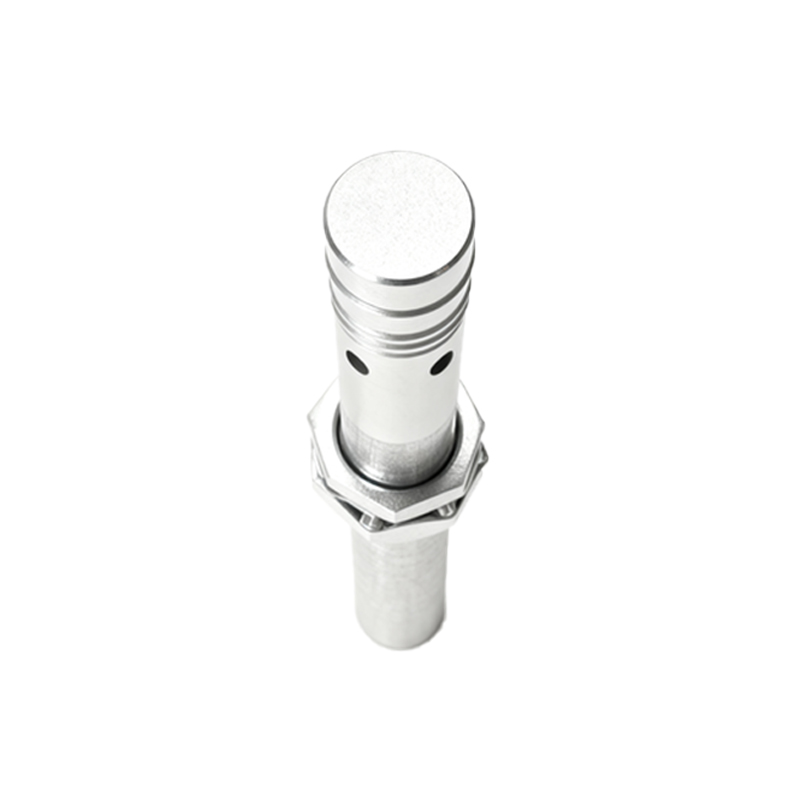
The pivotal event occurs when a conductive target, most commonly a ferrous or non-ferrous metal, enters the sensor's electromagnetic field. This field is generated by the oscillating current in the coil. According to Faraday's law of electromagnetic induction, eddy currents are induced on the surface of the target. These circulating currents are not free; they encounter the electrical resistance of the target material, leading to power loss in the form of heat (Joule heating). Crucially, these eddy currents generate their own opposing magnetic field, as described by Lenz's law. This secondary field interacts with the sensor's primary field.
This interaction is where the term "damping" becomes operationally precise. The energy required to generate these eddy currents is effectively drawn from the sensor's oscillator circuit. The opposing magnetic field alters the effective inductance (L) of the sensor coil. This change in inductance detunes the LC circuit, shifting it away from its resonant frequency. The combined effect of energy loss to the target and the detuning of the circuit results in a reduction of the oscillation amplitude. This reduction is what engineers term "oscillation damping" or "attenuation."
The degree of damping is not binary; it is directly proportional to several key factors. First is the target material's conductivity and permeability. Highly conductive materials like copper and aluminum induce strong eddy currents, causing significant damping even at greater distances. Ferrous materials (iron, steel), with their high magnetic permeability, also cause strong damping due to both eddy current losses and the alteration of the magnetic circuit's reluctance. Second is the distance between the target and the sensor's active face, known as the sensing distance. Damping increases exponentially as the target approaches. Third, the target's size and thickness play a role; a target larger than the sensor's face and of sufficient thickness will produce maximum damping.
The sensor's integrated electronics are designed to monitor this oscillation amplitude continuously. A threshold detection circuit, often a Schmitt trigger, is set to a specific trigger level. When the damping effect reduces the oscillation amplitude below this predefined threshold, the circuit interprets this as a "target present" condition. This triggers a change in the sensor's output state—switching a solid-state output (PNP/NPN) or a relay—which can then be used by a Programmable Logic Controller (PLC) or other control device to initiate an action, such as stopping a conveyor, counting parts, or verifying position.
Understanding damping is crucial for proper sensor selection and application. For instance, different sensor models are calibrated for different metals, often specified with a correction factor (e.g., sensing distance for steel is nominal, but must be reduced for stainless steel or aluminum). Engineers must also consider factors that can cause false damping, such the proximity of metal mounting brackets, excessive buildup of metallic dust on the sensor face, or the presence of other strong alternating magnetic fields, which can lead to erratic switching and system faults.
In summary, oscillation damping is not a flaw but the fundamental working principle of inductive proximity sensing. It is a sophisticated electromechanical process where a conductive target passively extracts energy from an oscillating system, leading to a measurable and controllable change in state. Mastery of this concept allows for the robust, reliable, and precise implementation of these sensors in demanding industrial environments, from packaging machinery and automotive assembly lines to material handling and robotic systems. It underscores the elegant synergy between basic physical laws and practical electronic design in modern industrial automation.