In the realm of industrial automation and precision measurement, specialized laser sensors stand as a cornerstone technology. Unlike their generic counterparts, these sensors are engineered for specific tasks, offering unparalleled accuracy, reliability, and performance in demanding environments. Their operation is fundamentally based on the principle of emitting a focused beam of coherent light—a laser—and analyzing the reflected signal. This analysis can measure distance, detect presence, profile contours, or gauge dimensions with micron-level precision.
The core technology hinges on several key methods. Time-of-Flight (ToF) sensors calculate distance by measuring the round-trip time of a laser pulse. Triangulation sensors, ideal for high-resolution short-range measurements, use a laser point, a receiver lens, and a position-sensitive detector to determine distance based on the angle of the reflected beam. Confocal chromatic sensors utilize white light, where only a specific wavelength is in perfect focus on the target, providing exceptional resolution for surface topology and thickness measurement. Laser contrast sensors are optimized to detect marks or differences on surfaces regardless of color or material by evaluating the contrast between the laser spot and its background.
The applications of specialized laser sensors are vast and critical across industries. In automotive manufacturing, they perform 100% inline inspection of weld seams, measure critical engine component clearances, and ensure perfect paint thickness. The electronics sector relies on them for solder paste inspection, chip placement verification, and microscopic circuit board profiling. In pharmaceutical packaging, laser sensors verify fill levels in opaque vials, check cap placement, and read tiny codes on blister packs with absolute certainty. Logistics and warehousing employ them for high-speed dimensioning of parcels and precise guidance of autonomous mobile robots (AMRs). Furthermore, in heavy industries like metal processing, they monitor roll gap distances and sheet flatness in real-time, directly impacting product quality.

Selecting the appropriate specialized laser sensor requires a meticulous analysis of the application parameters. Key considerations include:
1. Measurement Range and Standoff: The required distance between the sensor and the target.
2. Resolution and Accuracy: The smallest detectable change and the deviation from the true value, respectively. Sub-micron resolutions are common.

3. Spot Size: A smaller spot allows for finer feature detection but requires more precise alignment.
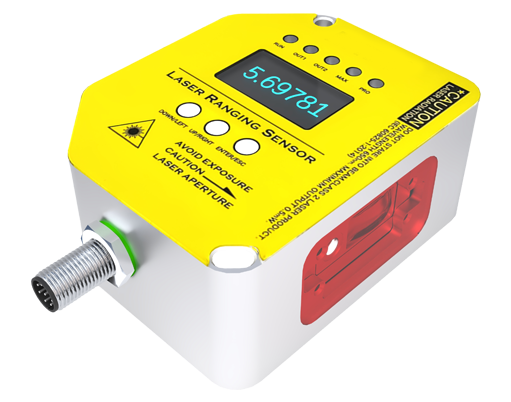
4. Target Material and Surface: Highly reflective, dark, transparent, or rough surfaces pose different challenges. Certain sensors are specifically designed for difficult surfaces like hot metals or glass.
5. Environmental Conditions: Resistance to dust, coolant, oil, vibration, and ambient light interference is crucial for industrial durability. Many sensors feature IP67 or higher ratings.
6. Output and Interface: Required communication protocols (IO-Link, Ethernet/IP, PROFINET) and analog/digital outputs must integrate with the existing control system.
7. Speed: The sensor's sampling rate must match the production line speed for reliable in-process control.
Integration is more than just mounting and wiring. Proper alignment using precision fixtures is paramount. The setup software, often provided by the manufacturer, allows for configuring measurement windows, filtering, and output logic. Regular calibration against a master standard ensures long-term stability. It is also vital to implement safety measures, as even low-power laser sensors are classified and require appropriate labeling and safeguards to protect operator eyesight.
The future trajectory of specialized laser sensors points towards greater intelligence and connectivity. The integration of embedded processors and AI algorithms enables sensors to perform complex classification and decision-making at the edge, reducing PLC load. Enhanced connectivity through Industrial IoT (IIoT) frameworks allows for predictive maintenance, where the sensor itself can report degradation in performance before a failure occurs. Furthermore, advancements in blue and violet laser diodes offer better performance on organic materials and reduced sensitivity to ambient infrared light.
For engineers and system integrators, mastering the capabilities and selection criteria of specialized laser sensors is no longer optional but essential. They are the eyes of modern automated systems, transforming physical parameters into actionable, high-fidelity data. By carefully matching the sensor's specialized strengths to the specific application challenge, one can achieve new levels of quality control, efficiency, and operational intelligence, driving forward the frontiers of precision manufacturing and automation.