In the realm of industrial automation, proximity sensors stand as fundamental components, enabling non-contact detection of objects with precision and reliability. Among the various configurations, the 24V DC proximity sensor has emerged as a de facto standard in countless applications. This article delves into the operational principles, key types, selection criteria, and practical considerations for deploying 24V proximity sensors effectively.
At its core, a proximity sensor detects the presence or absence of an object within its sensing range without physical contact. The 24V DC power specification is particularly favored in industrial environments for several compelling reasons. Firstly, it represents a safe low-voltage level, reducing risks associated with electrical shock compared to higher voltage systems. Secondly, 24V DC is a common output from standard industrial power supplies and Programmable Logic Controller (PLC) modules, ensuring seamless integration into existing control architectures. This voltage level offers a robust signal-to-noise ratio, providing stable operation even in electrically noisy plant environments, a critical factor for maintaining operational integrity.
The working principle varies based on the sensor type. The most prevalent categories are inductive, capacitive, and ultrasonic. Inductive proximity sensors are the workhorses for metal detection. They generate an electromagnetic field; when a metallic object enters this field, it causes a change in oscillation amplitude, which the sensor's circuitry detects and converts into a switching signal. These sensors are ideal for detecting ferrous and non-ferrous metals in applications like machine tooling, conveyor systems, and robotic arms. Capacitive sensors, on the other hand, can detect both metallic and non-metallic materials (plastics, wood, liquids) by measuring changes in capacitance. They are commonly used for level detection in tanks or for sensing materials through non-metallic container walls. Ultrasonic sensors use sound waves to detect objects and measure distance, suitable for challenging environments with dust, smoke, or varying colors.
Selecting the appropriate 24V proximity sensor requires careful analysis of several parameters. The sensing distance, or nominal range, is paramount. It is crucial to note that the effective sensing distance can be influenced by the target material's properties, particularly for inductive sensors. Factor of safety, typically 0.6 to 0.8 of the nominal range, should be applied in design to account for temperature fluctuations, voltage tolerances, and part wear. The output configuration is another critical choice. Sensors are available with NPN (sinking) or PNP (sourcing) transistor outputs, as well as Normally Open (NO) or Normally Closed (NC) contact logic. The selection must align with the input requirements of the connected controller (e.g., PLC). Physical housing design, such as cylindrical barrels (e.g., M8, M12, M18, M30 threaded barrels) or rectangular shapes, is chosen based on mounting constraints and environmental protection needs, denoted by IP (Ingress Protection) and NEMA ratings.
Installation and wiring demand attention to detail. Adherence to the manufacturer's datasheet for wiring is non-negotiable. For a standard 3-wire 24V DC sensor, the connections are typically: brown wire to 24V+, blue wire to 0V common, and the black (or white) wire as the switched output signal to the PLC input. Proper shielding and routing of cables away from high-power lines are essential to prevent electromagnetic interference. Furthermore, considering the sensor's switching frequency is vital for high-speed applications to ensure it can keep pace with the process.
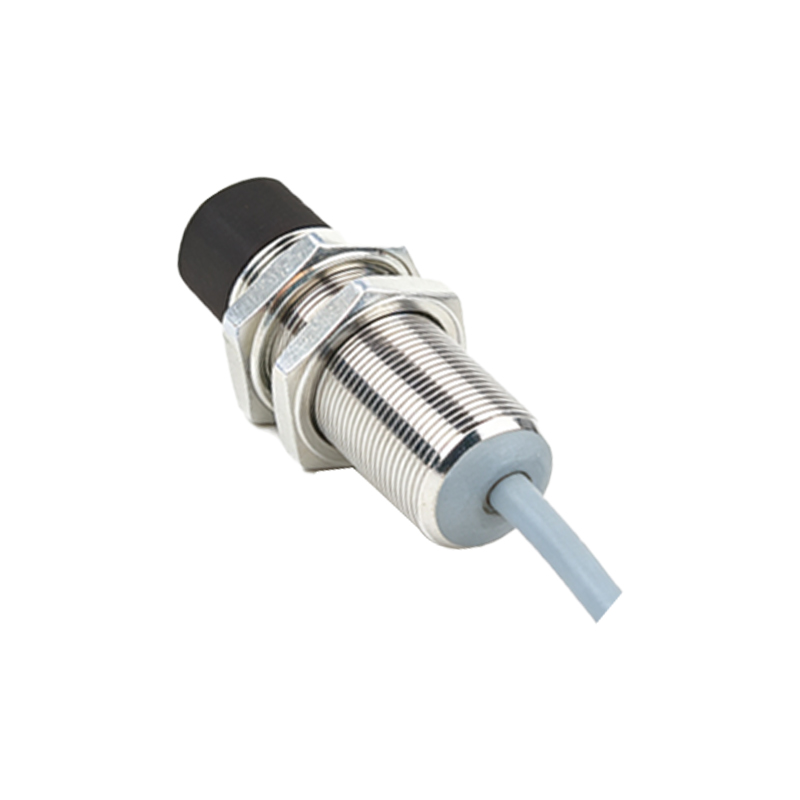
In practice, 24V proximity sensors are ubiquitous. They provide precise position feedback for cylinders, count products on high-speed packaging lines, ensure safety by confirming guard doors are closed, and verify the presence of components in assembly jigs. Their robustness, long service life (due to the absence of mechanical contacts), and immunity to environmental contaminants like oil and coolant make them indispensable.
In conclusion, the 24V DC proximity sensor is a cornerstone of modern industrial control. A deep understanding of its technology, coupled with meticulous selection and installation practices, empowers engineers to build reliable, efficient, and safe automated systems. As Industry 4.0 advances, these sensors continue to evolve with enhanced diagnostics and IO-Link communication capabilities, further solidifying their role in the connected factory of the future.