In the rapidly evolving landscape of industrial automation and quality control, wireless laser distance sensors have emerged as a pivotal technology, transforming how professionals measure, monitor, and manage spatial parameters with unprecedented accuracy and flexibility. Unlike traditional wired sensors, these advanced devices leverage laser triangulation or time-of-flight principles to deliver non-contact, high-precision distance measurements, all while operating free from the constraints of physical cabling. This wireless capability not only simplifies installation in complex or hazardous environments but also significantly reduces maintenance costs and downtime associated with cable wear and tear.
The core operational principle of a wireless laser distance sensor typically involves emitting a focused laser beam toward a target surface. The reflected light is then captured by a receiver within the sensor. By calculating the phase shift or time delay of the returned signal, the sensor determines the exact distance to the target with resolutions often down to the micrometer level. This high degree of precision is crucial in applications such as robotic guidance, where exact positioning is essential, or in structural health monitoring, where detecting minute deformations can prevent catastrophic failures.
One of the most compelling advantages of wireless laser sensors is their seamless integration into the Industrial Internet of Things (IIoT) ecosystem. Equipped with robust communication protocols like Bluetooth, Wi-Fi, or proprietary industrial wireless networks, these sensors can transmit real-time data to centralized control systems, cloud platforms, or mobile devices. This enables continuous remote monitoring and data analytics, allowing engineers to make informed decisions promptly. For instance, in a manufacturing plant, wireless laser sensors can track the dimensions of products on a conveyor belt, instantly flagging any deviations from tolerance limits and triggering corrective actions without human intervention.
Moreover, the application scope of wireless laser distance sensors is remarkably diverse. In the construction industry, they facilitate accurate surveying and alignment of structures, ensuring projects adhere to design specifications. In logistics and warehousing, they optimize inventory management by precisely measuring package dimensions for storage and shipping calculations. Even in challenging environments—such as high-temperature foundries, vibrating machinery platforms, or cleanrooms where contamination must be minimized—wireless laser sensors perform reliably, thanks to their rugged designs and immunity to electromagnetic interference.
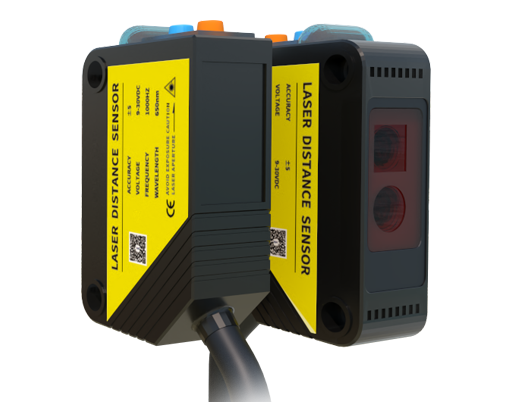
Despite their numerous benefits, selecting the right wireless laser distance sensor requires careful consideration of several technical parameters. Range, accuracy, response time, and environmental ratings (like IP67 for dust and water resistance) must align with specific operational demands. Additionally, power management is critical; while wireless sensors eliminate power cables, they rely on batteries or energy-harvesting techniques, necessitating a balance between performance and battery life. Modern sensors often incorporate low-power modes and efficient data transmission algorithms to extend operational periods, sometimes lasting years on a single battery charge.
Looking ahead, advancements in laser technology, miniaturization, and wireless communication are set to further enhance the capabilities of these sensors. The integration of artificial intelligence for predictive maintenance and adaptive calibration will likely become standard, pushing the boundaries of autonomous industrial systems. As industries worldwide strive for greater efficiency, safety, and connectivity, wireless laser distance sensors stand as a cornerstone technology, driving innovation and precision in measurement. Their ability to deliver reliable, real-time data without physical ties not only streamlines operations but also opens new possibilities for smart automation, ultimately contributing to smarter, more responsive industrial environments.