Laser sensor grating technology represents a critical advancement in precision measurement and detection within industrial automation. At its core, this technology utilizes the principle of optical diffraction through a grating structure to achieve high-resolution displacement, position, and velocity sensing. A laser sensor typically emits a coherent light beam onto a reflective or transmissive grating scale, which consists of a series of finely spaced parallel lines. When the laser light interacts with this periodic structure, it produces a diffraction pattern. The resulting interference of diffracted light waves generates a sinusoidal optical signal, whose phase shifts as the grating moves relative to the sensor head.
The fundamental operation relies on the grating equation: \( n\lambda = d(\sin\theta_i + \sin\theta_m) \), where \( \lambda \) is the laser wavelength, \( d \) is the grating period, \( \theta_i \) is the angle of incidence, and \( \theta_m \) is the diffraction angle for order \( n \). In practical industrial sensors, often a two-beam interferometric method is employed. Here, the ±1st order diffracted beams are recombined to create an interference fringe pattern. Photodetectors within the sensor convert these optical fringes into electrical signals—typically two channels in quadrature (sine and cosine waveforms). By analyzing the phase relationship and counting the fringe transitions, the system determines displacement direction and magnitude with sub-micron accuracy.
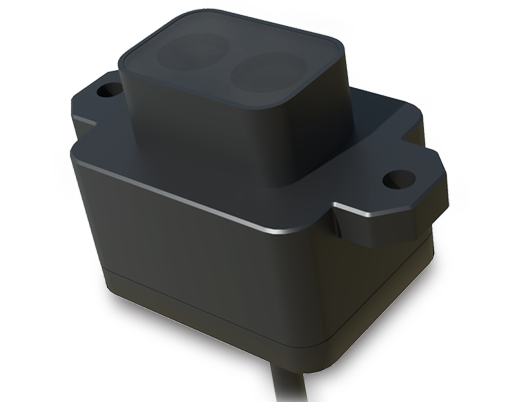
Key components include the laser diode as a stable light source, the grating scale (commonly made of glass or metal with chrome lines), collimating optics, and photodiode arrays. Modern designs often integrate signal processing electronics for real-time interpolation, enhancing resolution beyond the basic grating pitch. For instance, a grating with a 20 µm pitch can achieve 10 nm resolution through electronic interpolation.

Applications span across CNC machine tools, semiconductor manufacturing, robotics, and coordinate measuring machines. In CNC systems, linear encoders with laser grating sensors provide closed-loop feedback for precise axis control, compensating for mechanical errors like backlash and thermal drift. Rotary versions, using radial gratings, enable accurate angle measurement in servo motors. Environmental robustness is addressed through protective sealing against contaminants, and temperature compensation algorithms maintain accuracy under varying conditions.
Advantages over alternative technologies (such as magnetic or capacitive sensors) include non-contact operation, immunity to electromagnetic interference, and exceptional long-term stability. However, challenges like sensitivity to optical contamination or mechanical vibration necessitate careful installation. Ongoing innovations focus on miniaturization, higher-speed signal processing for dynamic measurements, and integration with Industry 4.0 digital interfaces for predictive maintenance analytics. Understanding these principles allows engineers to optimize sensor selection and implementation, ensuring reliable performance in demanding industrial environments where precision is paramount.
