In modern industrial automation, labeling machines play a crucial role in product identification, tracking, and branding. Among the various components that ensure their precision and efficiency, laser sensors stand out as a key enabling technology. This article delves into the working principles, types, and critical applications of laser sensors in labeling machinery, offering insights for engineers and system integrators.
Laser sensors in labeling machines primarily function as non-contact detection devices. They emit a focused beam of light—typically from a laser diode—toward a target surface. The reflected light is then captured by a receiver within the sensor. By analyzing the properties of the reflected beam, such as its intensity, time-of-flight, or triangulation data, the sensor can accurately determine the presence, position, distance, or even the surface characteristics of an object. This capability is fundamental for tasks like label gap detection, web break monitoring, and precise label placement.

There are several common types of laser sensors deployed in labeling systems. Diffuse reflective sensors are widely used for detecting labels on a roll. They measure the contrast between the reflective backing (often a liner) and the less reflective label gap or edge. The sensor's output triggers the labeling head to apply the label at the exact moment. Through-beam sensors, consisting of separate emitter and receiver units, are excellent for detecting transparent film labels or verifying that a product has passed a specific point before labeling. Background suppression sensors use triangulation to ignore reflections from distant backgrounds, making them ideal for detecting objects on conveyor belts with varying distances or complex backgrounds.
The integration of laser sensors significantly enhances labeling machine performance. Accuracy and Repeatability: Modern laser sensors offer sub-millimeter resolution, ensuring labels are applied consistently at the correct position, which is vital for high-speed production lines in industries like pharmaceuticals and food & beverage. Speed: High-response laser sensors can detect objects and trigger actions in microseconds, supporting line speeds exceeding hundreds of products per minute. Reliability: Unlike mechanical contact sensors, laser sensors have no moving parts, leading to reduced wear, minimal maintenance, and higher uptime. They are also less susceptible to environmental factors like dust or mild vibrations when properly housed.
Key applications include:
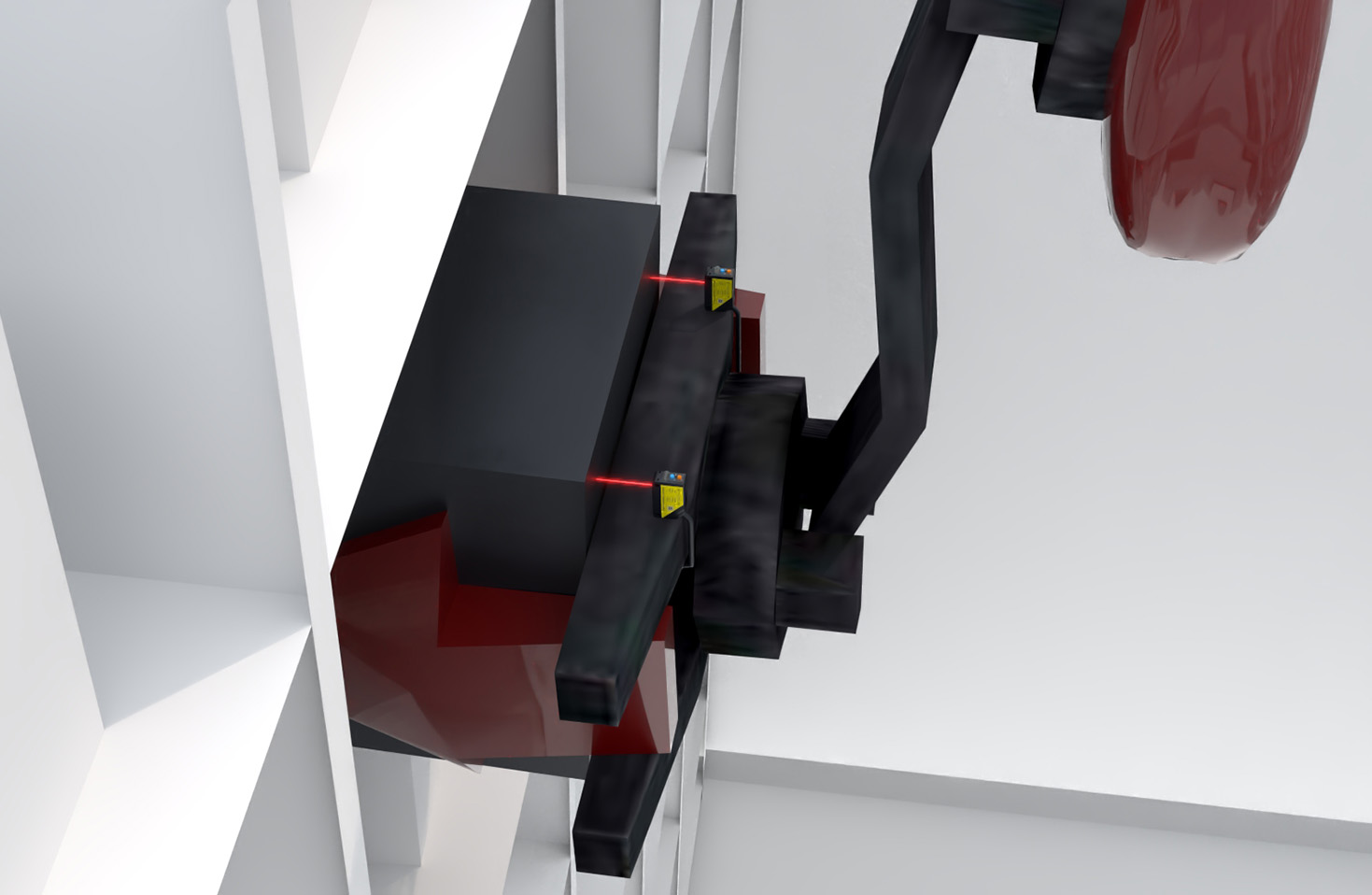
1. Label Gap/Edge Detection: The most common application. The sensor scans the label roll, identifies the gap between labels, and sends a signal to cut or dispense the label.
2. Product Presence Sensing: Verifies a product is correctly positioned on the conveyor before the labeling cycle begins, preventing wasted labels and mislabeling.
3. Print Registration Mark Detection: In print-and-apply systems, a laser sensor detects a printed registration mark on the label web to ensure the printed information is correctly aligned before application.

4. Web Break Monitoring: Monitors the continuity of the label material (web). A break in the web that interrupts the laser beam triggers an immediate machine stop to prevent jams.
When selecting a laser sensor for a labeling machine, engineers must consider several parameters: sensing range, spot size, response time, output type (e.g., digital PNP/NPN, analog), and environmental ratings (IP67 for washdown areas). The choice of red laser or visible laser light depends on the material; some colored or transparent materials may require a specific wavelength for optimal detection.
Future trends point toward smarter, more integrated sensors. The adoption of IO-Link communication allows for digital parameter setting, remote diagnostics, and condition monitoring, facilitating predictive maintenance. Furthermore, miniaturization of sensor components enables their installation in increasingly compact labeling heads.
In conclusion, laser sensors are indispensable for the precision, speed, and reliability of contemporary labeling machines. Their non-contact operation, high accuracy, and versatility solve critical challenges in automated packaging lines. A thorough understanding of their operation and careful selection based on the application are essential for optimizing labeling system performance and ensuring seamless production flow.