Side-mounted proximity sensors, a specialized category within the broader family of non-contact sensing devices, are engineered to detect the presence or absence of an object along their lateral sensing face. Unlike traditional front-sensing proximity switches, these sensors are designed with their sensing field projecting from the side of the housing, making them ideal for applications with spatial constraints where direct frontal approach is not feasible. The operational principle hinges on the generation of an electromagnetic field or an optical beam from the lateral surface, with detection occurring through changes in this field or beam when a target enters the predefined sensing range.
The most prevalent technology employed in side-mounted proximity sensors is the inductive principle. These inductive sensors generate a high-frequency oscillating electromagnetic field from a coil located within the side-facing sensing element. When a metallic target, such as steel, aluminum, or copper, enters this field, eddy currents are induced on the surface of the target. These eddy currents draw energy from the sensor's oscillator, resulting in a measurable amplitude reduction or a frequency shift in the oscillation. An internal circuit, typically comprising a trigger stage and an output amplifier, monitors this change. Once the change surpasses a defined threshold, it triggers the switching of the sensor's output state—either from OFF to ON (normally open) or from ON to OFF (normally closed). This solid-state output can control external devices like PLCs, relays, or indicators. Key performance parameters include sensing distance, which is standardized (e.g., 2mm, 5mm, 10mm) and influenced by the target material's properties and size, as well as factors like hysteresis (the difference between the switch-on and switch-off points) to prevent chatter, and operating frequency (switching speed).
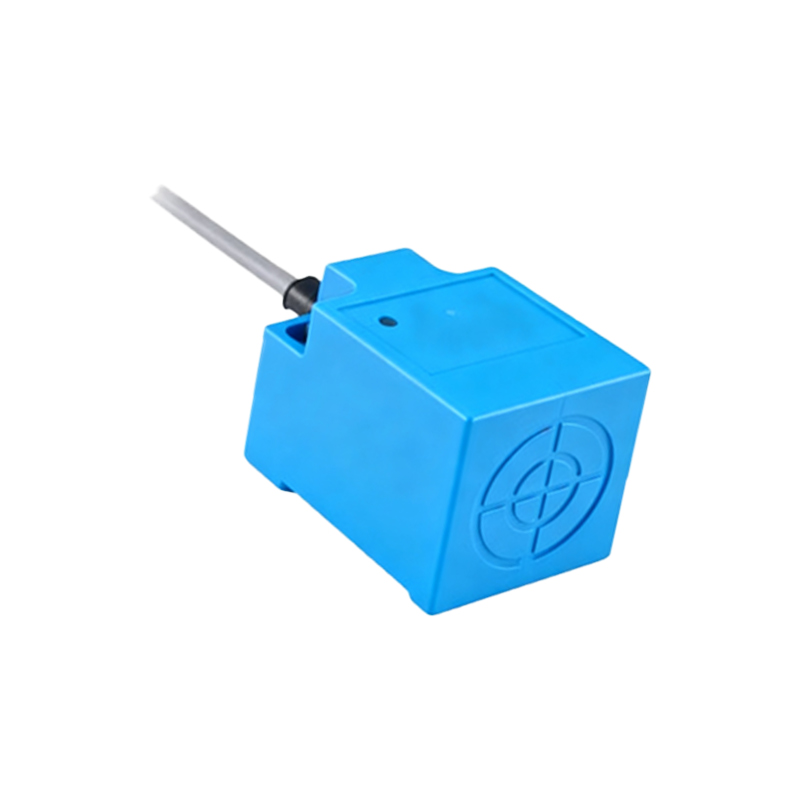
For non-metallic object detection, such as plastics, wood, or liquids, capacitive side-mounted sensors are utilized. They function by generating an electrostatic field from the side-mounted electrode. Any object, regardless of material, that enters this field alters the dielectric constant and thus the capacitance of the system. This capacitance change is detected by the internal circuitry, leading to an output switch. These sensors are particularly valuable in packaging, material handling, and level detection applications.
Another critical variant is the side-looking photoelectric sensor. These use an infrared or visible light beam emitted from a lateral window. The most common types are diffuse reflective sensors, where the sensor's receiver detects light reflected directly from the target, and through-beam sensors, which employ a separate reflector or a separate emitter and receiver unit to detect beam interruption. The key advantage is the precise detection of objects irrespective of their material composition (metal or non-metal), provided there is sufficient reflectivity or opacity.
The design and selection of a side-mounted proximity sensor require careful consideration of several application-specific factors. The housing material, often made of robust plastics like PBT or metals like stainless steel, must withstand the industrial environment, including exposure to coolants, oils, and physical impacts. Environmental ratings, notably the IP (Ingress Protection) code (e.g., IP67), indicate the level of protection against dust and water immersion, which is crucial for washdown areas in food and beverage or pharmaceutical industries. Electrical characteristics are equally vital: the operating voltage range (commonly 10-30V DC or 90-250V AC), output type (PNP/NPN for DC, or relay/SSR for AC), and connection method (pre-wired cable or quick-disconnect connector). Proper mounting is essential to ensure the specified sensing performance; recessed mounting can reduce the effective sensing distance but offers protection against mechanical damage, while non-recessed mounting provides the full nominal range.
In practical industrial automation, side-mounted sensors find extensive use in position verification, counting, and end-of-travel detection on linear actuators and cylinders where space beside the moving part is available. They are indispensable in conveyor systems for detecting the edge of materials or small components, in robotic arms for tool presence verification, and in assembly machines for part orientation checks. Their lateral sensing orientation allows for a more compact machine design, eliminating the need for additional clearance in front of the sensor. Maintenance primarily involves ensuring the sensing face remains clean from debris, metal chips, or buildup that could cause false triggering, and periodically verifying the switching distance and output signal integrity.
In summary, side-mounted proximity sensors offer a reliable and space-efficient solution for lateral object detection across diverse industries. Their operation, based on well-established electromagnetic or optical principles, provides high switching accuracy and repeatability. Understanding the nuances of inductive, capacitive, and photoelectric technologies, along with key specifications and environmental ratings, is fundamental for engineers to select and apply the optimal sensor, thereby enhancing the reliability and efficiency of automated systems.