In the realm of industrial automation and precision measurement, laser autofocus sensors have become indispensable tools. Their ability to maintain precise focus on a target surface, regardless of variations in distance or material, hinges on a sophisticated interplay of specialized components. This article delves into the core accessories and parts that constitute a high-performance laser autofocus system, explaining their functions and importance in ensuring operational reliability and accuracy.
At the heart of the system lies the laser diode. This component emits a coherent, low-power laser beam, typically in the visible red or infrared spectrum. The choice of wavelength is critical, as it affects the beam's visibility, absorption by different materials, and safety classifications. Industrial-grade diodes are selected for their stability, long service life, and consistent output power, which directly influences the sensor's measurement range and signal-to-noise ratio.
The emitted laser light passes through a series of optical lenses. These are not simple glass pieces but precision-engineered elements. Collimating lenses shape the divergent laser beam into a parallel, focused spot. Any imperfection here can lead to beam distortion, reducing measurement accuracy. Protective windows, often made of durable sapphire or coated glass, shield the internal optics from dust, coolant, and debris in harsh factory environments. Keeping these windows clean is a simple yet vital maintenance task.

A critical differentiating component is the position-sensitive detector (PSD) or a CMOS/CCD imaging sensor. This is the "eye" of the autofocus system. As the reflected laser beam returns, its position on this detector shifts if the target distance changes. The PSD provides an analog signal corresponding to the centroid of the light spot, offering very high-speed response. In contrast, CMOS-based systems capture an image of the spot, allowing for more advanced processing to handle difficult surfaces but potentially at slightly lower speeds. The choice depends on the required balance between speed, resolution, and surface compatibility.
The signal processing circuitry is the brain. This printed circuit board (PCB) hosts microprocessors, analog-to-digital converters (ADCs), and dedicated algorithms. It interprets the minute electrical signals from the detector, calculates the defocus error, and generates a correction output. This output is typically a digital command (like RS-485 or Ethernet/IP) or an analog signal (0-10V) sent to a motion stage's servo drive to adjust the Z-axis height. Robust filtering algorithms within this circuitry are essential to ignore vibration noise and cope with varying surface reflectivities.
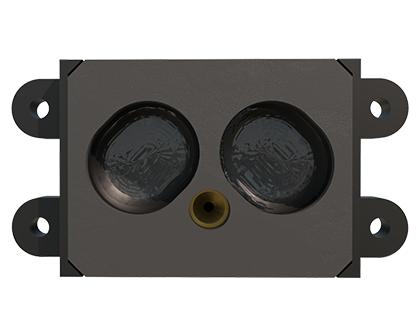
Housing and mechanical parts provide the structural integrity. Made from aluminum alloys or stainless steel, the housing protects internal components from electromagnetic interference (EMI), physical impact, and thermal fluctuations. Precision-machined mounting brackets and adjustable fixtures allow for exact alignment during installation. Connectors, such as M8 or M12 industrial-grade types, ensure reliable power and communication links, resistant to moisture and vibration.
Furthermore, specialized accessory kits are often crucial. Calibration targets, with known reflectivity and geometry, are used for initial setup and periodic verification. Extension cables of appropriate shielding and length maintain signal integrity over longer distances. For applications involving high-temperature environments, active air purge kits or cooling fins can be attached to prevent lens fogging and component overheating.
The performance of a laser autofocus sensor is a symphony conducted by its components. A weak laser diode, a dirty lens, a noisy detector, or poor signal processing can each become the single point of failure. Therefore, understanding these parts is not merely academic for engineers and maintenance personnel. It informs better selection criteria—matching wavelength to material, choosing the right detector type for surface finish, and ensuring adequate protection for the environment. It also guides effective troubleshooting and preventive maintenance schedules, minimizing costly downtime.
As industries push for finer tolerances in micro-machining, PCB inspection, and 3D printing, the demand on these components grows. Future trends point towards miniaturization of optics, integration of more powerful onboard processors for edge computing, and the development of blue-violet lasers for finer spot sizes on organic materials. The continuous evolution of these fundamental accessories will drive the next generation of even more precise and robust laser autofocus solutions, solidifying their role as a cornerstone of modern smart manufacturing.