In the world of automation, consumer electronics, and industrial safety, proximity sensors are indispensable components. While their operating principles—inductive, capacitive, ultrasonic, or photoelectric—often take center stage in discussions, the physical size of these sensors is a critical, yet frequently overlooked, parameter. The dimensions of a proximity sensor directly influence its suitability for an application, impacting everything from installation feasibility to detection performance and system design. Understanding sensor size is not merely about fitting into a space; it's about optimizing the entire sensing solution.
The size of a proximity sensor is primarily dictated by its sensing technology and its intended sensing range. Inductive sensors, designed to detect metallic objects, typically house a coil and oscillator circuit. A fundamental rule is that the diameter of the sensor's active face is proportional to its nominal sensing range. A small 4mm diameter cylindrical sensor might offer a 1mm range, perfect for detecting the position of a tiny gear tooth. In contrast, a large 30mm diameter sensor could provide a 15mm range, suitable for detecting the presence of a metal pallet on a conveyor. Miniaturization in this category has been significant, with "micro" sensors now available in housings as small as M3 (3mm diameter), enabling their use in extremely confined spaces like robotic grippers or precision assembly equipment.
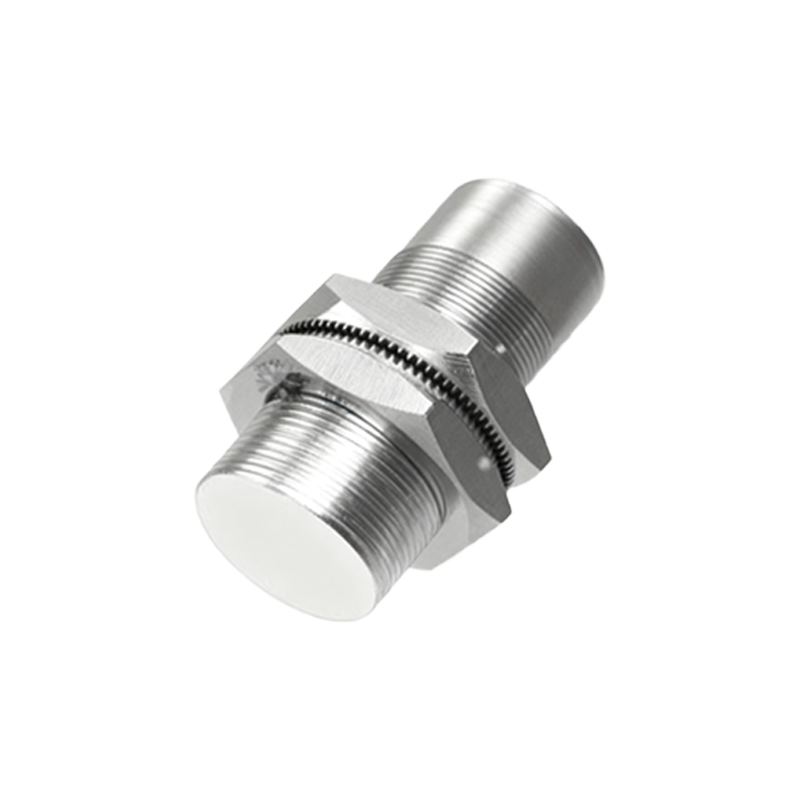
Capacitive sensors, which can detect both metallic and non-metallic materials, often have similar form factors to their inductive counterparts but may require a larger sensing electrode, influencing their housing size for a given range. Photoelectric sensors, using light beams, show a different relationship. Their size is more influenced by the complexity of their optics (e.g., through-beam vs. diffuse reflective), the need for separate emitter and receiver units, and the inclusion of advanced features like background suppression. Ultrasonic sensors, which measure distance using sound waves, generally require a transducer of a certain size to emit and receive the sonic pulse effectively, making them physically larger for longer ranges.
The implications of sensor size are profound. First, installation constraints are paramount. In modern machinery, space is at a premium. Compact sensors allow for more flexible mounting in dense control panels, tight machine frames, or small consumer devices like smartphones (where the proximity sensor that turns off the screen during a call is remarkably tiny). The choice of housing shape—cylindrical (threaded barrel), rectangular, or slot-style—is also a size-related decision that depends on the mounting environment.
Second, performance is intrinsically linked to size. For inductive and capacitive sensors, a larger active sensing face generally provides a more stable and slightly extended sensing field. It can also be less susceptible to misalignment. However, a smaller sensor offers a more precise, localized detection point, which is crucial for discriminating between closely spaced objects or detecting very small parts. The "blind zone" immediately in front of the sensor is also a consideration; its characteristics can vary with sensor design and size.
Third, sensing range and size have a direct trade-off. Engineers cannot arbitrarily demand a sub-miniature sensor with a very long range. Physics imposes limits. Achieving a longer range typically requires more energy, larger coils, or bigger transducers, which increases size. Selecting a sensor always involves balancing the required detection distance with the available physical space.
When selecting a proximity sensor, considering size involves several key steps:
1. Measure the Available Space: Determine the maximum dimensions (diameter, length, width) for the sensor body and any necessary clearance for wiring or mounting hardware.
2. Define the Required Sensing Range: Establish the exact distance at which the target must be reliably detected.
3. Identify the Target Object: Its material, size, and shape will dictate the sensor technology (inductive, capacitive, etc.), which in turn influences the size options.
4. Review Housing and Connection Styles: Standard cylindrical sensors (e.g., M8, M12, M18, M30 threads) offer a wide range of sizes. Rectangular or block-style housings provide different mounting options. The size and type of the electrical connection (pre-wired cable, quick-disconnect) also contribute to the overall footprint.
5. Consider Environmental Factors: In harsh environments, a sensor might need a robust, oversized housing for protection, even if its core sensing element is small.
In conclusion, the size of a proximity sensor is a fundamental specification that goes hand-in-hand with its technical capabilities. It is a key determinant in the sensor's application potential. From massive ultrasonic sensors monitoring bulk material levels to microscopic inductive chips embedded in wearable devices, the scale varies dramatically. A successful design does not simply choose the smallest sensor available; it selects the optimally sized sensor that delivers reliable performance within the spatial, functional, and economic constraints of the project. Ignoring the dimension factor can