In the realm of industrial automation and precision measurement, laser sensors have become indispensable tools. A critical, yet often overlooked, aspect of their performance is their interaction with different surface types, particularly matte surfaces. Unlike glossy or specular surfaces that reflect light in a direct, mirror-like manner, matte surfaces diffuse incident light. This fundamental difference poses unique challenges and opportunities for laser sensor technology. This article delves into the principles behind laser sensing on matte surfaces, explores key applications, and provides guidelines for optimal sensor selection.
The core principle of a typical laser sensor, such as a triangulation or time-of-flight sensor, involves emitting a laser beam towards a target and analyzing the reflected light. On a glossy surface, the beam reflects at a predictable angle, allowing for precise point measurement. However, on a matte surface, the microscopic roughness causes the light to scatter in many directions. This scattering, known as Lambertian reflection, creates a diffuse reflection pattern. For a sensor, this means the returning light signal is weaker and spread over a wider area. Advanced sensors are engineered to handle this diffusion. They utilize high-sensitivity receivers and sophisticated algorithms to locate the centroid or peak intensity of the scattered light spot, thereby determining distance or presence accurately. The wavelength of the laser also plays a role; red or blue lasers may interact differently with various matte materials, affecting signal strength.
The very characteristic that makes matte surfaces challenging also makes them ideal for certain applications. In robotics and automated guided vehicles (AGVs), matte floor tapes or markers are used for navigation. The diffuse reflection from these matte markers provides a consistent, glare-free signal that the vehicle's laser scanners can reliably detect, even under varying ambient light conditions. In 3D scanning and profilometry, a matte coating is often applied to shiny objects. This coating eliminates problematic specular highlights and hot spots, ensuring the laser scanner captures the true geometry of the object without distortion caused by direct reflections. Furthermore, in packaging and logistics, laser sensors excel at detecting the presence or position of cardboard boxes, textiles, and untreated wood—all inherently matte materials. Their ability to ignore minor surface sheen variations ensures robust performance.
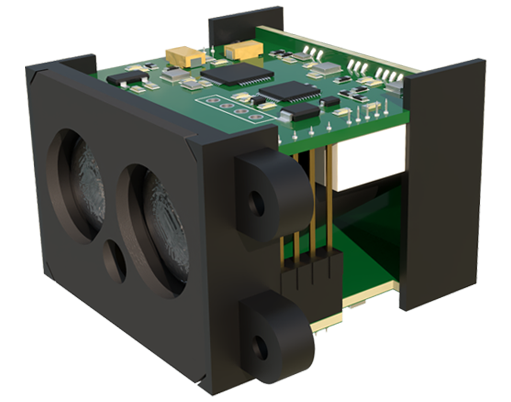
Selecting the right laser sensor for matte surface applications requires careful consideration of several technical parameters. First, the sensor's operating principle is paramount. Diffuse reflection sensors, specifically designed for non-cooperative surfaces, are typically the best choice. They often feature a high-power laser diode to compensate for signal loss due to diffusion. Second, the sensing range and spot size must be evaluated. A larger spot size can be beneficial on very rough matte surfaces as it integrates over a larger area, providing a more stable average signal. However, for precision measurement, a focused spot remains necessary. Third, background suppression capability is crucial. A sensor with strong background suppression will ignore distant objects or the background, locking onto the diffuse reflection from the target matte surface only. Finally, environmental factors like dust, dirt, or color variations of the matte surface itself can affect performance. Sensors with automatic exposure control or teach-in functions can adapt to different surface reflectivities, maintaining accuracy across light gray to dark black matte materials.

In conclusion, matte surfaces are not obstacles but rather common working environments for modern laser sensors. By leveraging the principles of diffuse reflection and incorporating robust design features, contemporary laser sensors deliver high reliability and precision on these surfaces. From guiding autonomous robots across factory floors to ensuring precise dimensional checks on coated parts, the synergy between laser technology and matte surfaces is a cornerstone of advanced industrial automation. Engineers and system integrators must understand this interaction to harness the full potential of laser sensing technology, ensuring optimal performance in diverse and demanding applications.
