Laser height and displacement sensors represent a critical category of non-contact measurement technology widely adopted across modern manufacturing, automation, and quality control sectors. These devices operate on the principle of optical triangulation or time-of-flight measurement to determine the distance between the sensor head and a target surface with exceptional precision. A typical sensor emits a focused laser beam onto the target; the reflected light is then captured by a receiving element, such as a position-sensitive detector (PSD) or a CMOS/CCD array. By analyzing the position or the phase shift of the reflected spot, the sensor's internal processor calculates the exact distance or displacement. This method enables high-speed, high-resolution measurements without physical contact, eliminating risks of surface damage or mechanical wear.
The industrial applications for these sensors are vast and varied. In automotive assembly lines, laser displacement sensors perform critical gap and flush measurements between body panels, ensuring consistent build quality and aesthetic standards. In electronics manufacturing, they precisely measure component height, solder paste thickness, and PCB warpage, which are essential for surface-mount technology (SMT) processes. The semiconductor industry relies on them for wafer mapping, thickness profiling, and monitoring planarization during chemical-mechanical polishing (CMP). Furthermore, in metal processing, these sensors monitor material thickness, vibration, and runout in rolling mills, contributing to tighter tolerances and reduced material waste.
Key performance parameters define a sensor's suitability for a specific task. Measurement range, often from a few millimeters to several meters, dictates the operational distance. Resolution, sometimes down to the sub-micron level, determines the smallest detectable change in distance. Sampling speed, which can exceed 100 kHz, is crucial for dynamic or high-speed production environments. Linearity error indicates the deviation from a perfect straight-line response across the measurement range. Environmental factors such as ambient light, temperature fluctuations, and target surface characteristics (color, reflectivity, texture) significantly influence performance. Modern sensors incorporate advanced features like multi-echo technology to handle transparent surfaces, automatic sensitivity adjustment for varying reflectivity, and integrated algorithms for data filtering and analysis.
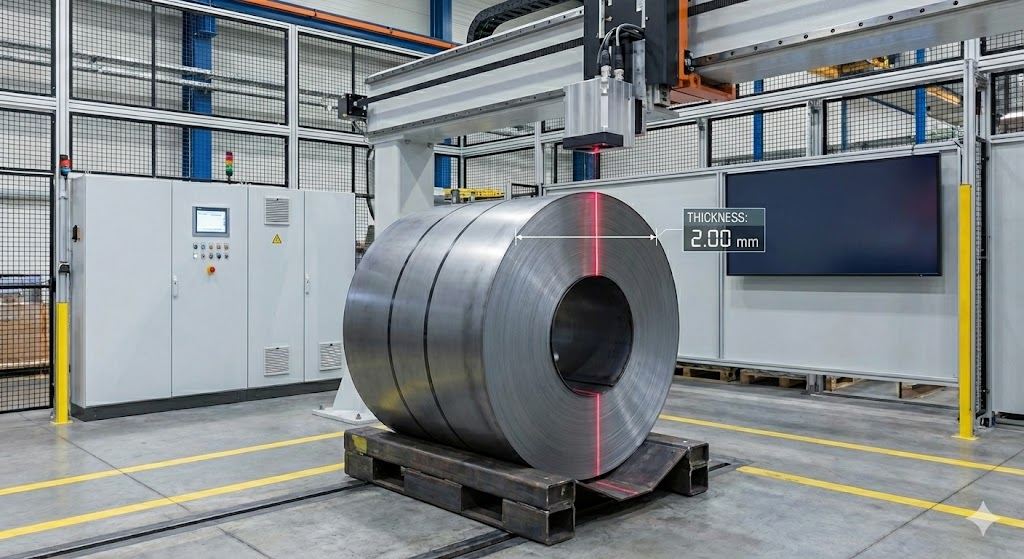
Selecting the appropriate sensor requires a thorough analysis of the application. For instance, a highly reflective, specular metal surface may necessitate a sensor with a coaxial optical design to avoid erroneous reflections, while a dark, absorptive material might require a model with a higher-power laser or a red laser instead of a blue one for better signal strength. For measuring fast-moving objects, a high sampling rate is paramount. Integration with factory networks is another consideration; many sensors now offer standard industrial communication protocols like EtherCAT, PROFINET, IO-Link, or analog outputs for seamless connectivity with PLCs and data acquisition systems.
The advantages of laser-based measurement are compelling. They offer unparalleled accuracy and repeatability compared to contact probes or ultrasonic sensors. The non-contact nature allows for measuring delicate, hot, or moving targets. Their fast response enables 100% in-line inspection, facilitating real-time process control and early defect detection, which is foundational for Industry 4.0 and smart factory initiatives. Data from these sensors can be fed into statistical process control (SPC) software to monitor trends, predict maintenance needs, and optimize production parameters.
Despite their robustness, challenges exist. Beam occlusion by dust, smoke, or coolant mist in harsh industrial environments can interrupt measurement. Extremely rough or transparent surfaces can scatter or transmit the laser beam, leading to signal loss. Therefore, proper installation, environmental shielding, and sometimes sensor pairing with air purge systems are necessary for reliable operation. Regular calibration against traceable standards is also essential to maintain long-term measurement integrity.
In conclusion, laser height and displacement sensors are indispensable tools for precision engineering and automated manufacturing. Their ability to provide fast, accurate, and reliable dimensional data drives quality improvement, efficiency gains, and cost reduction. As technology advances, we see trends toward miniaturization, increased intelligence with embedded edge computing, and enhanced connectivity, further solidifying their role as the eyes of modern industrial automation systems. Engineers and system integrators must continue to deepen their understanding of these devices' capabilities and limitations to fully leverage their potential in creating more agile and precise production ecosystems.