In the realm of industrial automation and electrical engineering, proximity sensors stand as critical components for non-contact detection, ensuring efficiency, safety, and precision. Among the diverse range of available sensors, the SN04 series has established itself as a reliable and widely adopted solution. This article delves into the technical specifications, operational principles, typical applications, and key considerations for integrating SN04 proximity sensors into electrical systems.
The SN04 is a general-purpose inductive proximity sensor. Its core operating principle is based on electromagnetic induction. The sensor generates a high-frequency oscillating electromagnetic field from its sensing face. When a metallic object (the target) enters this field, eddy currents are induced on the surface of the target. These eddy currents absorb energy from the oscillating circuit, causing a change in its amplitude or frequency. The sensor's internal detection circuit monitors this change and triggers a solid-state switching output, typically an NPN or PNP transistor. This switching action provides a clean, bounce-free signal to a Programmable Logic Controller (PLC), relay, or other control device, indicating the presence or absence of the target.
A key characteristic of the SN04 is its compact cylindrical housing, often in an M12 or M18 threaded form factor, which facilitates easy installation. The sensing distance, or nominal range, is standardized, commonly at 4mm for the SN04-N model. It is crucial to note that this is the rated operating distance for a standard target (usually a square of mild steel). Factors such as target material, size, and shape can affect the actual sensing distance. For non-ferrous metals like aluminum or copper, the effective sensing range is reduced, often requiring a correction factor provided in the datasheet.
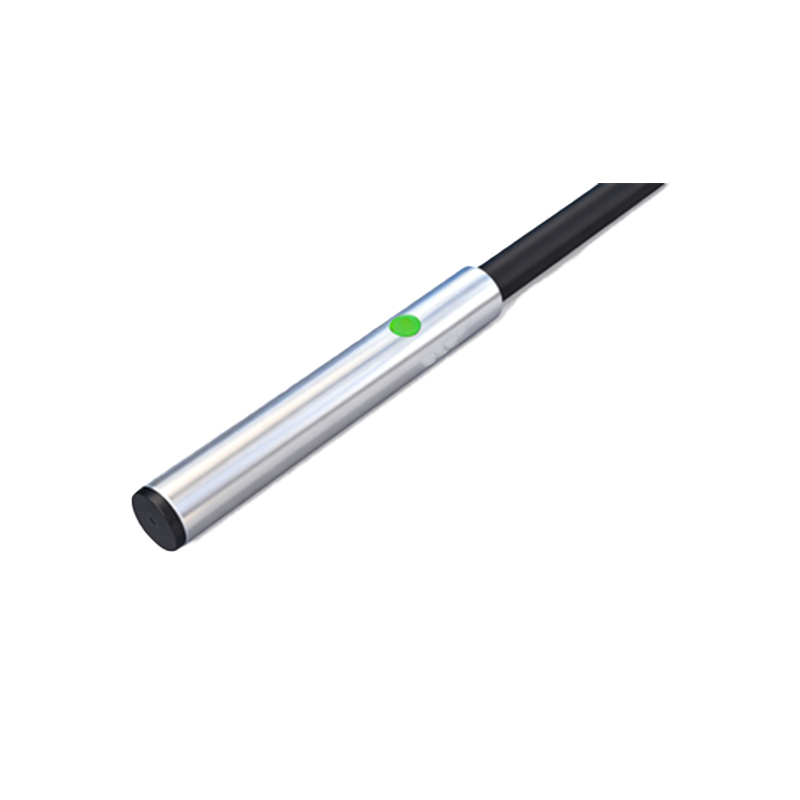
The electrical output configuration is a primary selection criterion. The SN04 is available in both NPN (sinking) and PNP (sourcing) transistor outputs. In an NPN configuration, the output transistor switches the load to common (0V), while a PNP configuration switches the load to the positive supply voltage. The choice between NPN and PNP depends entirely on the input requirements of the connected control system. Furthermore, models are available with Normally Open (NO) or Normally Closed (NC) logic, providing flexibility for different control circuit designs. The standard operating voltage range for DC models is typically 6-36V DC, making them compatible with common industrial 12V or 24V DC power supplies.
Wiring the SN04 is straightforward, usually involving three wires: brown for positive supply voltage (V+), blue for common (0V), and black for the switched output signal. A key advantage of this three-wire design is that it does not require an external load resistor, simplifying installation. Proper shielding and routing of cables are recommended in electrically noisy environments to prevent false triggering from electromagnetic interference (EMI).
The applications for SN04 proximity sensors are vast across manufacturing and machinery. They are extensively used for object detection on conveyor lines, such as counting bottles or detecting the position of a workpiece. In automated assembly, they verify the presence of components. They serve as end-of-travel limit switches in linear actuators or cylinders, providing precise positional feedback without physical contact, thereby eliminating mechanical wear. Machine safeguarding is another critical area, where sensors can detect if a safety guard is closed before enabling machine operation.
When specifying an SN04 sensor, engineers must consider several factors beyond just the sensing distance. The target material is paramount; for non-standard materials, testing is advised. The operating environment demands attention to the sensor's ingress protection (IP) rating, such as IP67, which indicates protection against dust and temporary immersion, suitable for washdown areas. Temperature ratings must align with the ambient conditions of the application. Mounting is also critical; flush-mountable models can be installed embedded in metal without affecting performance, while non-flush models offer a longer sensing range but require a clear area around the sensing face.
In summary, the SN04 proximity sensor represents a robust, cost-effective, and versatile solution for metallic object detection. Its straightforward design, reliable performance, and ease of integration have cemented its place in the electrical engineer's toolkit. By understanding its operating principles, output configurations, and application requirements, professionals can effectively deploy these sensors to enhance the automation, control, and reliability of modern electrical systems. Always consult the manufacturer's specific datasheet for the exact model in use to ensure correct selection, installation, and operation.