In the rapidly evolving landscape of industrial automation and precision measurement, laser distance sensors have become indispensable tools. Among the various types available, wide-angle laser distance sensors represent a significant advancement, offering enhanced flexibility and coverage for complex applications. This article delves into the principles, advantages, and practical uses of these sensors, providing insights for engineers and professionals in the electrical and automation sectors.
Laser distance sensors operate on the principle of time-of-flight (ToF) or phase-shift measurement, emitting a laser beam towards a target and calculating the distance based on the time or phase difference of the reflected signal. Traditional laser sensors often feature a narrow beam, which is ideal for precise point measurements but can be limiting in scenarios requiring broad area monitoring. Wide-angle laser sensors, however, incorporate optical designs that disperse the laser beam over a larger angular range, typically from 30 to 120 degrees or more, depending on the model. This design allows for the simultaneous measurement of multiple points or the scanning of extensive surfaces without mechanical movement, thereby increasing efficiency and reducing wear.
The core advantage of wide-angle laser sensors lies in their ability to cover expansive areas with a single device. In warehouse automation, for instance, these sensors can monitor inventory levels across wide racks or detect the presence of objects in large storage bays, optimizing space utilization and logistics. Similarly, in construction and civil engineering, they facilitate the rapid assessment of terrain profiles or structural deformations over wide angles, enhancing safety and accuracy. The automotive industry leverages them for vehicle positioning and obstacle detection in advanced driver-assistance systems (ADAS), where a broad field of view is crucial for real-time environmental perception.
Technical specifications such as measurement range, accuracy, and response time are critical when selecting a wide-angle laser sensor. Most models offer ranges from a few centimeters to several hundred meters, with accuracies within millimeters for high-end versions. The wide-angle feature does not inherently compromise accuracy; instead, advanced signal processing algorithms compensate for potential distortions at the edges of the beam. Engineers must consider factors like ambient light interference, target reflectivity, and environmental conditions (e.g., dust, humidity) to ensure reliable performance. For example, sensors with robust housings and IP ratings are essential in harsh industrial environments to prevent damage from moisture or particulates.
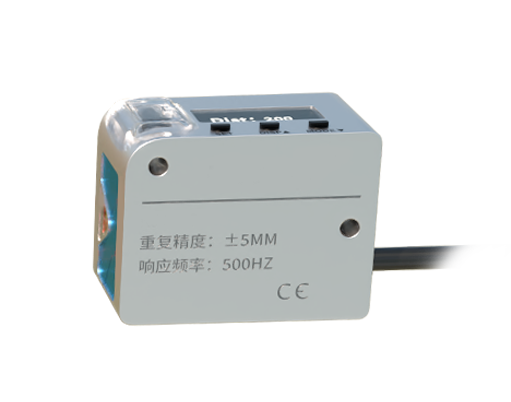
Integration of wide-angle laser sensors into existing systems is straightforward, thanks to standardized communication protocols like IO-Link, Ethernet/IP, or Modbus. This compatibility allows for seamless data exchange with PLCs (Programmable Logic Controllers) and SCADA (Supervisory Control and Data Acquisition) systems, enabling real-time monitoring and control. In robotics, these sensors enhance navigation and object manipulation by providing comprehensive spatial data, reducing the need for multiple narrow-beam sensors and simplifying system architecture.
Looking ahead, innovations in wide-angle laser sensor technology are focused on improving resolution, reducing power consumption, and incorporating AI-driven analytics for predictive maintenance. As industries embrace Industry 4.0 and the Internet of Things (IoT), the demand for intelligent, wide-coverage sensors is expected to grow, driving further advancements in this field. Professionals should stay informed about these trends to leverage the full potential of wide-angle laser sensors in optimizing operational efficiency and safety.

In summary, wide-angle laser distance sensors offer a versatile solution for modern industrial challenges, combining broad coverage with high precision. By understanding their capabilities and applications, engineers can make informed decisions to enhance measurement and automation processes, ultimately contributing to smarter and more efficient industrial ecosystems.