Point laser vision sensors represent a critical advancement in industrial automation, offering unparalleled precision for measurement, inspection, and guidance tasks. Unlike area-scan or 3D vision systems, these sensors utilize a single, focused laser point to capture highly accurate distance or profile data. The core principle involves projecting a laser beam onto a target surface. The reflected light is then captured by a receiver, typically a CMOS or CCD element. By analyzing the position or characteristics of this reflected spot—using triangulation, time-of-flight, or confocal measurement techniques—the sensor calculates precise dimensional information such as height, width, depth, or presence/absence.
The advantages of point laser sensors are numerous. Their primary strength lies in exceptional accuracy, often reaching micron-level resolution, making them ideal for stringent quality control. They excel in high-speed applications due to fast sampling rates and minimal data processing overhead compared to full-field imaging. Furthermore, they demonstrate remarkable robustness in challenging environments. Their focused laser point is less susceptible to ambient light interference, and many models are built to withstand dust, vibrations, and temperature variations common on factory floors. Common applications include precise gap and flush measurement in automotive assembly, thickness monitoring of rolled metals or films, weld seam tracking, and detection of minute surface defects like scratches or dents. They are also pivotal in robotics for precise bin-picking guidance and part positioning.
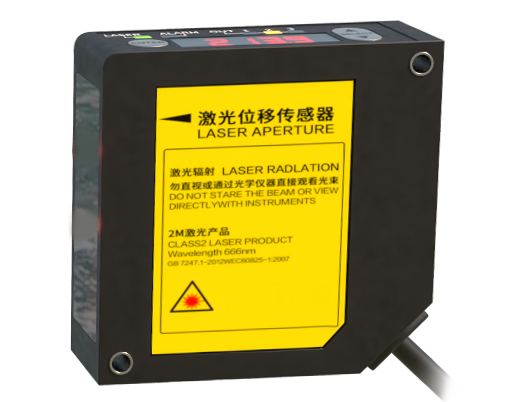
When selecting a point laser vision sensor, engineers must consider several key parameters. Measurement range and stand-off distance define the operational envelope. Spot size dictates the minimum feature that can be resolved. Repeatability and linearity specifications are crucial for understanding long-term measurement stability and accuracy across the entire range. The choice of laser wavelength (commonly red or blue) can affect performance on different material surfaces; for instance, blue lasers often provide better signal-to-noise ratio on organic materials or hot surfaces. Output interfaces (e.g., analog voltage/current, digital I/O, Ethernet/IP, PROFINET) must integrate seamlessly with existing PLCs or control systems.
Integration and calibration are straightforward but vital steps. Proper mechanical mounting ensures stability, while alignment tools help target the laser spot accurately. Many modern sensors feature intuitive software for setting measurement windows, thresholds, and filtering parameters. Advanced models incorporate auto-teaching functions and onboard logic for decision-making, reducing the load on central controllers. Regular maintenance primarily involves keeping the lens clean to ensure optimal laser transmission and reception.
Looking ahead, the evolution of point laser vision sensors is intertwined with Industry 4.0 trends. Future developments point toward even smaller form factors, higher speeds, and enhanced connectivity for IoT frameworks. The integration of AI at the edge could enable sensors to perform more complex classification tasks directly. Furthermore, the combination of point laser data with other sensor inputs in sensor fusion systems will create more comprehensive and intelligent inspection solutions. In conclusion, point laser vision sensors are indispensable tools for modern manufacturing, providing the exact, reliable, and high-speed data required to drive efficiency, ensure quality, and enable sophisticated automation in an increasingly precise industrial world.