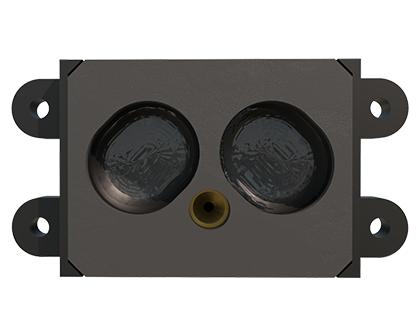
In the realm of industrial automation and precision measurement, laser height sensors have become indispensable tools for ensuring quality control, process efficiency, and safety. These sensors operate on the principle of emitting a laser beam towards a target surface and measuring the time-of-flight or phase shift of the reflected light to calculate distance or height with remarkable speed. However, the term "accuracy" in this context is multifaceted, encompassing several critical parameters that engineers must comprehend to select and deploy these sensors effectively.
Accuracy, fundamentally, refers to the closeness of a measured value to the true value. For laser height sensors, this is not a single specification but a combination of factors including resolution, repeatability, linearity, and environmental stability. Resolution denotes the smallest detectable change in height, often in micrometers or even nanometers for high-end models. Repeatability indicates the sensor's ability to produce consistent results under unchanged conditions—a vital trait for continuous production lines. Linearity error describes the deviation from an ideal straight-line response across the sensor's measurement range. Environmental influences such as temperature fluctuations, ambient light, and target surface characteristics (like color, texture, or reflectivity) can significantly impact these parameters.
The core technology behind these sensors often involves triangulation or time-of-flight methods. Triangulation-based sensors are excellent for short-range, high-resolution applications, such as inspecting PCB components or measuring coating thickness. Their accuracy can be exceptionally high but may be affected by the target's optical properties. Time-of-flight sensors, suitable for longer ranges, measure the round-trip time of a laser pulse. While generally robust, their accuracy can be influenced by signal noise and the speed of light variations in different media.
To achieve optimal accuracy, calibration against known standards is paramount. Manufacturers typically provide calibration certificates traceable to national standards. In-field calibration checks using gauge blocks or precision stages help maintain performance. Furthermore, advanced sensors now incorporate internal compensation algorithms for temperature and automatic gain control to adapt to varying surface reflectivity.

Application context dictates accuracy requirements. In semiconductor manufacturing, sub-micron accuracy is non-negotiable for wafer alignment. In automotive assembly, millimeter-level accuracy might suffice for robot-guided part placement. Engineers must balance specifications with cost, as higher accuracy often commands a premium. Key considerations include defining the required measurement range, the acceptable error budget, and the operational environment.
Emerging trends are pushing the boundaries of laser sensor accuracy. The integration of multi-wavelength lasers helps mitigate errors from surface color variations. Enhanced digital signal processing (DSP) filters out ambient noise more effectively. Some systems now combine laser measurement with vision systems for multi-dimensional verification, elevating overall system reliability.
In conclusion, laser height sensor accuracy is a sophisticated interplay of design, calibration, and application awareness. By thoroughly understanding specifications like resolution, repeatability, and environmental tolerances, engineers can harness these powerful instruments to drive precision in modern industrial processes, from microelectronics to heavy machinery, ensuring products meet ever-tightening quality standards.