Laser proximity sensors have become indispensable components in modern industrial automation, offering unparalleled precision for non-contact measurement and detection tasks. Their performance is defined by a combination of technical specifications and real-world operational factors. This article delves into the key parameters that determine sensor efficacy and how to optimize them for specific applications.
The core principle involves emitting a focused laser beam towards a target. The sensor then analyzes the reflected light, typically using triangulation or time-of-flight (ToF) methods. Triangulation sensors are excellent for high-resolution, short-range measurements, calculating distance based on the angle of the reflected beam on a receiver array. ToF sensors measure the time delay between emission and reception, making them suitable for longer ranges, though sometimes with slightly lower resolution at close distances.
Critical performance specifications include:
Measurement Range: This defines the minimum and maximum distances over which the sensor can operate accurately. Selecting a sensor with a range appropriate for the application is fundamental. Using a sensor at the extremes of its range can affect linearity and stability.
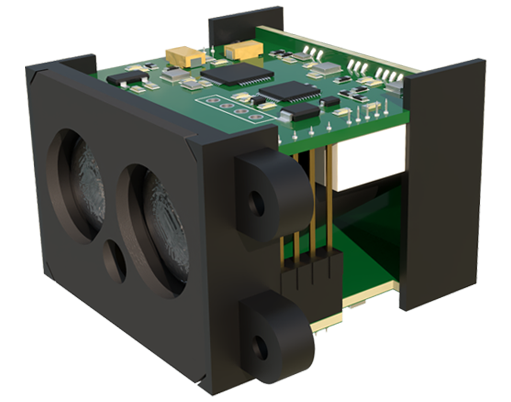
Repeatability: Often the most crucial specification, this indicates the sensor's ability to consistently return the same measurement for a target at a fixed position under unchanged conditions. High repeatability, often in the micron range, is vital for quality control and precision assembly.
Resolution: This is the smallest detectable change in distance. It is influenced by electrical noise, optical quality, and signal processing algorithms.
Linearity: This describes the deviation of the sensor's output signal from a perfectly straight line across its measurement range. High linearity simplifies calibration and system integration.
Response Time: The speed at which the sensor can update its output. Fast response times, often in the millisecond or microsecond range, are necessary for high-speed production lines or dynamic positioning systems.
Spot Size: The diameter of the laser beam at the target. A smaller spot allows for precise measurement of small features or edges but requires more precise alignment.
Environmental factors significantly impact performance. Ambient light, particularly from other lasers or strong sunlight, can saturate the receiver. Dust, steam, or oil mist can scatter or attenuate the laser beam. Vibrations can affect mechanical alignment, and temperature fluctuations can cause electronic drift. Selecting sensors with robust housings (IP67/IP69K ratings), specialized filters to block ambient light, and built-in temperature compensation is essential for harsh environments.
For optimal performance, correct installation and alignment are paramount. The sensor must be mounted securely to minimize vibration. The laser beam should strike the target surface perpendicularly for the strongest return signal; angled surfaces can cause diffuse reflection and signal loss. The target's properties—its color, material, and surface texture—also play a role. Dark, matte, or transparent materials absorb or scatter light, reducing signal strength compared to bright, reflective surfaces. Many modern sensors feature automatic teaching or background suppression functions to compensate for varying target colors.
Applications demanding high performance include robotic guidance for precise part handling and welding seam tracking, semiconductor wafer alignment and inspection, precision thickness measurement in rolling mills, and fill-level detection in transparent containers. In each case, prioritizing the correct combination of range, speed, and environmental robustness is key.
Advancements continue to push the boundaries. Innovations include sensors with integrated IO-Link for digital parameter setting and diagnostics, models with exceptionally small spot sizes for micro-measurements, and multi-echo evaluation algorithms that can ignore false signals from background objects like dust or glass windows. Understanding the detailed performance characteristics of laser proximity sensors enables engineers to select the ideal device, ensuring reliability, accuracy, and longevity in increasingly complex and demanding industrial systems.