In industrial automation, robotics, and consumer electronics, proximity sensors are critical components for detecting the presence or absence of objects without physical contact. However, the raw signals from these sensors are often contaminated by electrical noise, environmental interference, and mechanical vibrations. This noise can lead to false triggers, erratic behavior, and reduced system reliability. Input filtering is therefore an essential design consideration to ensure accurate and stable sensor readings. This article explores the core principles and practical techniques for effectively filtering proximity sensor inputs.
The primary sources of noise affecting proximity sensors are diverse. Electromagnetic interference (EMI) from motors, relays, or power lines can induce spurious signals in sensor wiring. Cross-talk from adjacent cables, especially in dense control panels, is another common culprit. For capacitive sensors, changes in humidity or the presence of non-target materials can cause signal drift. Inductive sensors might be affected by nearby metallic debris or varying material properties. Even the sensor's own switching characteristics can generate electrical transients. Without proper filtering, a control system might interpret these noise spikes as valid detection events, leading to operational failures.

The foundation of input filtering lies in understanding the signal's temporal characteristics. A genuine object detection event typically has a certain minimum duration, while electrical noise often appears as sharp, short-lived pulses. Time-based filtering, or debouncing, leverages this difference. A simple digital implementation involves a counter that increments when the input is active (detected) and decrements when it is inactive. A detection is only registered as valid when the counter reaches a predefined threshold. This threshold, often configurable, defines the "debounce time." For instance, setting a 50-millisecond debounce time will ignore all noise pulses shorter than 50ms, requiring a sustained signal to be recognized. This method is highly effective for eliminating contact bounce and random EMI spikes.
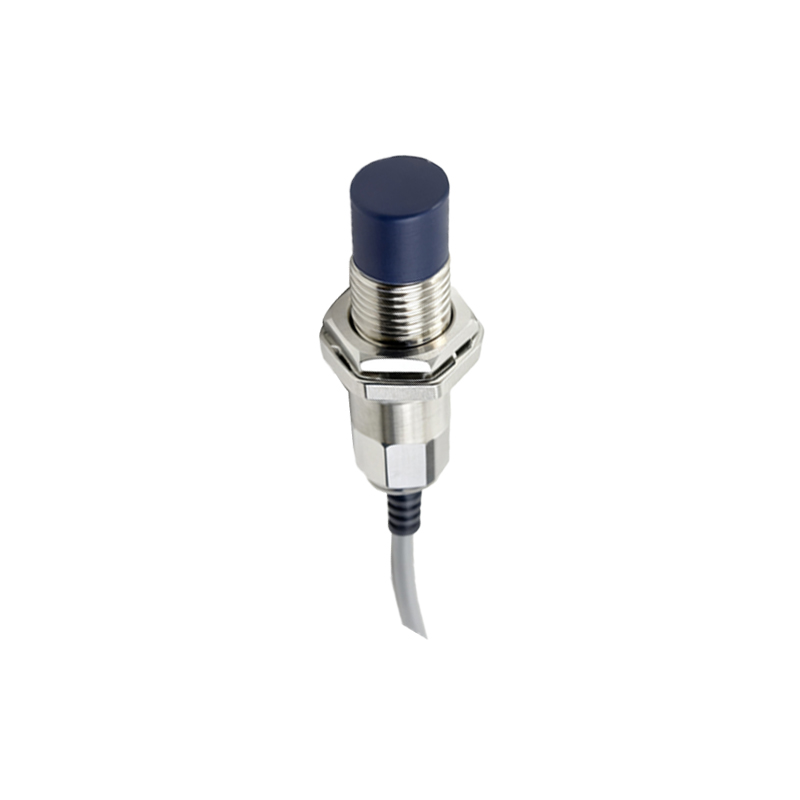
For analog sensor outputs or more complex noise profiles, hardware-based filtering is indispensable. The most fundamental circuit is the passive Resistor-Capacitor (RC) low-pass filter. Placed at the sensor's output, it attenuates high-frequency noise while allowing the slower-changing true signal to pass. The cutoff frequency (fc = 1/(2πRC)) is chosen to be above the maximum expected signal frequency but well below the predominant noise frequency. For example, in a slow-moving assembly line application, a cutoff of 10Hz might be suitable. For digital signals, an RC filter can smooth the edges, but its output may become ambiguous for a microcontroller's digital input. In such cases, a Schmitt trigger following the RC filter restores clean digital logic levels with hysteresis, providing further noise immunity.
In modern digital control systems, software filtering algorithms offer flexibility and precision. Beyond basic debouncing, moving average filters are excellent for smoothing analog data. By continuously averaging a window of the last 'n' samples, rapid fluctuations are averaged out, revealing the underlying trend. For applications requiring faster response, a weighted moving average or an exponential moving average (EMA) gives more importance to recent samples. More advanced techniques, like median filtering, are particularly robust against outlier noise spikes. The median filter takes a window of samples, sorts them, and outputs the middle value, effectively eliminating single-sample spikes without introducing the lag associated with averaging.
The choice of filtering strategy must be a deliberate system design decision. Key factors include the required response speed of the application, the dominant noise frequency, and the sensor type. A high-speed packaging machine cannot tolerate the lag of a heavy 500ms filter, whereas a conveyor belt safety curtain might use a 100-200ms filter for utmost reliability. Environmental ratings also matter; sensors in harsh environments may need more aggressive filtering. It is often beneficial to implement a multi-stage approach: a hardware RC filter for initial broadband noise suppression, followed by a software debounce or digital filter in the microcontroller for fine-tuning and logic conditioning.
Ultimately, effective proximity sensor input filtering is not about eliminating all noise—an impossible task—but about maximizing the signal-to-noise ratio for the specific application. By combining an understanding of noise sources with appropriate hardware and software techniques, engineers can design systems where sensors act as reliable and precise eyes for automated equipment. Proper filtering ensures that every detection event is intentional, safeguarding process integrity, enhancing product quality, and preventing costly downtime due to false triggers or missed detections. Testing under real-world operating conditions with an oscilloscope to visualize the raw and filtered signals remains the best practice for validating any filter design.