In the intricate landscape of industrial automation, proximity sensors stand as fundamental components, enabling machines to perceive their environment without physical contact. These devices detect the presence or absence of an object within a defined sensing range, providing critical data for control systems. Their non-contact operation eliminates mechanical wear, ensures high reliability, and allows for rapid response times—key attributes in high-speed production lines and precision applications.
The operational principle of a proximity sensor is based on the disturbance of an electromagnetic field, acoustic wave, or light beam. The most prevalent types include inductive, capacitive, ultrasonic, and photoelectric sensors. Inductive proximity sensors are the workhorses of metal detection. They generate an oscillating electromagnetic field from a coil. When a metallic target enters this field, it induces eddy currents, causing a change in oscillation amplitude. This change is detected by the sensor's circuitry, triggering an output signal. These sensors are exceptionally robust, immune to environmental contaminants like dust or oil, and ideal for detecting ferrous and non-ferrous metals in harsh industrial settings, such as machine tools, robotic arms, and conveyor systems.
Capacitive proximity sensors, on the other hand, can detect both metallic and non-metallic materials, including liquids, plastics, wood, and granules. They function by generating an electrostatic field. Any object with a dielectric constant different from air will alter the capacitance of the sensing circuit, prompting a state change. This makes them versatile for applications like level detection in silos, material handling, and presence detection of packaged goods. However, they can be sensitive to environmental factors like humidity.
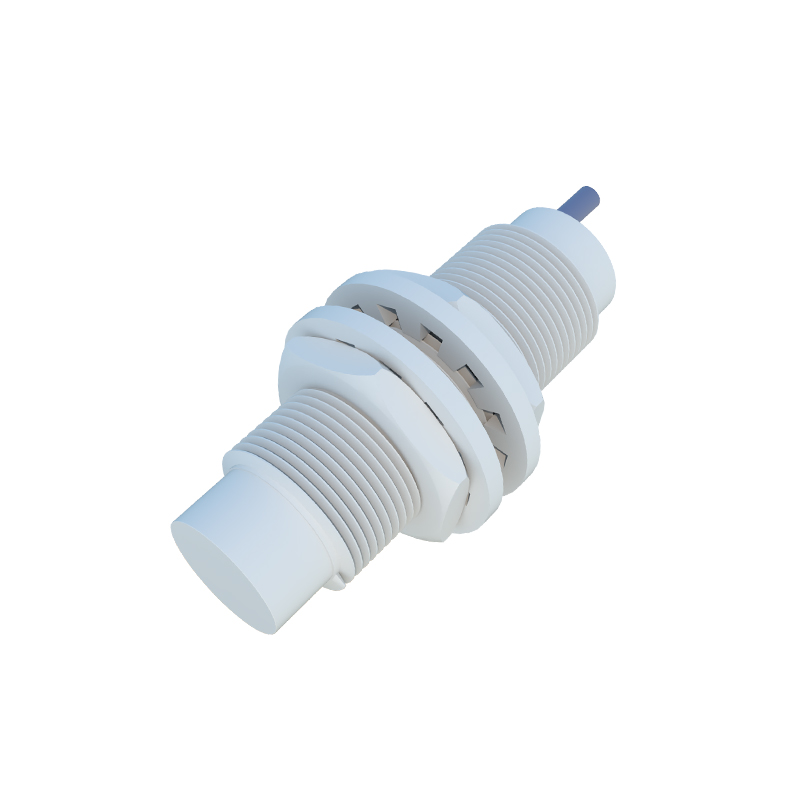
Ultrasonic sensors emit high-frequency sound waves and measure the time for the echo to return. They are excellent for distance measurement, level control, and detecting objects with complex surfaces or varying colors that might challenge photoelectric sensors. Their performance can be affected by temperature variations and air turbulence, but they offer a substantial sensing range and can handle demanding environments.
Photoelectric sensors utilize a light emitter (often LED) and a receiver. They are categorized into through-beam, retro-reflective, and diffuse-reflective modes. Through-beam models, with separate emitter and receiver units, offer the longest range and highest reliability. Retro-reflective types use a reflector, while diffuse sensors detect light reflected directly from the target. Photoelectric sensors are highly precise and can detect极小 objects, but their optical components require cleanliness to prevent false triggers from dust or dirt.
Selecting the appropriate proximity sensor requires a meticulous analysis of the application parameters. Key factors include:
1. Target Material: Metal detection leans towards inductive sensors; for non-metallics, capacitive or ultrasonic are suitable.
2. Sensing Distance: The required nominal sensing range (Sn) and any installation tolerances must be considered. Always derate the catalog specification for reliable operation.
3. Environmental Conditions: Exposure to washdowns, chemicals, extreme temperatures, or heavy particulate matter dictates the required ingress protection (IP) rating and housing material (e.g., stainless steel, PBT plastic).
4. Output Configuration: The choice between NPN (sinking) or PNP (sourcing) transistor outputs, NO (normally open) or NC (normally closed) contacts, and analog vs. discrete signals must align with the PLC or controller input module.
5. Response Frequency: For high-speed counting or sorting, a sensor with a fast switching frequency (in Hz) is critical to avoid missing targets.
6. Electrical Characteristics: Supply voltage range (commonly 10-30V DC) and current consumption must match the available power supply.
Installation and wiring are equally crucial. Maintaining proper clearance from metal mounting surfaces (as per manufacturer guidelines) prevents false actuation for inductive sensors. Shielding and using twisted-pair cables minimize electrical noise interference in environments with variable frequency drives or welding equipment. Regular maintenance, primarily lens cleaning for photoelectric sensors and checking for physical damage or buildup, ensures long-term operational integrity.
The evolution of Industry 4.0 and IoT has further integrated proximity sensors into smart factory networks. Modern sensors feature IO-Link communication, enabling the digital transmission of not just switch status, but also diagnostic data like operating temperature, signal strength, and device health. This facilitates predictive maintenance, remote parameter configuration, and seamless integration into higher-level control systems, transforming simple detection into a source of valuable process intelligence.
In conclusion, proximity sensors are indispensable for automated systems, providing the essential "sense of touch." A deep understanding of their operating principles, types, and selection criteria empowers engineers to design robust, efficient, and intelligent automation solutions. The correct sensor choice, coupled with proper installation, directly impacts system uptime, product quality, and overall operational safety.
SEO描述