In industrial automation and control systems, proximity sensors are fundamental components for non-contact object detection. Among their various operational modes, the latching function, often termed "proximity sensor latching" or "self-latching," is a critical feature that enhances reliability and simplifies control logic. This article delves into the mechanics, types, and practical applications of this functionality.
At its core, latching refers to the sensor's ability to maintain its output state even after the target object has moved away from its sensing field. A standard, non-latching proximity sensor typically provides an output signal only while the target is within the detection range. Once the target leaves, the output reverts to its normal, non-activated state (e.g., turns OFF). A latching sensor, however, behaves differently. When a target enters the sensing range and triggers the sensor, the output switches state (e.g., turns ON) and remains in that state indefinitely, even after the target is completely removed. It will only reset or switch back to its original state when a specific reset condition is met.
This reset condition is what defines the two primary types of latching mechanisms: magnetic reset and target reset. Magnetic reset latching sensors require a separate magnet, often called a reset magnet, to change the output state back. For instance, a sensor might latch ON when a metal target approaches. To turn it OFF, a technician must briefly present the designated reset magnet to a specific point on the sensor housing. This makes it ideal for applications requiring manual, authorized intervention for state change, such as machine guarding or safety door monitoring where a tool is needed to reset a fault condition.
Target reset latching, on the other hand, uses a second detection event to toggle the state. Commonly implemented in two-wire AC sensors, the output latches ON upon detecting the first target. It then remains ON until a second target of specific characteristics (sometimes the same target returning) is detected, which then commands the sensor to unlatch and turn OFF. This "toggle" action is useful in simple counting or batch processing applications without needing a separate reset signal.
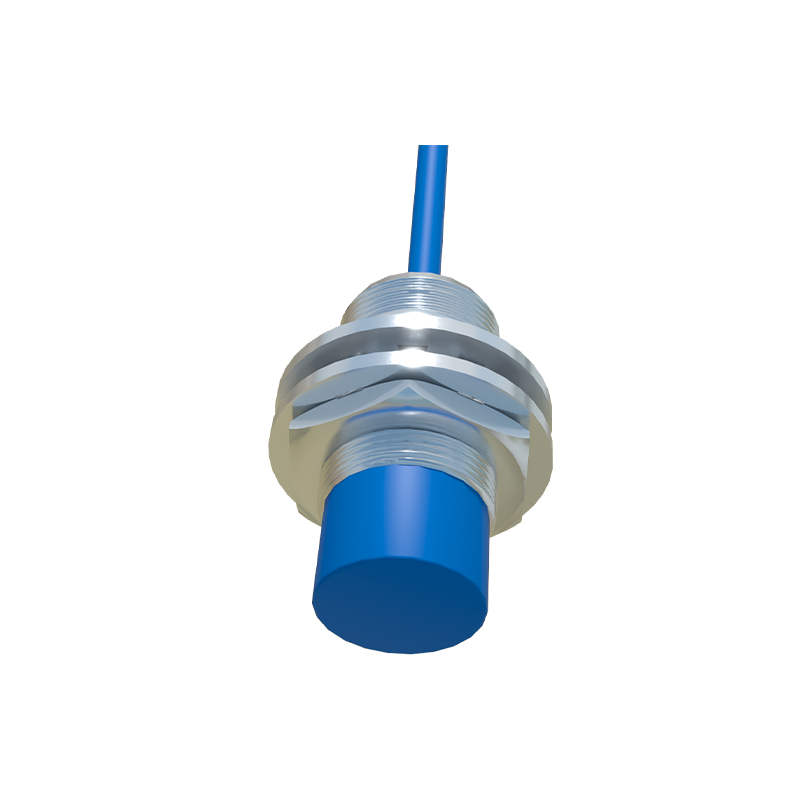
The implementation of latching circuitry varies between sensor technologies. In inductive proximity sensors (for metal detection), the latching function is typically achieved through internal electronic memory circuits, such as flip-flops or specialized ICs, that retain the last triggered state. The power supply to the sensor must remain stable for the memory to hold the state; removing power will usually reset a latched sensor. Some advanced models may include battery-backed memory. In contrast, reed switch-based magnetic proximity sensors can achieve a mechanical form of latching through the use of special bi-stable or "latching" reed switches that physically remain in their last switched position until an opposite magnetic polarity forces them back.
The advantages of using latching proximity sensors are significant. They provide signal stability in environments with vibrating or shaky targets, preventing rapid, unwanted output chatter. They simplify PLC programming by providing a maintained signal, eliminating the need for seal-in (latching) logic in the controller's software. This reduces scan time and program complexity. Furthermore, they are invaluable in applications requiring event confirmation or where the target's presence is transient but its detection must be recorded, such as in object passage verification on high-speed conveyors or in tamper-evident systems.
Practical applications are widespread. In material handling, a latching sensor can confirm that a package has passed a certain point on a line, holding the signal until a downstream process acknowledges it. In machine safety, a magnetic-reset latching sensor on a protective door can latch into an alarm state if the door is opened during operation, requiring a deliberate reset with a key magnet to restart the machine, ensuring safety protocols are followed. In automated assembly, a target-reset sensor can be used to count every other part, controlling a diverter arm accordingly.
When selecting a latching proximity sensor, key parameters to consider include the reset method (magnetic, target, or electrical signal), the operating voltage, output type (PNP/NPN, NO/NC), and environmental ratings like IP classification. It is crucial to consult the manufacturer's datasheet to understand the exact latching behavior and reset requirements.
In conclusion, the self-latching feature transforms a standard proximity sensor from a simple instantaneous detector into a memory-equipped device that can store detection events. By understanding the principles of magnetic reset and target reset latching, engineers can design more robust, efficient, and fail-safe automated systems, leveraging this functionality to bridge the gap between physical detection and logical control requirements.