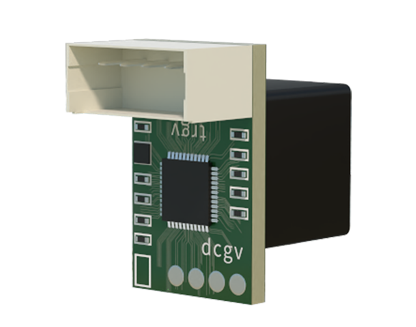
In the rapidly evolving landscape of industrial automation and quality control, the demand for high-precision, reliable, and space-efficient measurement solutions has never been greater. Enter the compact laser displacement sensor, a technological marvel that has fundamentally transformed how engineers and technicians approach dimensional inspection, positioning, and profile measurement. These miniature powerhouses, often no larger than a matchbox, deliver micron-level accuracy, making them indispensable across a diverse range of applications from semiconductor manufacturing to automotive assembly lines.
The core principle behind a laser displacement sensor is triangulation. The sensor projects a focused laser beam onto the target surface. The reflected light is then captured by a high-resolution CMOS or CCD receiver at a specific angle. Any change in the target's distance causes a proportional shift of the light spot on the receiver. This shift is processed by sophisticated internal algorithms to calculate the precise displacement value. The "compact" designation refers to a holistic miniaturization of this optical system, electronics, and housing without compromising performance. Advances in laser diode technology, micro-optics, and application-specific integrated circuits (ASICs) have been pivotal in achieving this feat.
The advantages of adopting compact laser displacement sensors are manifold. First and foremost is their unparalleled size-to-performance ratio. Their small form factor allows for installation in confined spaces where traditional sensors cannot fit, enabling measurements on intricate components or within densely packed machinery. This facilitates innovative inline inspection solutions directly on production lines. Secondly, their non-contact nature is critical. They can measure delicate, soft, hot, or fast-moving objects without any risk of surface damage or wear, ensuring consistent data integrity over millions of cycles. Furthermore, modern compact models boast impressive specifications: high sampling speeds exceeding 100 kHz for dynamic processes, resolutions down to 0.1 µm, and exceptional resistance to ambient light interference and varying surface colors or materials through advanced signal processing.
The application spectrum for these sensors is vast and continually expanding. In electronics manufacturing, they are used to measure coplanarity of BGA solder balls, thickness of wafer substrates, and precise placement of micro-components. The automotive industry relies on them for gap and flush measurement between body panels, brake disc thickness monitoring, and robotic guidance for assembly. In pharmaceutical packaging, they verify fill levels in vials and blister packs. They also play a crucial role in 3D profiling, vibration analysis of machinery, and as feedback devices in precision stages and actuators. Their robustness, often featuring IP67 or higher ingress protection ratings, makes them suitable for harsh environments found in metalworking or foundries.

When selecting a compact laser displacement sensor, several key parameters must be evaluated. The measuring range, stand-off distance, and spot size dictate the sensor's physical applicability. A smaller spot size is preferable for measuring edges or small features. Linearity and repeatability are the bedrock of measurement confidence. The response speed must match the process dynamics. Output interfaces (e.g., analog voltage/current, digital Ethernet, IO-Link) determine integration ease with PLCs and data acquisition systems. Perhaps most importantly, the sensor's capability to handle different surface types—from specular metals to dark, absorbent plastics—through adjustable sensitivity or multi-peak detection modes is essential for versatile application.
Looking ahead, the trajectory for compact laser displacement sensors points toward even greater intelligence and connectivity. The integration of embedded AI for real-time decision-making, such as automatic outlier rejection or adaptive calibration, is on the horizon. Enhanced industrial communication protocols will facilitate seamless integration into Industry 4.0 and smart factory ecosystems, allowing for predictive maintenance and big-data analytics. Furthermore, developments in blue laser technology offer improved performance on organic and translucent materials, opening new application frontiers.
In conclusion, compact laser displacement sensors represent a critical convergence of optics, electronics, and software engineering. They are no longer mere measurement tools but enablers of higher quality, efficiency, and automation. By delivering laboratory-grade precision in a rugged, miniature package, they empower engineers to solve complex measurement challenges, driving innovation and ensuring excellence in modern manufacturing and beyond. Their continued evolution will undoubtedly remain at the forefront of metrology advancements.