The 9818 laser sensor represents a significant advancement in industrial sensing technology, offering unparalleled precision and reliability for a wide range of applications. As a non-contact measurement device, it utilizes a focused laser beam to detect the presence, position, or displacement of objects with micron-level accuracy. This makes it an indispensable tool in modern automation, quality control, and process monitoring systems.
Operating on the principle of triangulation or time-of-flight measurement, the 9818 sensor emits a laser pulse towards a target. The reflected light is captured by a receiver, and the sensor's internal processor calculates the distance or presence based on the light's behavior. This method ensures high-speed response times, often in the microsecond range, which is critical for dynamic production lines. The sensor is typically housed in a rugged, IP67-rated enclosure, making it resistant to dust, moisture, and mechanical shocks commonly found in industrial environments like manufacturing plants, automotive assembly lines, and packaging facilities.
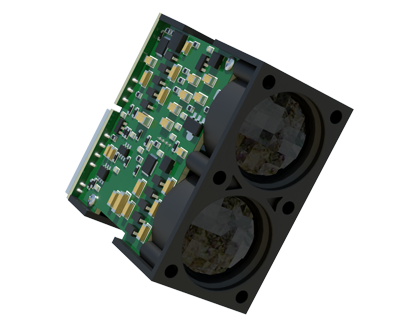
Key technical specifications of the 9818 laser sensor include a measurement range that can vary from a few millimeters to several meters, depending on the model. It offers a linearity error of less than ±0.1% and a repeatability of up to 0.01 mm, ensuring consistent performance even under varying conditions. The sensor supports multiple output options, such as analog voltage (0-10V), current (4-20mA), and digital interfaces like IO-Link or RS-485, allowing seamless integration with PLCs (Programmable Logic Controllers) and SCADA (Supervisory Control and Data Acquisition) systems. Additionally, it features adjustable sensitivity and teach-in functions, enabling easy configuration for specific tasks without extensive programming.
In practical applications, the 9818 laser sensor excels in tasks such as edge detection on moving conveyor belts, thickness measurement of materials like metal sheets or plastic films, and fill-level monitoring in containers. For example, in automotive manufacturing, it is used to verify the precise placement of components like brake pads or engine parts, reducing errors and enhancing safety. In logistics, it assists in dimensioning packages for accurate sorting and shipping. Its ability to operate in harsh conditions—such as high temperatures, vibrations, or ambient light interference—sets it apart from traditional photoelectric or ultrasonic sensors, which may suffer from inaccuracies due to environmental factors.
When selecting a 9818 laser sensor, engineers should consider factors like the target material's surface properties (e.g., reflective, transparent, or dark), required measurement speed, and environmental constraints. For reflective surfaces, a model with background suppression might be necessary to avoid false triggers. Regular maintenance involves cleaning the lens to prevent dust buildup and calibrating the sensor periodically to ensure long-term accuracy. Compared to alternatives like inductive or capacitive sensors, the 9818 offers superior versatility but may require a higher initial investment, though its durability and precision often justify the cost through reduced downtime and improved product quality.
Looking ahead, advancements in the 9818 series are likely to incorporate smart features such as AI-based diagnostics and wireless connectivity for Industry 4.0 initiatives. These enhancements will enable predictive maintenance and real-time data analytics, further optimizing industrial processes. In summary, the 9818 laser sensor is a robust, high-performance solution that addresses the evolving demands of precision measurement in automation, making it a cornerstone of efficient and reliable industrial operations.