In the world of industrial automation and machine control, the ability to detect the presence or absence of an object without physical contact is fundamental. Among the various technologies that enable this capability, inductive proximity sensors stand out for their robustness, reliability, and precision in metallic environments. These non-contact electronic devices are ubiquitous on factory floors, embedded within machinery to count parts, verify positioning, monitor limits, and ensure safety.
At its core, an inductive proximity sensor operates on the principle of electromagnetic induction. The key component is a coil wound around a ferrite core, which forms part of an oscillator circuit. When an alternating current is passed through this coil, it generates a high-frequency oscillating electromagnetic field at the active face of the sensor. This field is contained within a small, defined area. When a conductive metal target enters this electromagnetic field, eddy currents are induced on the surface of the target. These eddy currents draw energy from the sensor's oscillator circuit, causing a reduction in the amplitude of the oscillation. An integrated evaluation circuit continuously monitors this oscillation amplitude. Once the amplitude drop reaches a predetermined threshold—corresponding to the target being within the specified sensing distance—the circuit triggers a change in the sensor's output state, typically switching a solid-state transistor from OFF to ON, or vice versa.
This operating principle dictates the primary characteristic of inductive sensors: they are designed to detect metallic objects. However, not all metals are detected with equal efficiency. The sensor's performance is influenced by the target material's conductivity and permeability. Standard sensors are typically calibrated for mild steel, which is assigned a reduction factor of 1.0. Other metals have different reduction factors. For instance, stainless steel might have a factor of 0.7 to 0.85, meaning the effective sensing range is reduced by 15-30% compared to mild steel. Non-ferrous metals like aluminum or copper, which are conductive but have low permeability, can have factors as low as 0.3 to 0.4. This material dependency is a critical consideration during selection and installation.
The design and construction of these sensors contribute significantly to their durability. Most feature a housing made of nickel-plated brass, stainless steel, or ruggedized PBT plastic, making them resistant to impacts, vibrations, and harsh industrial conditions. They are inherently immune to environmental factors like dust, dirt, oil, and coolants that would foul mechanical limit switches. With no moving parts to wear out, they offer exceptionally long service lives, often rated for tens of millions of switching cycles.
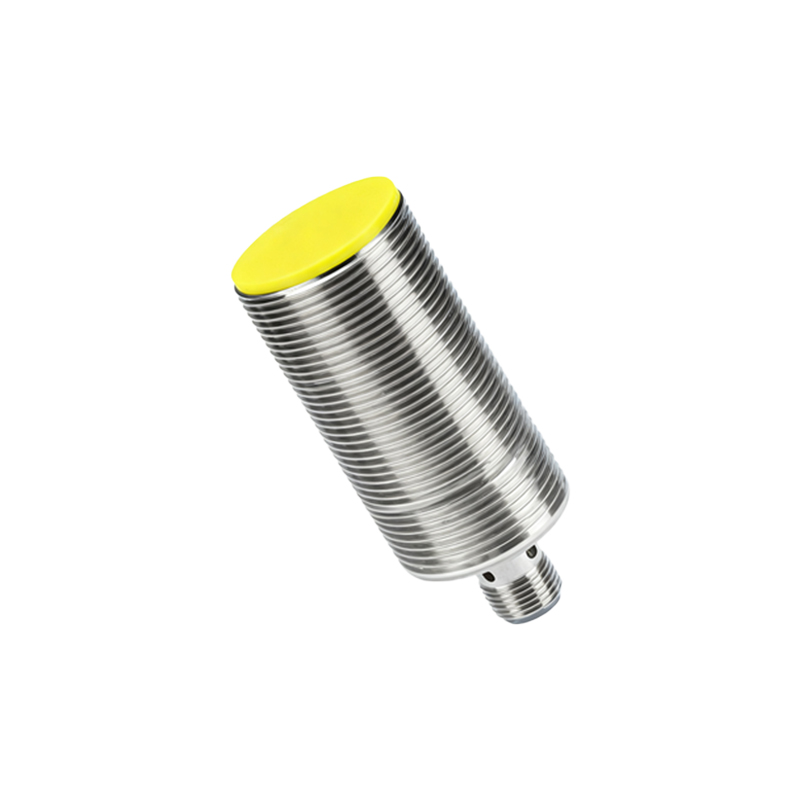
Applications for inductive proximity sensors are vast and varied. In automotive assembly lines, they verify the presence of engine blocks or wheel hubs. In packaging machinery, they count cans or bottles on a conveyor. In CNC machine tools, they serve as precise homing switches for axes or confirm the presence of a tool in the spindle. Cylindrical sensors are commonly used for position detection, while rectangular or ring-shaped variants are employed for specific tasks like detecting broken drill bits or monitoring the passage of small metal parts.
When selecting an inductive proximity sensor, several key parameters must be evaluated. The sensing distance, or nominal range, is the first consideration. Common ranges are from 1 to 20 mm for standard cylindrical models. It is standard practice to derate this distance by 10-20% for reliable operation and to account for manufacturing tolerances and temperature variations. The housing style—cylindrical (threaded barrel), rectangular, or slot-type—must suit the mechanical mounting constraints. Output configuration is another critical choice: NPN (sinking) or PNP (sourcing) transistor outputs for DC models, or two-wire AC/DC models. The choice depends on the control system's input card requirements (e.g., PLC). Other factors include the switching frequency (how fast it can detect objects), protection class (IP67 or IP69K for washdown environments), and whether a shielded or unshielded design is needed. Shielded sensors can be flush-mounted in metal without affecting their field, while unshielded sensors offer a longer range but require a non-metallic surround.
In summary, inductive proximity sensors are indispensable workhorses in modern industrial systems. Their contactless, wear-free operation, combined with high switching speeds and environmental resilience, makes them a superior choice for detecting metallic objects. A clear understanding of their operating principle, material factors, and key specifications is essential for engineers and technicians to deploy them effectively, ensuring reliable and efficient automation processes. As technology advances, newer models continue to offer enhanced features like IO-Link digital communication for diagnostics and parameter setting, further solidifying their role in the evolving landscape of smart manufacturing.