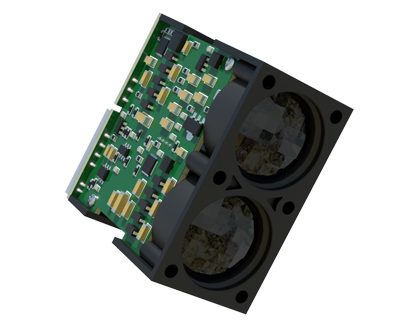
Laser sensors have become indispensable components in modern industrial automation, offering unparalleled precision, speed, and reliability. These devices operate by emitting a focused beam of light—typically from a laser diode—and detecting the reflection or interruption of that beam to measure distance, detect presence, or profile objects. The core principle hinges on techniques like time-of-flight (ToF), triangulation, or phase-shift measurement, each suited to specific applications ranging from sub-millimeter accuracy in semiconductor manufacturing to long-range detection in logistics.
In manufacturing environments, laser sensors excel in tasks where traditional mechanical or ultrasonic sensors fall short. For instance, on high-speed assembly lines, they perform non-contact measurement of component dimensions, verify part placement, and inspect surface defects without physical wear. Their ability to function in harsh conditions—resistant to dust, vibration, and extreme temperatures—makes them ideal for automotive, aerospace, and packaging industries. A key advantage is their response time; some models achieve microsecond-level detection, enabling real-time quality control and reducing production downtime.
The integration of laser sensors with Industrial Internet of Things (IIoT) platforms has further expanded their utility. By connecting via protocols like IO-Link or Ethernet/IP, these sensors transmit data to centralized systems for predictive maintenance and process optimization. For example, in robotic guidance systems, laser sensors provide continuous feedback on object position, allowing robots to adjust trajectories dynamically. This enhances flexibility in custom manufacturing and reduces reprogramming needs.
However, selecting the right laser sensor requires careful consideration of parameters such as measurement range, resolution, beam type (point, line, or array), and environmental interference. Factors like target material color or reflectivity can affect accuracy, often mitigated through advanced algorithms or complementary sensors. Regular calibration and adherence to safety standards (e.g., IEC 60825 for laser classification) are crucial to maintain performance and ensure operator protection.
As industries advance toward smart factories, laser sensors will continue to evolve with innovations like multi-spectral imaging and AI-driven analysis. Their role in enabling automation—from precise metrology to adaptive robotics—underscores their status as a cornerstone of industrial innovation, driving efficiency and quality in an increasingly competitive landscape.