In the realm of industrial automation, precision, reliability, and durability are non-negotiable. The Proximity Sensor GX-100 stands as a testament to these principles, engineered to deliver exceptional performance in the most demanding environments. This article provides a detailed technical examination of the GX-100, exploring its operational principles, key specifications, and diverse application scenarios.
At its core, the GX-100 is a non-contact inductive proximity sensor. It operates on the fundamental principle of electromagnetic induction. The sensor generates a high-frequency oscillating electromagnetic field from its active face. When a metallic target object enters this detection field, eddy currents are induced on the surface of the target. This causes a change in the oscillation amplitude within the sensor's internal LC oscillator circuit. The sensor's robust circuitry detects this damping effect and triggers a solid-state switching output, signaling the presence of the target without any physical contact. This mechanism ensures virtually wear-free operation and a long operational lifespan, significantly outperforming mechanical limit switches.
The GX-100 series is available in both shielded and unshielded designs, offering flexibility for different installation requirements. Shielded models (flush-mountable) can be installed embedded in metal without affecting their sensing characteristics, while unshielded models (non-flush) offer an extended sensing range. A standard sensing distance for a typical M18 threaded barrel model is 8mm, with variants available for shorter or longer ranges. It is crucial to note that the sensing distance is rated for a standard target of mild steel (Fe360). For other metals such as stainless steel, aluminum, or copper, a correction factor must be applied, as the different electrical conductivity and permeability affect the effective sensing range.
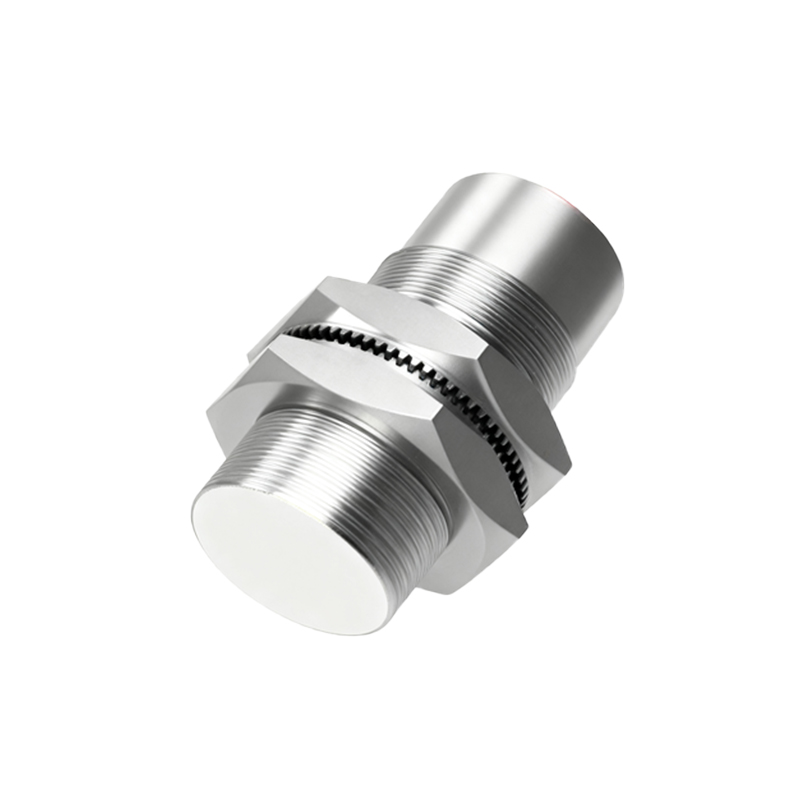
Output configuration is a critical selection parameter. The GX-100 is offered with NPN (sinking) or PNP (sourcing) transistor outputs in both normally open (NO) and normally closed (NC) logic. This allows for seamless integration into a wide array of control systems, whether they are based on PLCs, microcontrollers, or relay logic. The sensor operates on a wide DC voltage range, typically from 10-30V DC, ensuring compatibility with standard industrial power supplies. An integral LED status indicator provides immediate visual confirmation of power and output switching, greatly aiding in installation and troubleshooting.
Environmental robustness is a hallmark of the GX-100's design. Housed in a rugged nickel-plated brass or stainless-steel barrel with a PBT sensing face, it boasts an IP67 (and often IP69K) ingress protection rating. This makes it impervious to dust, oils, coolants, and high-pressure washdowns, which are common in food processing, automotive manufacturing, and packaging machinery. Its operating temperature range typically spans from -25°C to +70°C, ensuring stable performance in both freezer applications and near hot machinery.
Application examples for the GX-100 are vast across factory floors. It is extensively used for precise position detection of metal parts on conveyor lines, such as verifying the presence of engine blocks or sheet metal panels. In robotic cells, it serves as an end-of-arm tooling presence sensor or a safety interlock to confirm gripper closure. It acts as a high-speed counter for metal teeth on gears or chains, and as a limit switch for cylinder position feedback in pneumatic systems. Its fast response time and high switching frequency make it ideal for high-speed production lines where milliseconds count.
When installing the GX-100, several best practices ensure optimal performance. Maintain the specified gap between multiple sensors to prevent mutual interference. Ensure the target approaches the sensor face perpendicularly for consistent detection. For non-ferrous targets, always verify the effective sensing range using the manufacturer's correction factors. Regular maintenance is minimal but should include periodic cleaning of the sensing face to remove any metallic dust or debris buildup that could cause false triggering.
In conclusion, the Proximity Sensor GX-100 represents a mature, highly reliable solution for object detection in industrial automation. Its blend of solid-state reliability, environmental toughness, and flexible electrical integration makes it a versatile and indispensable component in modern manufacturing systems. By understanding its technical nuances and application guidelines, engineers and technicians can leverage its full potential to enhance machine efficiency, safety, and uptime.