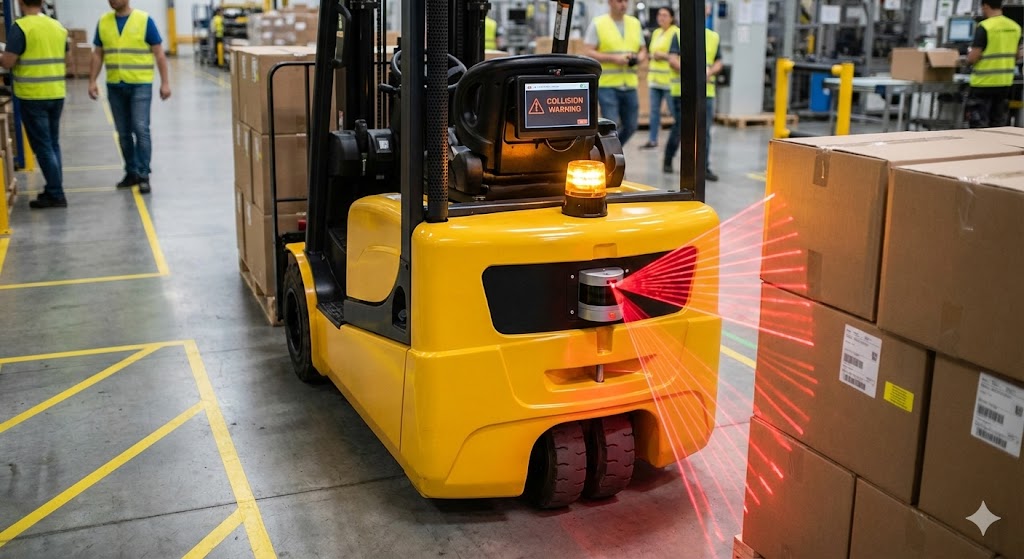
In the realm of industrial automation and precision measurement, laser sensors stand as pivotal components, enabling high-accuracy detection and control. Understanding their operational principles is crucial for engineers and technicians. An effective educational tool in this domain is laser sensor animation, which visually demystifies complex concepts. This article delves into how such animations elucidate the working mechanisms of laser sensors, catering to professionals seeking both foundational knowledge and advanced insights.
Laser sensors operate based on the principles of light emission, reflection, and detection. At their core, a laser diode emits a focused beam of coherent light toward a target object. The animation typically begins by illustrating this emission process, showing how the laser generates a narrow, intense beam with minimal divergence. This visual representation helps engineers grasp why laser sensors offer superior precision compared to other optical sensors. Key parameters, such as wavelength and power output, are often highlighted, emphasizing their impact on sensor performance in various environments, from clean rooms to harsh industrial settings.
Next, the animation depicts the interaction between the laser beam and the target. When the beam strikes the object, it may be reflected, scattered, or absorbed, depending on the surface properties. For instance, a smooth surface causes specular reflection, directing most light back toward the sensor, while rough surfaces lead to diffuse reflection. Animations use color-coded rays or dynamic diagrams to differentiate these behaviors, making it easier to understand how sensor design adapts to different materials. Engineers can observe how factors like color, texture, and distance affect the intensity and angle of the returning light, which directly influences measurement accuracy.
The detection phase is where the animation truly shines in explaining technical nuances. A photodetector, such as a photodiode or CCD array, captures the reflected light. The animation zooms in on this component, showing how it converts light signals into electrical currents. Time-of-flight (TOF) and triangulation methods are commonly animated to demonstrate distance measurement. In TOF, the animation might display a timer starting at emission and stopping upon detection, with the elapsed time calculating distance based on light speed. For triangulation, the animation illustrates the geometric relationship between the emitter, detector, and target, clarifying how displacement is computed from the angle of reflected light. These visuals simplify abstract mathematical concepts, aiding engineers in selecting the right sensor for applications like robotics or quality inspection.
Advanced animations also cover signal processing and output stages. They show how analog signals from the photodetector are amplified, filtered, and converted to digital data via an ADC (Analog-to-Digital Converter). Engineers can see noise reduction techniques in action, such as background light suppression or modulation of the laser beam. The animation might simulate real-world scenarios, like detecting a moving object on a conveyor belt, where processing speed and response time are critical. This segment often includes graphical overlays of waveforms or data plots, reinforcing how sensor outputs interface with PLCs (Programmable Logic Controllers) or SCADA systems for automated decision-making.

Furthermore, animations address common challenges and calibration procedures. For example, they visualize alignment errors, showing how misplacement of the sensor or target leads to inaccuracies. Step-by-step calibration sequences demonstrate adjustments for zero-point setting or sensitivity tuning. Engineers benefit from seeing troubleshooting steps animated, such as dealing with ambient light interference or thermal drift. These practical insights enhance maintenance skills and reduce downtime in industrial operations.
In summary, laser sensor animation serves as a powerful educational resource, bridging theoretical principles with hands-on application. By breaking down each stage—from emission to output—into digestible visual segments, it empowers engineers to optimize sensor deployment, improve system reliability, and innovate in fields like automotive manufacturing, aerospace, and pharmaceuticals. As technology evolves, interactive 3D animations and simulations are set to deepen this understanding, fostering a more intuitive grasp of laser sensing technologies.