In the realm of industrial automation, robotics, and structural health monitoring, the accurate measurement of large displacements is a critical requirement. Traditional contact-based sensors, such as linear variable differential transformers (LVDTs) or potentiometers, often face limitations due to mechanical wear, inertia effects, and physical obstruction. Laser-based displacement sensors have emerged as a superior non-contact solution, offering high precision, rapid response, and exceptional versatility for measuring extensive ranges of motion, often from millimeters to several meters. This article delves into the operational principles, key technologies, and practical applications of laser sensors in large-displacement scenarios, providing insights for engineers and technicians in the electrical and automation fields.
The fundamental principle behind laser displacement measurement is optical triangulation. A laser diode projects a focused beam onto the target surface. The reflected light is captured by a receiving lens at a specific angle and focused onto a position-sensitive detector, typically a CMOS or CCD array. As the target moves, changing the distance to the sensor, the position of the reflected light spot shifts on the detector. This shift is precisely calculated by the sensor's internal processor to determine the displacement value with high accuracy. For large-displacement measurements, sensors often employ a "time-of-flight" (ToF) principle or phase-shift analysis in addition to triangulation, especially for ranges exceeding one meter. ToF sensors measure the time delay between the emitted laser pulse and its return, calculating distance based on the constant speed of light. This method is highly effective for long ranges, though sometimes at a slight trade-off in resolution compared to short-range triangulation sensors.
Key performance parameters for selecting a laser sensor for large-displacement tasks include measuring range, resolution, linearity, and sampling speed. Modern laser sensors can achieve sub-micron resolution over ranges of several hundred millimeters and millimeter-level resolution over ranges of tens of meters. Linearity, which indicates the deviation from a perfect straight-line response, is crucial for calibration and overall system accuracy. High-speed sampling rates, often in the kilohertz range, enable the capture of dynamic movements and vibrations. Environmental factors pose significant challenges. Ambient light interference, particularly from strong industrial lighting, can be mitigated by using modulated laser light and narrow-band optical filters. Target surface characteristics—such as color, reflectivity, texture, and material—profoundly affect measurement stability. Highly reflective or transparent surfaces may require special treatment or the use of sensors with automatic gain control and advanced algorithms to compensate for signal variation. For dark or absorptive surfaces, sensors with higher laser power output are necessary to ensure a sufficient return signal.
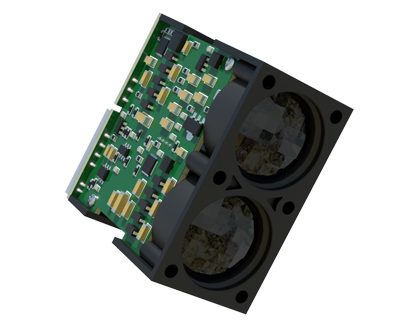
The applications of laser-based large-displacement sensors are vast and growing. In aerospace, they monitor wing deflection and structural deformation under load. In civil engineering, they measure bridge sag, building settlement, and dam displacement with remote, non-contact safety. Automotive manufacturers use them for chassis alignment, panel gap inspection, and crash test analysis. Within robotics, they provide critical feedback for arm positioning and end-effector trajectory over large work envelopes. In the semiconductor industry, they ensure precise wafer stage positioning. Furthermore, they are indispensable in quality control for verifying the dimensions of large fabricated parts, rolls, and assemblies.
Integration into modern control systems is straightforward, with most sensors offering analog outputs (e.g., 4-20 mA, 0-10 V) and digital interfaces (RS-485, Ethernet/IP, PROFINET, EtherCAT). This allows seamless connectivity to PLCs, data acquisition systems, and industrial PCs for real-time monitoring and closed-loop control. When installing these sensors, careful consideration must be given to mounting stability, thermal effects on the sensor and target, and minimizing vibration along the optical axis. Regular calibration against traceable standards is recommended to maintain long-term measurement integrity.
In conclusion, laser displacement sensors represent a pinnacle of non-contact metrology for large-displacement applications. Their combination of precision, speed, and flexibility addresses the limitations of contact probes and other optical methods. As laser and detector technologies continue to advance, alongside smarter signal processing algorithms, these sensors will push the boundaries of what is measurable, enabling more sophisticated automation, safer infrastructure, and higher manufacturing quality. For engineers designing systems where precise, reliable long-range motion tracking is paramount, laser-based sensors are an indispensable tool in the instrumentation arsenal.