In the realm of industrial automation, precision and reliability are non-negotiable. Among the myriad of sensing technologies available, PNP laser sensors have carved out a critical niche, offering unparalleled accuracy for detection, positioning, and measurement tasks. This article delves into the operational principles, key advantages, and diverse applications of PNP laser sensors, providing a comprehensive overview for engineers and system integrators.
At its core, a PNP laser sensor is an active optoelectronic device. It operates by emitting a focused, coherent beam of laser light—typically in the visible red or infrared spectrum—towards a target. A photoelectric receiver within the sensor then detects the reflected or interrupted light beam. The "PNP" designation refers to the transistor output stage of the sensor. In a PNP (sourcing) configuration, the output switch connects the load to the positive supply voltage when activated. This is in contrast to NPN (sinking) sensors. The choice between PNP and NPN is often dictated by regional standards and the design of the programmable logic controller (PLC) or control system, with PNP being prevalent in many European and international applications.
The defining characteristic of laser-based sensing is its exceptional precision. The highly collimated laser beam enables the detection of extremely small objects or precise edges with sub-millimeter accuracy. This focused beam minimizes background interference and allows for stable detection even at significant distances, a feature known as excellent background suppression. Many advanced models incorporate time-of-flight (ToF) or phase-shift measurement principles for precise distance measurement, functioning as laser distance sensors.
Key technical advantages of PNP laser sensors are numerous. First is their high switching frequency, enabling them to detect rapidly moving objects on high-speed production lines. Second, their long sensing range, which can extend to several meters for some models, provides flexibility in system layout. Third, the visible laser spot (in models with red lasers) simplifies alignment and commissioning during installation. Furthermore, they exhibit remarkable resistance to ambient light interference and are largely unaffected by the color or surface texture of the target object, ensuring consistent performance. Their robust housing, often rated at IP67 or higher, makes them suitable for harsh industrial environments with dust, moisture, or vibration.

The application spectrum for PNP laser sensors is vast. In packaging machinery, they are indispensable for precise label registration, bottle cap detection, and fill level control. Within the automotive industry, they facilitate robot guidance, part presence verification on assembly lines, and weld seam tracking. In material handling, they are used for precise positioning of pallets, stack height control, and break-of-beam safety curtains. Electronics manufacturing relies on them for wafer handling, component placement verification, and miniaturized part detection. Their role in logistics automation, particularly for dimensioning parcels and guiding autonomous mobile robots (AMRs), is also growing rapidly.
When integrating a PNP laser sensor, several factors require consideration. Engineers must select the appropriate sensing mode: diffuse reflective for detecting the light reflected directly from the target, retro-reflective for use with a reflector, or through-beam (which requires a separate receiver) for maximum range and reliability. The choice of output type (digital switch, analog, or IO-Link) depends on the control complexity. Correct wiring is paramount; the PNP output must be connected to a compatible PLC input module designed for a sourcing signal. Regular maintenance, primarily keeping the lens clean from contamination, is essential for sustained optimal performance.
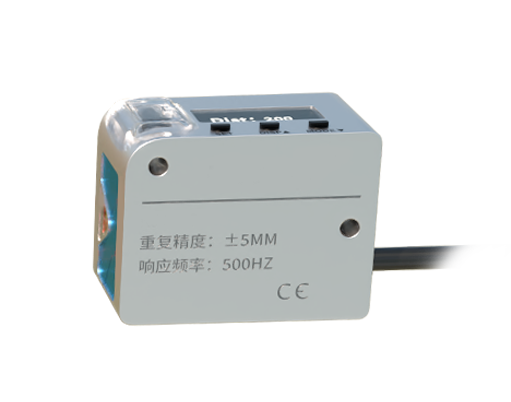
Looking ahead, the evolution of PNP laser sensors is intertwined with Industry 4.0 trends. The integration of IO-Link communication facilitates smart sensor capabilities, allowing for remote parameter configuration, real-time diagnostics, and predictive maintenance data. Furthermore, the miniaturization of components is leading to ever-smaller sensor designs without compromising performance, enabling their use in increasingly compact machinery.
In conclusion, PNP laser sensors represent a sophisticated and vital technology in the automation engineer's toolkit. Their combination of pinpoint accuracy, long range, high speed, and robust construction makes them a preferred solution for demanding detection challenges. As automation systems strive for greater precision and intelligence, the role of the reliable PNP laser sensor will only become more pronounced, continuing to drive efficiency and quality across global industries.