Linear proximity sensors are fundamental components in modern industrial automation, offering non-contact detection of metallic objects. Their operation hinges on the principle of electromagnetic induction, specifically the change in oscillation amplitude within a resonant circuit. This article delves into the core working mechanism, exploring the technology that enables precise and reliable position sensing.
At the heart of most linear proximity sensors lies an LC oscillator circuit. This circuit consists of an inductor (L) and a capacitor (C), which together generate a high-frequency electromagnetic field at the sensor's active face. This field is emitted from a coil wound around a ferrite core. When no target object is present within the sensor's nominal sensing range, the oscillator operates at its free-running amplitude, maintaining a stable state.
The critical change occurs when a conductive target, typically ferrous or non-ferrous metal, enters this oscillating electromagnetic field. As the target approaches, eddy currents are induced on its surface. These eddy currents are circular electrical currents that flow within the conductor and, according to Lenz's law, create their own magnetic field opposing the original field generated by the sensor's coil. This opposition results in a loss of energy within the oscillator circuit.
This energy loss manifests as a reduction in the amplitude of the oscillation. The closer the target comes to the sensor face, the stronger the eddy currents, and the greater the damping effect on the oscillator's amplitude. It is this precise relationship—distance versus amplitude reduction—that provides the linear characteristic. The sensor does not simply switch on or off; instead, it produces an analog output signal (voltage or current) that is directly proportional to the distance between the sensor and the target.
Internal signal conditioning circuitry is responsible for processing this change. The circuit monitors the oscillator's amplitude, converts the analog damping effect into a clean electrical signal, and outputs it. Common output types include analog voltage (e.g., 0-10V), analog current (e.g., 4-20mA), or digital signals via built-in analog-to-digital converters. The linear output allows the sensor to act as a precise measuring device, not just a presence detector.
Several factors influence the performance and accuracy of a linear proximity sensor. The first is the target material. Ferrous metals like steel cause a greater damping effect and typically have a longer sensing range than non-ferrous metals like aluminum or copper. Sensor specifications always define the sensing range for a standard target, usually a square of mild steel of a defined thickness. Target size and shape also matter; the target should generally be at least as large as the sensor's sensing face to ensure a consistent and linear output.
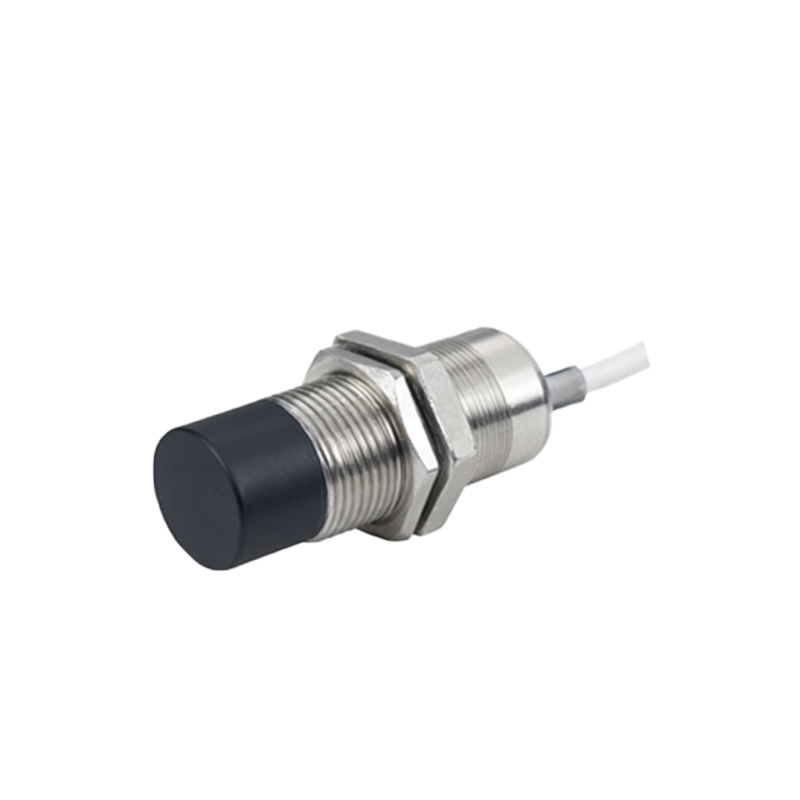
Environmental considerations are crucial for reliable operation. Extreme temperatures can affect the electronic components and the physical properties of materials. Most industrial sensors are housed in robust, shielded metal casings (often stainless steel) to protect against physical damage and electromagnetic interference (EMI) from other machinery. Proper shielding ensures that the sensor only responds to targets in its frontal axis and is not influenced by adjacent metallic objects or other sensors.
The applications for linear proximity sensors are vast and critical. They are indispensable in precision machining for tasks like tool wear compensation, where the sensor monitors the position of a cutting tool relative to a workpiece. In assembly automation, they verify the precise placement of components. They control roll diameter in winding machines, monitor valve positions, and provide feedback in hydraulic or pneumatic cylinder positioning. Their non-contact nature eliminates mechanical wear, ensuring long-term reliability and maintenance-free operation in harsh environments filled with oil, coolant, or dust.
In summary, the working principle of a linear proximity sensor is an elegant application of electromagnetic theory. By generating a high-frequency field and measuring the damping caused by eddy currents in a metallic target, it translates physical distance into a proportional electrical signal. This capability for accurate, non-contact measurement makes it a cornerstone of industrial control and measurement systems, enabling higher levels of automation, quality control, and operational efficiency.