In the landscape of industrial automation and precision measurement, display laser sensors have emerged as a cornerstone technology. These sophisticated devices project a visible laser beam onto a target, enabling precise detection, positioning, and measurement. Unlike conventional photoelectric sensors, the visible beam simplifies alignment, setup, and troubleshooting, making them invaluable across diverse sectors from manufacturing and logistics to robotics and quality control.
The core principle of a display laser sensor involves emitting a focused beam of coherent light. When this beam strikes an object, the sensor's receiver detects the reflected light. Advanced models utilize various detection methods. The through-beam type, with separate emitter and receiver units, offers the longest sensing range and highest reliability for clear presence detection. The diffuse-reflective type, with a single housing containing both emitter and receiver, detects objects by measuring the light scattered back from the target's surface. More complex are the background suppression and retro-reflective types, which provide enhanced accuracy by ignoring distant backgrounds or utilizing a reflector, respectively.
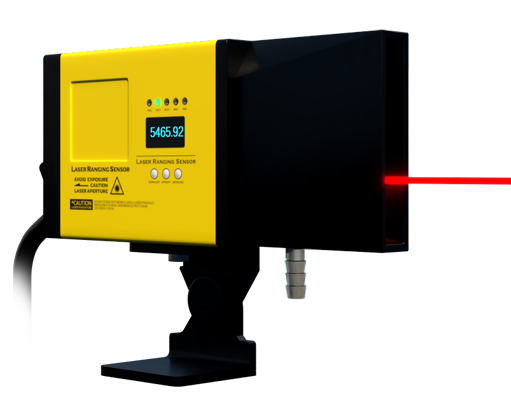
A defining feature of modern display laser sensors is the integrated digital or OLED display. This interface provides real-time feedback on measurement values, signal strength, and operational status. Technicians can configure parameters such as sensing distance, output delay, and switching thresholds directly on the device, often via intuitive push-button controls. This on-sensor programmability drastically reduces setup time and dependency on external controllers for basic tuning.
The applications for these sensors are extensive and critical. In assembly lines, they perform precise part presence verification, ensuring components are correctly positioned before robotic welding or adhesive application. They measure height, width, or diameter of products with micron-level resolution, instantly flagging out-of-tolerance items. In packaging machinery, they count items, control fill levels, and verify label placement. Within automated guided vehicles (AGVs) and mobile robots, they serve as compact, reliable proximity sensors for navigation and collision avoidance. Furthermore, in electronic assembly, their fine spot size allows for the inspection of tiny components like chip capacitors or connector pins.

Selecting the appropriate display laser sensor requires careful consideration of several technical parameters. Sensing Range is paramount; it must comfortably exceed the maximum working distance in the application. Spot Size determines the minimum detectable object and measurement precision; a smaller spot allows for higher resolution but may be more sensitive to surface irregularities. Resolution refers to the smallest change in distance the sensor can reliably detect. Response Time, often in the microsecond range, is crucial for high-speed production lines. Output Type is another key decision: digital (NPN/PNP) outputs for simple switch functions, or analog (4-20mA, 0-10V) outputs for continuous distance measurement. Environmental robustness, indicated by an IP (Ingress Protection) rating, is essential for use in dusty, humid, or washdown conditions typical in food processing or automotive plants.

Installation and calibration, while simplified by the visible beam, still demand attention. The sensor must be securely mounted to minimize vibration. The beam should strike the target surface perpendicularly for optimal signal return, especially with shiny or dark-colored objects that can reflect light poorly or specularly. Regular maintenance involves cleaning the lens to prevent dust accumulation, which can attenuate the laser beam and cause measurement drift. Most units feature built-in diagnostics, indicated on the display, to warn of conditions like insufficient signal or overload.
The future trajectory of display laser sensor technology points toward greater intelligence and connectivity. We are seeing the integration of IO-Link communication, which allows for detailed parameterization, remote monitoring, and predictive maintenance data exchange directly with PLCs. Enhanced algorithms within the sensor can now compensate for different surface colors and materials automatically, reducing setup complexity. Furthermore, miniaturization continues, enabling their deployment in increasingly cramped spaces without sacrificing performance.
In conclusion, display laser sensors represent a fusion of optical precision and user-centric design. Their visible beam demystifies sensor alignment, while their powerful capabilities in detection and measurement drive efficiency, quality, and safety in modern industrial systems. For engineers and system integrators, understanding their operating principles, key specifications, and application best practices is fundamental to leveraging their full potential in creating smarter, more responsive automation solutions.