In the world of industrial automation, robotics, and precision engineering, the ability to measure distance, position, and presence without physical contact is paramount. This is where proximity sensors and displacement sensors come into play. While the terms are sometimes used interchangeably, they represent distinct categories of non-contact sensing technologies, each with its own principles, strengths, and ideal applications. Understanding their differences and capabilities is crucial for selecting the right tool for the job.
Proximity sensors are primarily designed to detect the presence or absence of an object within a defined sensing range. Their output is typically a simple on/off signal, indicating whether an object is "near" or "far." Think of them as a switch that is activated without being touched. Common types include inductive sensors, which detect metallic objects; capacitive sensors, which can detect both metallic and non-metallic materials like plastics or liquids; and photoelectric sensors, which use a beam of light. Their key function is binary detection. For instance, an inductive proximity sensor on a conveyor line can count metal parts, or a capacitive sensor can monitor the fill level of a liquid in a non-metallic tank. They are robust, relatively inexpensive, and excellent for applications requiring reliable object detection, position verification, or end-of-travel limits.
Displacement sensors, on the other hand, are all about precise measurement. They don't just tell you if an object is there; they tell you exactly how far away it is, often with micron-level accuracy. Their output is an analog signal or a digital value that continuously corresponds to the distance between the sensor and the target. These sensors are used when you need to know the precise position, thickness, vibration, or deformation of an object. Key technologies in this domain include Laser Triangulation Sensors, which project a laser spot onto a target and use a receiving element to calculate distance based on the angle of the reflected light. They offer high resolution and are suitable for a wide range of surfaces. Eddy Current Sensors are used for precise displacement and vibration measurement of conductive metals, even in the presence of oils or dirt. Ultrasonic sensors measure distance based on the time-of-flight of sound waves and are effective for longer ranges and various materials, though with lower precision than laser or eddy current types.
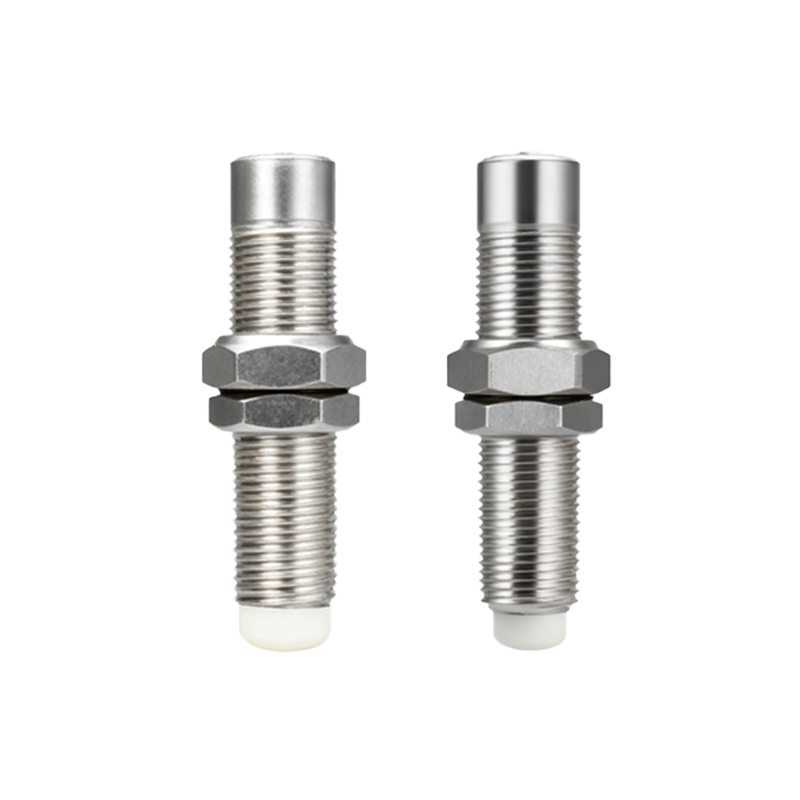
The choice between a proximity sensor and a displacement sensor hinges on the application's requirements. If the need is to confirm a part is in place for a machining operation, a simple inductive proximity sensor suffices. However, if the task is to measure the runout of a rotating shaft to thousandths of an inch, a non-contact eddy current displacement sensor is necessary. Similarly, in quality control, checking the height profile of a solder paste on a circuit board demands the fine resolution of a laser displacement sensor, not just a proximity check.
Integration into modern systems is seamless for both types. They connect to Programmable Logic Controllers (PLCs), data acquisition systems, and industrial networks, providing critical feedback for closed-loop control. This feedback allows machinery to adjust in real-time—compensating for tool wear, aligning components, or sorting parts based on dimensional tolerances.
When selecting a sensor, several factors must be evaluated beyond just the basic type. The sensing range, target material, environmental conditions (like temperature, dust, or moisture), required response speed, and output signal type are all critical. For displacement sensors, additional parameters like linearity, resolution, and sampling rate become vital. Consulting with sensor specialists and reviewing detailed technical specifications is always recommended to ensure optimal performance and reliability.
In conclusion, proximity sensors and displacement sensors are foundational elements of automated and precision systems. Proximity sensors act as the reliable sentinels for detection, while displacement sensors serve as the precise gauges for measurement. By leveraging the appropriate technology, engineers and technicians can achieve higher levels of efficiency, quality, and control across countless industries, from manufacturing and automotive to aerospace and consumer electronics. Their continued evolution promises even greater capabilities in the push toward smarter, more responsive industrial environments.