Forget the pristine lab conditions on the datasheet. After two decades of deploying proximity sensors in steel mills, mining operations, and chemical plants, I've learned that theoretical specs are merely a starting point for negotiation with reality. The real expertise lies in managing the deviations.
Experience Corrections: The Reality Gap
The advertised sensing range is the first casualty. A sensor rated for 15mm in a clean, ambient environment might deliver only 8-10mm when coated with a fine layer of conductive iron ore dust or non-conductive polymer powder. The drop isn't linear; it's exponential after a critical contamination threshold. Temperature compensation circuits? They often assume a stable ambient. In a forging press, we recorded localized radiant heat spikes of over 120°C on the sensor face despite an ambient of 45°C, causing temporary signal dropout. The sensor body survived, but its output lied. Response time is another myth. A 1ms response spec is valid for a clean, perpendicular target. Introduce a vibrating conveyor with a warped metal target oscillating at 50Hz, and effective response degrades to 3-4ms due to the angular variation and changing reflectivity. Relying on the 1ms figure for precise positioning here will cause a collision.
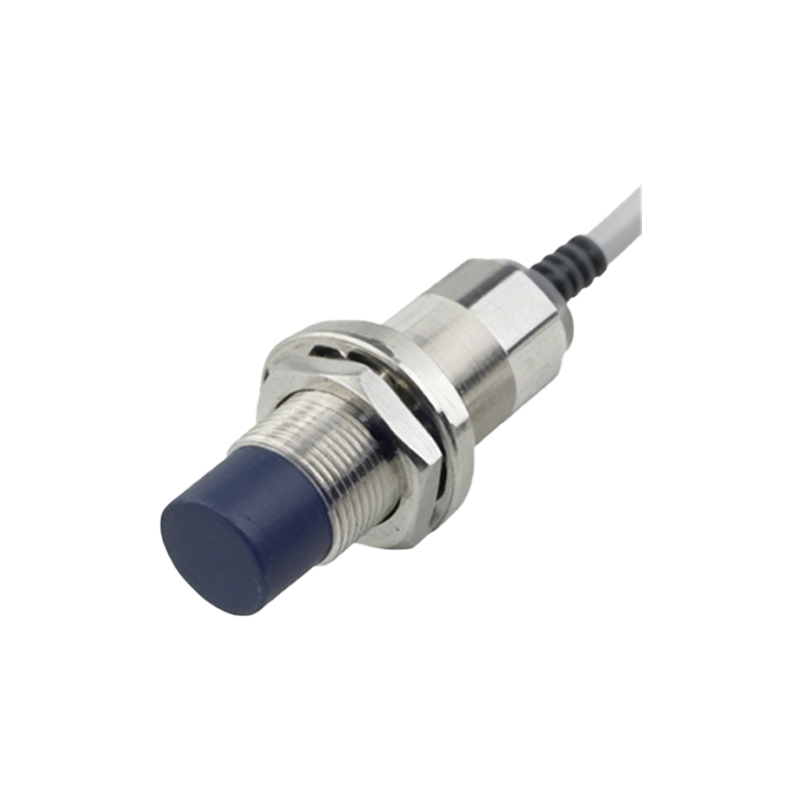
Boundary Conditions: When to Walk Away
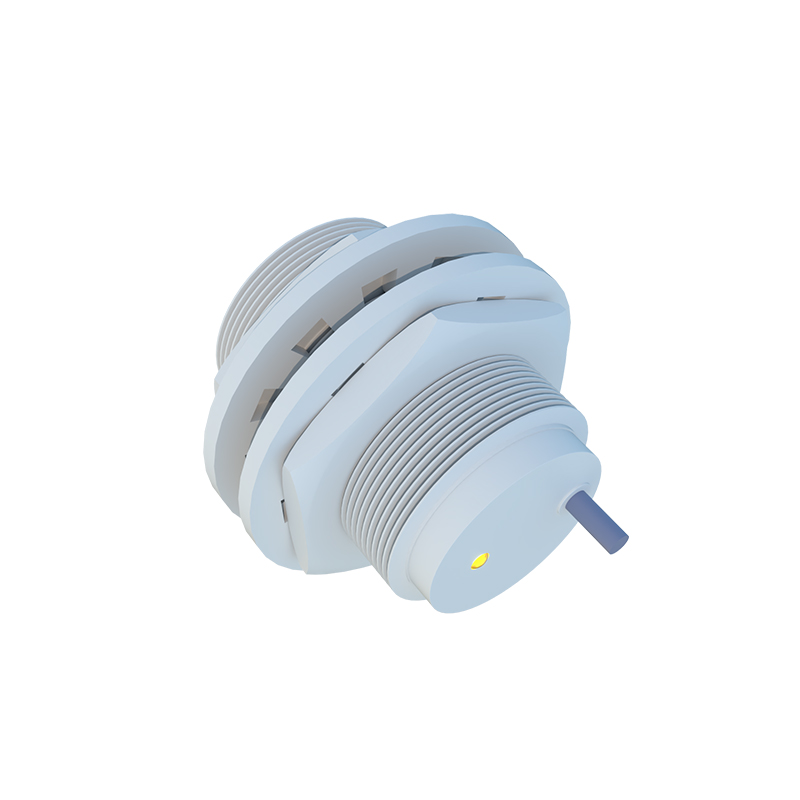
Knowing when not to use a technology is more critical than knowing how to use it.
1. Inductive Sensors with Non-Ferrous Targets: This seems obvious, but the failure mode is subtle. In an aluminum die-casting line, using a standard inductive sensor to detect molten aluminum is futile. However, the dangerous scenario is using it to detect "clean" aluminum billets. Performance is inconsistent (30-60% of rated range), and any buildup of aluminum oxide (alumina) on the sensor face, an excellent insulator, completely kills the signal. The risk isn't just missed detection; it's the false confidence during commissioning when it works briefly on a shiny new billet.
2. Capacitive Sensors in Humid Environments: They are marketed for material level detection, but a boundary condition is condensing humidity or coating adhesion. A capacitive sensor detecting plastic granules in a silo will also detect the gradual buildup of static-charged dust on its face, leading to a false "full" reading. In environments with >95% RH and cycling temperatures, condensation forms a permanent water film, effectively shorting the sensor to itself. It will read "proximity" continuously.
3. Ultrasonic Sensors in High-Pressure Air or Vacuum: The physics of sound propagation is key. In an area with frequent 100+ PSI compressed air blow-offs, the turbulent air vortices create severe acoustic noise and physical deflection of the ultrasonic wavefront, causing erratic readings. Conversely, in a industrial vacuum chamber (<0.1 atm), the sound attenuation is so high that effective range may drop by 80%. Using ultrasonics here is a fundamental mismatch.
Counter-Intuitive Conclusions: Data-Driven Insights
1. Sometimes, a "Less Accurate" Sensor is More Reliable. In high-vibration, high-contamination settings, a large-hysteresis, analog-output inductive sensor often outperforms a precise digital IO-Link model. The analog signal, while noisier, provides a trendable "health indicator" (e.g., decreasing amplitude signals mounting debris). The digital "perfect" sensor provides a crisp on/off signal until the moment it fails catastrophically with no warning. Reliability trumps resolution.
2. Increased Sensing Range Can Decrease System Stability. Selecting a sensor with a 30mm range for a 10mm application "for safety" is a common mistake. The longer-range sensor has a larger electromagnetic field (for inductive) or sound cone (for ultrasonic). It will see the target sooner, but it will also see the machine frame, passing debris, or hydraulic lines behind the target, increasing susceptibility to false triggers. The "sweet spot" is a sensor whose nominal range is 1.5x the application distance.
3. The Primary Failure Mode is Rarely the Sensing Element. Post-mortem analysis on hundreds of failed sensors reveals that less than 20% fail due to a corrupted core (oscillator, piezoelectric crystal). Over 70% fail due to interface and mechanical issues: cable flex fatigue at the gland entry, corrosion of the connector pins from washdown chemicals, or the housing seal failing, allowing potting compound to be contaminated. The battle is won or lost at the physical and electrical interfaces, not the core technology.
The final insight: Proximity sensing is not a component selection problem; it is a system integration challenge. The sensor must be chosen not just