Proximity sensors are fundamental components in modern automation and electronics, designed to detect the presence or absence of objects within a certain range without physical contact. Their ability to perform reliably in harsh environments and provide non-contact sensing makes them indispensable in industries ranging from manufacturing and automotive to consumer electronics and security. Understanding the different types is crucial for selecting the right sensor for a specific application. The primary classification of proximity sensors is based on their underlying detection technology. The main categories include inductive, capacitive, photoelectric, ultrasonic, and magnetic proximity sensors.
Inductive proximity sensors are among the most common types used in industrial settings. They operate on the principle of electromagnetic induction. The sensor generates an oscillating electromagnetic field from its coil. When a metallic object, typically ferrous metals like iron or steel, enters this field, it induces eddy currents within the object. This causes a change in the oscillation amplitude, which is detected by the sensor's circuit, triggering an output signal. A key characteristic of inductive sensors is that they only detect metallic targets. They are highly reliable, resistant to environmental factors like dust and moisture, and have no moving parts, leading to long service life. Common applications include position sensing of machine parts, metal detection in conveyor systems, and speed measurement of rotating gears.
Capacitive proximity sensors, in contrast, can detect both metallic and non-metallic materials. Their operation is based on changes in capacitance. The sensor acts as one plate of a capacitor, with the target object acting as the other plate. The sensor generates an electrostatic field. When any object with a dielectric constant different from air (such as liquids, plastics, wood, grains, or powders) enters this field, it alters the capacitance. This change is measured, and the sensor switches its output. These sensors are versatile and can detect materials through certain non-metallic barriers, making them ideal for level detection in tanks (for liquids or granular solids), presence detection of plastic or glass bottles, and touch-sensitive interfaces.
Photoelectric proximity sensors use light to detect objects. They consist of a light emitter (usually an LED emitting visible red, infrared, or laser light) and a receiver. They are further subdivided into three main operating modes. The through-beam type has separate emitter and receiver units placed opposite each other. Detection occurs when the target object interrupts the light beam. This mode offers the longest sensing range and high reliability. The retro-reflective type uses a single unit containing both emitter and receiver, along with a reflector. The emitted light bounces off the reflector back to the receiver. An object is detected when it blocks this reflected beam. The diffuse reflective type, often called the proximity mode, has the emitter and receiver in the same housing. It detects an object when the emitted light reflects off the object's surface back to the receiver. Photoelectric sensors are excellent for long-range detection and can sense virtually any material, but their performance can be affected by environmental conditions like dust, fog, or color and reflectivity of the target.
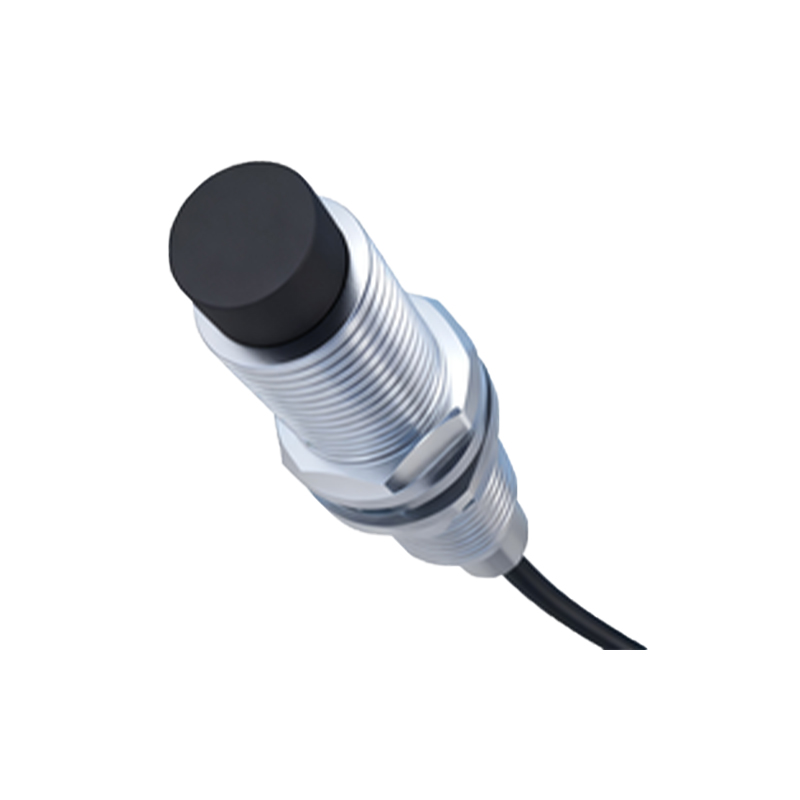
Ultrasonic proximity sensors function by emitting high-frequency sound waves (typically beyond human hearing) and evaluating the reflected echo. They measure the time interval between sending the signal and receiving the echo to calculate the distance to the target. These sensors can detect solid objects, liquids, and transparent materials regardless of color, transparency, or material composition. They are particularly effective in challenging environments with dust, smoke, or vapors where photoelectric sensors might fail. Common uses include distance measurement, level sensing in bulk material containers, and object detection on automated guided vehicles (AGVs). However, they can be influenced by temperature variations and air turbulence, and soft materials may absorb sound waves, reducing detection reliability.
Magnetic proximity sensors, often referred to as reed switches or Hall effect sensors, detect the presence of a magnetic field. Reed switches consist of two ferromagnetic reeds sealed in a glass tube. When a permanent magnet approaches, the reeds magnetize and attract each other, closing the contact. Hall effect sensors produce a voltage output when exposed to a magnetic field. These sensors are simple, cost-effective, and used for detecting the position of moving parts, such as in door and window security systems, or sensing the rotation of a magnet attached to a shaft for speed measurement. They are highly reliable for detecting only magnets and are immune to non-magnetic environmental contaminants.
In summary, the world of proximity sensors is defined by five principal technologies: inductive, capacitive, photoelectric, ultrasonic, and magnetic. Each type possesses distinct operating principles, strengths, and ideal application scenarios. The choice depends critically on factors such as the target material, required sensing distance, environmental conditions, and cost considerations. Inductive sensors excel with metals in tough industrial environments. Capacitive sensors offer material versatility. Photoelectric sensors provide flexibility and range. Ultrasonic sensors handle difficult atmospheres and various materials, while magnetic sensors offer